


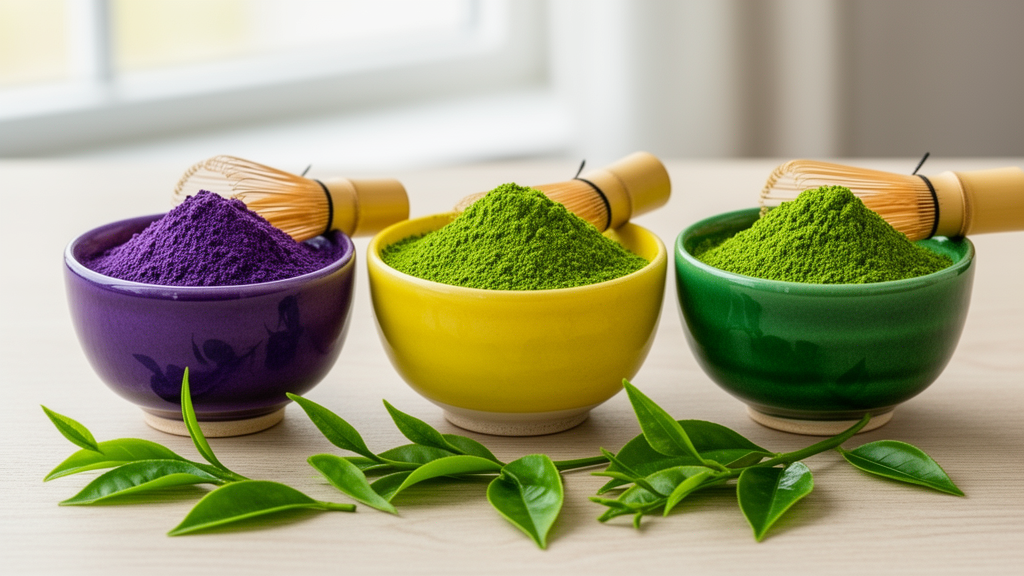
Matcha, the vividly green powdered tea that has spread from Japanese tea ceremonies into lattes, desserts, and nutraceutical shelves worldwide, has long been made almost exclusively from green-leaf tea cultivars. A new study published in Frontiers in Nutrition suggests that this narrow raw-material base may be leaving an entire spectrum of flavors untapped. Researchers at the Tea Research Institute of the Chinese Academy of Agricultural Sciences in Hangzhou systematically compared matcha produced from green-, purple-, and yellow-leaf tea cultivars, combining trained sensory evaluation with two complementary analytical platforms to map the chemistry behind each tea’s color, taste, and aroma. Their conclusion: leaf color is not merely cosmetic. It is a visible marker of deep metabolic differences that translate directly into the cup.
The team grew six tea cultivars under identical conditions at an experimental field in Shengzhou, China: two green-leaf cultivars, including the Japanese benchmark variety Yabukita; two purple-leaf strains derived from the anthocyanin-rich cultivar Zijuan; and two yellow-leaf strains derived from Baijiguan. In spring 2024, all plants were shaded with black nets blocking 80 percent of sunlight for a deliberately short period, from the fish-leaf stage to one bud and two leaves. The researchers chose brief shading because light-sensitive yellow-leaf cultivars can gradually re-green under prolonged shade, which would erase the very pigmentation the study aimed to exploit. Fresh shoots were then processed into tencha through a standardized automated line, steam-fixed at 100 degrees Celsius for 20 seconds, dried in multiple stages reaching about 180 degrees Celsius, and finally stone-milled into powder passed through a 500-micrometer sieve. Each cultivar yielded three independently manufactured batches, which served as replicates for all downstream analyses.
Sensory evaluation followed the Chinese national standard GB/T 34778-2017, with five trained panelists scoring powder appearance, brew color, taste, and aroma in randomized, coded presentations. Green matcha, the quality reference, earned the highest overall score at 92.3, displaying the bright green color, fresh taste, and seaweed-like aroma prized in premium products. Yellow matcha scored nearly as well, between 90.4 and 91.7, with a fine powder, umami-dominated taste, and a mild glutinous aroma, despite its apricot-colored infusion. Purple matcha deviated most from conventional expectations: its appearance and infusion color scored lower, and it tasted noticeably bitter and astringent, but its aroma performance matched green matcha, with a fresh, holly-like fragrance the authors suggest could anchor aroma-based product differentiation.
Quantitative biochemical analysis explained these sensory splits. Using high-performance liquid chromatography and ultra-performance liquid chromatography, the team measured catechins, caffeine, and free amino acids in each powder. Green matcha contained substantially lower total catechins, epigallocatechin gallate, and caffeine than its colored counterparts, while accumulating higher levels of arginine and aspartic acid, amino acids associated with freshness and umami intensity. Because catechins and caffeine act synergistically to intensify bitterness and astringency, their relative scarcity in green matcha allowed savory amino acids to dominate perception. Purple matcha, by contrast, showed the highest levels of epigallocatechin, caffeine, and total alkaloids, a co-enrichment that plausibly explains its lingering after-bitterness even though its theanine content was respectable. Yellow matcha carried the highest theanine and glutamine concentrations, compounds that enhance umami and mouthfeel, alongside elevated epicatechin gallate, a catechin that contributes moderate astringency with a smoother sensory profile than EGCG.
To move beyond targeted measurements, the researchers deployed widely targeted metabolomics on a UPLC-MS/MS platform, annotating a remarkable 3,139 non-volatile metabolites spanning amino acids, flavonoids, terpenoids, alkaloids, lipids, nucleotides, and more. Quality-control samples pooled from all extracts showed Spearman correlation coefficients above 0.97, indicating strong analytical reproducibility. Principal component analysis separated the six samples cleanly by leaf-color phenotype: the first principal component, explaining 28.3 percent of variance, distinguished green from purple matcha, while the second, at 21.3 percent, separated the yellow samples. Samples clustered tightly within color groups, confirming that metabolic similarity runs along pigmentation lines rather than randomly across cultivars.
Differential metabolite analysis, using strict statistical thresholds of false-discovery-corrected significance, variable importance in projection scores of at least one, and fold changes of at least two, identified 131 differentially accumulated metabolites between green and purple teas, 114 between green and yellow, and 76 between purple and yellow. Sixteen metabolites were shared across all three comparisons, including representative flavonoids, amino acids, organic acids, phenylpropanoids, and alkaloids. Pathway enrichment analysis pointed to flavonoid biosynthesis and amino acid metabolism as the major axes of divergence. In the green-versus-purple comparison, phenylalanine metabolism, flavone and flavonol biosynthesis, D-amino acid metabolism, and aminoacyl-tRNA biosynthesis were prominently enriched, consistent with the fact that phenylalanine feeds the phenylpropanoid pathway that produces the anthocyanins responsible for purple leaves.
Those anthocyanins showed up clearly in the data. Purple matcha was enriched in cyanidin-3-O-galactoside, cyanidin 3-rutinoside, kuromanin, rutin, and several other anthocyanins and flavonols, compounds that confer both the distinctive purple hue and the stronger bitterness and astringency recorded by the sensory panel. The study also detected elevated L-valine, a bitter amino acid that can participate in Maillard reactions during high-temperature processing to form pyrazines associated with roasted, nutty aromas, and two terpenoids, citronellal and sclareol, linked to citrus-floral and musky-amber notes respectively. Yellow matcha, meanwhile, accumulated high levels of L-lysine, L-glutamine, phenylalanine, histidine, leucine, isoleucine, and proline, underpinning its umami-sweet character, along with flavonol glycosides such as isoquercitrin and quercitrin, which deepen the yellowish-green infusion color and, despite extremely low taste thresholds, add moderate bitterness. The authors caution that because anthocyanins were not quantified in the same leaves before and after processing, the magnitude of pigment degradation during matcha manufacture cannot be established from this data alone.
Aroma chemistry added a third dimension. Using headspace solid-phase microextraction coupled to gas chromatography time-of-flight mass spectrometry, the team identified 67 volatile compounds, with terpenes the most abundant class at 25.37 percent of the profile, followed by esters, alcohols, and ketones. Green matcha contained the richest volatile complement, dominated by aldehydes such as heptanal, benzeneacetaldehyde, and beta-cyclocitral, along with the carotenoid degradation products dihydroactinidiolide and beta-ionone, which together produce the signature seaweed-like, herbal, and violet-floral notes of premium matcha. Purple matcha’s volatiles skewed toward floral and fruity territory, with abundant leaf alcohol derivatives including (Z)-3-hexen-1-ol, terpineol, and phenylethyl alcohol. Yellow matcha’s profile was led by terpenes and alcohols such as beta-ocimene, alpha-copaene, and humulene, contributing fruity and herbal notes, while trace heterocyclics like pyrrole and indole may account for subtle nutty and roasted undertones that complement its mellow, rice-soup-like mouthfeel.
The practical implications extend beyond flavor curiosity. China’s tea industry has registered more than 400 new cultivars in the past five years, roughly a quarter of them leaf-color variants, yet these genetic resources remain largely absent from matcha production. By demonstrating that purple and yellow cultivars produce matcha with distinct, chemically grounded, and in the yellow case nearly benchmark-equivalent sensory profiles, the study provides a biochemical framework for cultivar selection and product diversification. A purple matcha could be marketed for its holly-like aroma and anthocyanin content, while a yellow matcha could target consumers seeking maximum umami with a distinctive glutinous character. The researchers also flag open questions: optimal shading regimes for non-green cultivars remain unknown, anthocyanin stability during the high-temperature drying stages needs quantitative tracking, and the focused differential comparison used one representative cultivar per color group, so cultivar identity and leaf-color effects cannot be fully disentangled statistically. Still, the message is clear. The color of a tea leaf is a chemical announcement, and matcha makers are only beginning to listen.
Subject of Research: Metabolic and volatile compound differences underlying the flavor of matcha from green-, purple-, and yellow-leaf tea cultivars
Article Title: Metabolic characteristics and chemical basis of matcha from cultivars with different leaf colors
Article References: Ding, S., Liu, D., Liu, H., Gong, Y., Mei, P., Ye, Y., Wang, P., Zhang, C., Chen, J., Ma, C., & Zhao, X. (2026). Metabolic characteristics and chemical basis of matcha from cultivars with different leaf colors. Frontiers in Nutrition, 13, Article 1951952. https://doi.org/10.3389/fnut.2026.1951952
Image Credits: AI Generated
DOI: 10.3389/fnut.2026.1951952
Keywords: matcha, tea cultivars, metabolomics, anthocyanins, theanine, catechins, flavonoid biosynthesis, volatile compounds, leaf color, sensory evaluation, food chemistry, Camellia sinensis
Cite Scienmag News
Alexandra Wallace. (October 19, 2026). Purple, Yellow and Green Tea Leaves Yield Chemically Distinct Matcha, Study Finds. Scienmag. https://scienmag.com/purple-yellow-and-green-tea-leaves-yield-chemically-distinct-matcha-study-finds/
Alexandra Wallace. "Purple, Yellow and Green Tea Leaves Yield Chemically Distinct Matcha, Study Finds." Scienmag, 19 October 2026, https://scienmag.com/purple-yellow-and-green-tea-leaves-yield-chemically-distinct-matcha-study-finds/. Accessed 19 October 2026.
Alexandra Wallace. "Purple, Yellow and Green Tea Leaves Yield Chemically Distinct Matcha, Study Finds." Scienmag. October 19, 2026. https://scienmag.com/purple-yellow-and-green-tea-leaves-yield-chemically-distinct-matcha-study-finds/


