


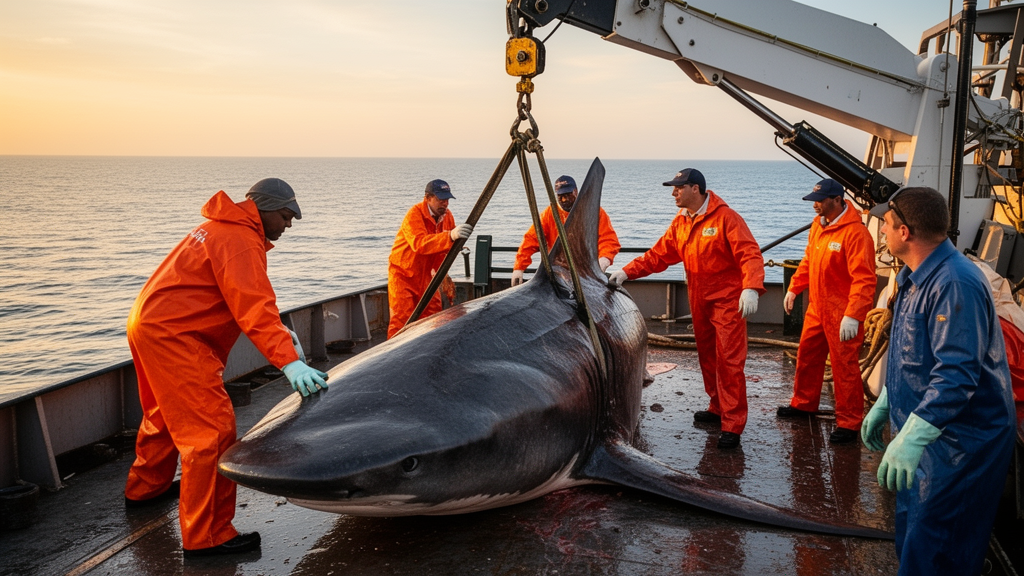
In the pre-dawn hours of 21 July 2024, artisanal fishermen working a longline roughly 20 kilometers north of the community of Salinas Roca Partida, off the coast of Veracruz, Mexico, hauled up something extraordinary from a depth of about 120 meters. Baited with bonito and set with number 3 hooks, their gear had snagged an adult male bluntnose sixgill shark, Hexanchus griseus, measuring 326 centimeters in total length and weighing 197 kilograms. The capture, filmed on low-resolution video by the fishermen themselves, now stands as the first confirmed record of this ancient deep-water predator from the southern Gulf of Mexico and the first voucher-verified record for Mexican waters of both the Gulf of Mexico and the Caribbean Sea.
The find, published in the journal Acta Ichthyologica et Piscatoria, matters far beyond a single line on a distribution map. The bluntnose sixgill shark is one of the ocean’s most enigmatic large predators, a living relic whose lineage stretches back hundreds of millions of years. Yet despite a global distribution spanning every ocean except the Antarctic and Arctic, its populations are patchy and its records surprisingly scarce. In the western Atlantic, the species has been documented from Nova Scotia in Canada down to Brazil and Argentina, but confirmed sightings within the Gulf of Mexico had been limited exclusively to the northern portion, with a 433-centimeter female taken off Alabama in 1962 and a 325-centimeter male caught at Port Isabel, Texas, in February 1984. The new Veracruz specimen extends the species’ confirmed range more than 822 kilometers to the southwest.
Identification of the shark rested on the unmistakable anatomical hallmarks of the genus. Hexanchus griseus belongs to the family Hexanchidae, the cow sharks, a group distinguished by having six gill slits rather than the five found in most sharks. The Veracruz specimen displayed six large gill slits that were not inserted on the pectoral fins, a robust body, and a broad head whose length measured 14.7 percent of total length. Most striking is the dentition: six rows of large, serrated, comb-shaped teeth on each side of the lower jaw, a saw-like battery adapted for slicing through large prey, contrasted with ten hooked-cusped teeth on each side of the upper jaw. The snout was wide, the mouth large and ventrally arched, and the eye small, with a dark pupil ringed in white and a prominent tapetum lucidum that gave the living animal a fluorescent greenish eye-shine, an adaptation for hunting in dim depths.
The researchers, working with taxonomic keys and specialized identification guides, took a full suite of morphological measurements using a measuring tape following established protocols, and weighed the animal on a commercial scale rounded to the nearest kilogram. Because of the specimen’s enormous size, only the cephalic region and the mixopterygia, the male reproductive structures known as claspers, could be preserved. These were deposited in the Ichthyological Collection of the Facultad de Estudios Superiores Iztacala at the Universidad Nacional Autónoma de México under catalog number CIFI-2400, transforming an anecdotal catch into a permanent scientific voucher.
Biometric comparisons reveal how closely this Mexican male mirrors its northern Gulf counterpart. The Texas specimen from 1984 measured 325 centimeters against the Veracruz animal’s 326, with precaudal lengths of 234 and 230 centimeters respectively, and remarkably similar fin dimensions, including dorsal fin heights of 14.8 and 15.5 centimeters. A comparative female from the Gulf of Trieste in Slovenia, at just 217 centimeters and 52 kilograms, illustrates the sexual size dimorphism typical of the species. The new data table, spanning more than sixty characters from prenarial length to caudal fork dimensions, provides one of the most complete morphometric profiles ever published for an Atlantic male of this species.
Perhaps the most biologically revealing details concern the shark’s reproductive condition. Dissection showed the animal to be sexually mature, with elongated, vascularized testes, a well-developed vas deferens, and seminal vesicles filled with sperm. The claspers were fully calcified and mobile, and bore several hematomas, evidence of recent mating activity. This is significant because male bluntnose sixgill sharks are known to reach sexual maturity between 309 and 330 centimeters in total length, placing the 326-centimeter Veracruz specimen squarely within that window. Intriguingly, Mediterranean populations appear to mature at smaller sizes, around 300 centimeters, hinting at regional variation in life-history traits that scientists are only beginning to understand.
The species’ biology is as unusual as its anatomy. Bluntnose sixgill sharks are aplacental viviparous, meaning females nourish embryos internally without a placenta and can give birth to more than 50 offspring at a time. Females do not mature until they exceed 400 centimeters, and the species can reach a total length of 480 centimeters, making it one of the largest predatory sharks in the ocean. Its diet is correspondingly broad, encompassing a wide variety of fishes as well as marine mammals. Bathymetrically, the species ranges from the surface down to 2,500 meters but is most commonly encountered between 200 and 1,000 meters, although at higher latitudes it ventures into shallower water more frequently. Stable isotope studies have shown that adults undertake ontogenetic migrations, and that pregnant females approach the outer coastal edge to give birth.
Why was a mature male patrolling the continental slope off Veracruz? The researchers suggest that the continuous deep-water adjacencies around the capture area provide access to productive feeding grounds, a pattern consistent with recent records of other benthic-demersal chondrichthyans in the Los Tuxtlas region. Nighttime bathymetric migrations into shallower waters for feeding, documented through tracking studies, are known to influence the incidence of sixgill sharks in longline fisheries elsewhere, and may explain why an artisanal longline set at a modest 120 meters could intercept such a deep-dwelling giant. Juveniles of the species also frequently approach coastal areas, adding another layer to its vertical movements.
Local knowledge adds a colorful chapter to the story. Fishermen in the region have reported capturing sixgill sharks on several occasions, but the animals were routinely released because the flesh is bland, poorly textured, and laden with fat considered toxic. Owing to this high oil concentration, the meat is regarded as ichthyosarcotoxic, capable of causing illness if consumed. For this reason, species of the genera Hexanchus and Heptranchias have earned the local nickname tiburón leche, or milk sharks. This unpalatability has a conservation silver lining: although the species is caught incidentally in deep-water fisheries throughout its range, its capture carries little economic importance, as has also been observed off Tunisia, and the Veracruz fishermen’s practice of releasing the animals may afford the species a measure of protection.
That protection matters. The bluntnose sixgill shark is currently listed as near threatened on the IUCN Red List, and there are indications that local populations have been extirpated in parts of its range due to overfishing. The genus itself has undergone a taxonomic revolution in recent years: once considered a duo, it is now recognized as comprising three species, with the Atlantic sixgill shark, Hexanchus vitulus, split from the bluntnose sixgill on genetic grounds in 2019, joining the bigeye sixgill shark, Hexanchus nakamurai. Accurate records like the Veracruz voucher are therefore essential for untangling which species occurs where, particularly in poorly surveyed tropical waters. While earlier Mexican reports of the species on the Gulf and Caribbean coasts existed, none had been backed by a preserved specimen, leaving the species’ presence in Mexican Atlantic waters officially unconfirmed until now. The green-eyed giant of Veracruz, preserved in a UNAM collection, closes that gap and signals that the deep waters of the southern Gulf of Mexico may harbor far more of these ancient predators than science has ever documented.
Subject of Research: First confirmed record of the bluntnose sixgill shark in the southwestern Gulf of Mexico
Article Title: First record of the bluntnose sixgill shark, Hexanchus griseus ( Elasmobranchii , Hexanchiformes , Hexanchidae ), from the southwestern Gulf of Mexico
Article References: Del Moral-Flores, L. F., Lozano-Quiroz, S. A., Escartín-Alpizar, V. R., García-Mercado, E., & Hernández-Ortiz, R. (2025). First record of the bluntnose sixgill shark, Hexanchus griseus (Elasmobranchii, Hexanchiformes, Hexanchidae), from the southwestern Gulf of Mexico. Acta Ichthyologica et Piscatoria, 55, 115-121. https://doi.org/10.3897/aiep.55.147223
Image Credits: AI Generated
Keywords: bluntnose sixgill shark, Hexanchus griseus, Gulf of Mexico, Veracruz, deep-sea shark, new record, chondrichthyes, Hexanchidae, marine biodiversity, shark conservation, morphometrics, IUCN near threatened
Cite Scienmag News
Margaret Porter. (October 19, 2026). Giant Sixgill Shark Hauled From Gulf Depths Confirms Species in Mexican Waters. Scienmag. https://scienmag.com/giant-sixgill-shark-hauled-from-gulf-depths-confirms-species-in-mexican-waters/
Margaret Porter. "Giant Sixgill Shark Hauled From Gulf Depths Confirms Species in Mexican Waters." Scienmag, 19 October 2026, https://scienmag.com/giant-sixgill-shark-hauled-from-gulf-depths-confirms-species-in-mexican-waters/. Accessed 19 October 2026.
Margaret Porter. "Giant Sixgill Shark Hauled From Gulf Depths Confirms Species in Mexican Waters." Scienmag. October 19, 2026. https://scienmag.com/giant-sixgill-shark-hauled-from-gulf-depths-confirms-species-in-mexican-waters/


