


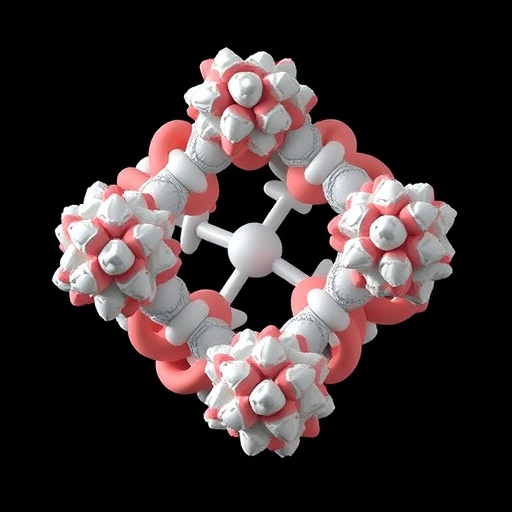
A new molecular design strategy is bringing two traditionally separate worlds of chemistry together: proteins, nature’s highly evolved molecular machines, and foldamers, synthetic molecules engineered to imitate the controlled shapes of biological polymers. In a study published in Nature Chemistry, J. Sigl, V. Morozov, L. Wang and colleagues describe a protein–foldamer “supramolecular synthon” that can guide the spontaneous formation of hybrid architectures. The work offers a glimpse of a future in which synthetic molecules do not merely imitate biology, but cooperate with biological structures to build organized materials from the bottom up.
The central idea is based on a deceptively simple question: can a protein and a wholly synthetic molecule be designed to recognize one another with the same precision that biological components use to assemble? Proteins typically fold into complex three-dimensional structures and then interact through carefully positioned chemical groups. Foldamers are artificial molecules designed to reproduce this behavior. Their backbones are not necessarily made from the amino acids found in proteins; instead, they are built from synthetic units that adopt predictable helices, turns, sheets or other ordered conformations. By controlling these shapes, chemists can create molecular partners with programmable recognition properties.
The phrase “supramolecular synthon” refers to a recurring assembly motif held together not by conventional covalent bonds, but by weaker, reversible interactions. These may include hydrogen bonds, electrostatic attractions, hydrophobic effects, aromatic stacking and van der Waals forces. Individually, such interactions are modest. Working together across a precisely matched interface, however, they can produce highly selective and surprisingly strong association. The new protein–foldamer synthon functions as a molecular connection point, allowing biological and synthetic components to organize into larger structures without requiring the researchers to chemically fuse them into one permanent molecule.
That distinction is important. Covalent attachment can be powerful, but it often demands extensive chemical modification and may interfere with a protein’s natural folding, activity or ability to move. A noncovalent strategy is more adaptable. If the interactions are designed correctly, the components can assemble under suitable conditions, disassemble when conditions change and exchange partners as the system evolves. This dynamic behavior is a defining feature of many biological materials. It is also one of the most difficult properties to reproduce in synthetic systems, because molecular order must emerge from a constantly moving, solvent-filled environment rather than from a rigid manufacturing process.
The study’s approach turns molecular shape into an architectural tool. A foldamer can be engineered to present chemical groups at specific distances and orientations, effectively creating a synthetic surface that a protein can recognize. When the protein encounters that surface, complementary contacts stabilize the association. Repeated interactions can then propagate through the sample, producing assemblies larger than the individual molecules. Depending on the geometry of the building blocks, such growth could generate chains, sheets, bundles, capsules or other hierarchical structures. The key advance is not simply that a protein binds a synthetic molecule, but that the interaction can act as a reusable pattern for constructing an organized hybrid material.
At the technical level, this kind of assembly depends on balancing several competing forces. The foldamer must be rigid enough to maintain its intended conformation, yet not so inflexible that it cannot accommodate the protein interface. The binding surface must be selective enough to prevent random aggregation, while remaining strong enough to support growth beyond a single protein–foldamer pair. Solvent, pH, temperature and ionic strength can all influence the outcome because they alter hydrogen bonding, charge interactions and the behavior of hydrophobic surfaces. Successful supramolecular design therefore requires simultaneous control over molecular shape, chemical functionality and environmental conditions.
Protein–foldamer assemblies could also address a persistent problem in nanotechnology: how to build complex structures with molecular precision while preserving the ability to repair, remodel or respond to signals. Conventional nanofabrication methods can create remarkably small features, but they are often energy-intensive and difficult to adapt once a structure has been produced. Biological systems solve the problem differently. They rely on self-assembly, using local interactions to produce global order. A hybrid architecture that combines protein functionality with foldamer stability could inherit advantages from both sides: the recognition and catalytic potential of proteins, together with the structural tunability and resistance to degradation that synthetic molecules can offer.
The implications extend beyond materials design. Foldamers are being investigated for molecular recognition, catalysis, drug discovery and the development of molecules that can interfere with pathological protein interactions. Proteins, meanwhile, are central to biosensors, therapeutic platforms and engineered cellular systems. A general protein–foldamer assembly principle could eventually support responsive biomaterials that change structure in the presence of a target molecule, nanoscale systems that display enzymes in controlled arrangements or delivery platforms that assemble only under specific biological conditions. Such applications remain prospective, but the ability to create a defined interface between natural and synthetic molecular components is a necessary foundation.
The work also highlights a broader shift in chemistry: the move from making isolated molecules to programming collective behavior. In traditional synthesis, success is often measured by whether a desired compound has been produced in high yield and purity. Supramolecular chemistry asks a larger question—what will those molecules do when placed together? The answer depends on information encoded in their surfaces and shapes. By establishing a protein–foldamer synthon, the researchers provide a new molecular “instruction” that can be reused in different contexts. It is a small piece of chemical information, but one capable of directing organization across many length scales.
For now, the most striking message is that the boundary between biological and synthetic matter is becoming increasingly negotiable. Proteins need not be treated only as fragile natural objects, and foldamers need not remain isolated imitations of biological structures. When their interfaces are designed with sufficient precision, the two can cooperate as modular building blocks in self-assembling systems. The result is a promising platform for exploring how complexity emerges from reversible molecular interactions—and a potential route toward hybrid materials that combine the adaptability of life with the design freedom of modern chemistry.
Cite Scienmag News
Bethany Barker. (August 17, 2026). Protein-Foldamer Building Blocks Enable Self-Assembling Hybrid Architectures. Scienmag. https://scienmag.com/protein-foldamer-building-blocks-enable-self-assembling-hybrid-architectures/
Bethany Barker. "Protein-Foldamer Building Blocks Enable Self-Assembling Hybrid Architectures." Scienmag, 17 August 2026, https://scienmag.com/protein-foldamer-building-blocks-enable-self-assembling-hybrid-architectures/. Accessed 4 September 2026.
Bethany Barker. "Protein-Foldamer Building Blocks Enable Self-Assembling Hybrid Architectures." Scienmag. August 17, 2026. https://scienmag.com/protein-foldamer-building-blocks-enable-self-assembling-hybrid-architectures/


