

Friday, July 17, 2026
Science
No Result
View All Result
  • Login
  • HOME
  • SCIENCE NEWS
  • CONTACT US
  • HOME
  • SCIENCE NEWS
  • CONTACT US
No Result
View All Result
Scienmag
No Result
View All Result
Home Science News Climate

Protecting marine species while developing cost-effective renewable energy

July 17, 2026
in Climate
Reading Time: 2 mins read
0
Protecting marine species while developing cost-effective renewable energy

Protecting marine species while developing cost-effective renewable energy

65
SHARES
587
VIEWS
Share on FacebookShare on Twitter
ADVERTISEMENT

A new study in Nature Climate Change warns that the global push for renewable energy could unintentionally disrupt marine life unless conservation costs are explicitly built into the planning process. Researchers argue that siting offshore wind and other blue-energy projects using conventional methods can lead to predictable ecological trade-offs—especially in areas where sensitive species overlap with high-yield energy resources.

The team, led by Ganley and colleagues, frames the problem as a decision challenge: how to balance biodiversity protection with the need for cost-effective clean power. Using a quantitative optimization approach, the researchers identify where conservation protections would do the most ecological good while limiting increases in project costs. Rather than treating environmental mitigation as an afterthought, the framework incorporates habitat sensitivity and conservation priorities alongside energy economics.

Technically, the method links marine species conservation targets to spatial planning outputs by evaluating how different development patterns change expected ecological outcomes. This allows planners to explore multiple scenarios—some focused on maximizing energy output, others aimed at minimizing ecological harm—and then to select strategies that meet both objectives with less waste than traditional planning.

A central finding is that “win-win” locations exist but require deliberate selection. In some regions, the cheapest energy can coincide with relatively lower conservation risk; in others, pursuing purely cost-driven development would force disproportionately costly biodiversity losses. The model quantifies these imbalances, showing that explicitly accounting for conservation can shift deployment toward areas where ecological benefits per unit cost are higher.

The study also highlights how conservation effectiveness depends on scale and connectivity. Protecting isolated hotspots may not fully prevent broader impacts if species move across larger seascapes. By considering spatial patterns rather than single-point exclusions, the framework better reflects how marine ecosystems function.

For policymakers and industry, the implications are practical: permitting and environmental assessments could become more transparent when they rely on optimization-based plans tied to conservation metrics. This could reduce delays and improve public trust by demonstrating that biodiversity goals are not sacrificed for expediency.

Ultimately, the paper’s message is clear: renewable energy expansion and marine conservation can be aligned, but only if planning tools treat ecological constraints as core design inputs, not optional add-ons.

If adopted more widely, such frameworks could help turn marine spatial planning into a measurable climate solution—one that cuts emissions while preserving the living ocean that supports fisheries, ecosystems, and coastal resilience.

Subject of Research: Balancing marine species conservation with cost-effective renewable energy development.

Article Title: Balancing marine species conservation with cost-effective renewable energy development.

Article References: Ganley, L.C., Redfern, J.V., O’Brien, O. et al. Balancing marine species conservation with cost-effective renewable energy development. Nat. Clim. Chang. (2026). https://doi.org/10.1038/s41558-026-02696-9

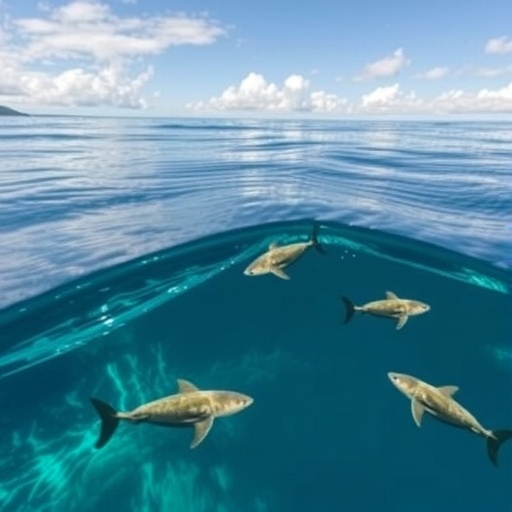
Image Credits: AI Generated

DOI: https://doi.org/10.1038/s41558-026-02696-9

Tags: balancing renewable energy and marine ecosystem healthconservation prioritization in energy project sitingcost-effective blue energy sitingecological outcomes of offshore renewable energyecological trade-offs in renewable energy developmenthabitat sensitivity analysis for offshore projectsmarine biodiversity protection strategiesmarine species conservationminimizing ecological harm in offshore energy developmentoffshore wind energy planningquantitative optimization in marine spatial planningspatial planning for marine conservation
Share26Tweet16
Previous Post

Gamma and beta rhythms and 1/f slope shift with depression severity

Next Post

Optical anisotropy enables more robust skyrmion-based information storage

Related Posts

Targeted tropical forest restoration can reduce water losses from deforestation
Climate

Targeted tropical forest restoration can reduce water losses from deforestation

July 15, 2026
Rising Global Heat Stress Threatens Growing Human Populations
Climate

Rising Global Heat Stress Threatens Growing Human Populations

June 23, 2026
Global Changes Boost Long-Term Belowground Carbon Storage
Climate

Global Changes Boost Long-Term Belowground Carbon Storage

June 23, 2026
Ecological Integrity of Avoided Deforestation Projects Explained
Climate

Ecological Integrity of Avoided Deforestation Projects Explained

June 22, 2026
Global Inequality in Carbon Footprint Ownership Revealed
Climate

Global Inequality in Carbon Footprint Ownership Revealed

June 17, 2026
Forests’ Cooling Power Limited by Rising Dryness
Climate

Forests’ Cooling Power Limited by Rising Dryness

June 17, 2026
Next Post
Optical anisotropy enables more robust skyrmion-based information storage

Optical anisotropy enables more robust skyrmion-based information storage

  • Mothers who receive childcare support from maternal grandparents show more

    Mothers who receive childcare support from maternal grandparents show more parental warmth, finds NTU Singapore study

    27656 shares
    Share 11059 Tweet 6912
  • University of Seville Breaks 120-Year-Old Mystery, Revises a Key Einstein Concept

    1061 shares
    Share 424 Tweet 265
  • Bee body mass, pathogens and local climate influence heat tolerance

    682 shares
    Share 273 Tweet 171
  • Researchers record first-ever images and data of a shark experiencing a boat strike

    546 shares
    Share 218 Tweet 137
  • Groundbreaking Clinical Trial Reveals Lubiprostone Enhances Kidney Function

    531 shares
    Share 212 Tweet 133
Science

Embark on a thrilling journey of discovery with Scienmag.com—your ultimate source for cutting-edge breakthroughs. Immerse yourself in a world where curiosity knows no limits and tomorrow’s possibilities become today’s reality!

RECENT NEWS

  • New Challenges and Trends Shape Automotive Battery Recycling Efforts
  • TAL-Net Temporal Attention LSTM Predicts U.S. Urban Electricity Use and Emissions
  • Electromechanical docking systems enable thin-film robotic and electronic module transfers
  • Sleeve Gastrectomy Triggers Adipose Browning by Modulating Asprosin and ATF3-Nrf2

Categories

  • Agriculture
  • Anthropology
  • Archaeology
  • Athmospheric
  • Biology
  • Biotechnology
  • Blog
  • Bussines
  • Cancer
  • Chemistry
  • Climate
  • Earth Science
  • Editorial Policy
  • Marine
  • Mathematics
  • Medicine
  • Pediatry
  • Policy
  • Psychology & Psychiatry
  • Science Education
  • Social Science
  • Space
  • Technology and Engineering

Subscribe to Blog via Email

Enter your email address to subscribe to this blog and receive notifications of new posts by email.

Join 5,146 other subscribers

© 2025 Scienmag - Science Magazine

Welcome Back!

Login to your account below

Forgotten Password?

Retrieve your password

Please enter your username or email address to reset your password.

Log In
No Result
View All Result
  • HOME
  • SCIENCE NEWS
  • CONTACT US

© 2025 Scienmag - Science Magazine

Discover more from Science

Subscribe now to keep reading and get access to the full archive.

Continue reading
