

Sunday, July 26, 2026
Science
No Result
View All Result
  • Login
  • HOME
  • SCIENCE NEWS
  • CONTACT US
  • HOME
  • SCIENCE NEWS
  • CONTACT US
No Result
View All Result
Scienmag
No Result
View All Result
Home Science News Climate

UNFCCC Shifts Preferences Among Key Actors in Climate Negotiations

July 26, 2026
in Climate
Reading Time: 2 mins read
0
UNFCCC Shifts Preferences Among Key Actors in Climate Negotiations

UNFCCC Shifts Preferences Among Key Actors in Climate Negotiations

65
SHARES
587
VIEWS
Share on FacebookShare on Twitter
ADVERTISEMENT

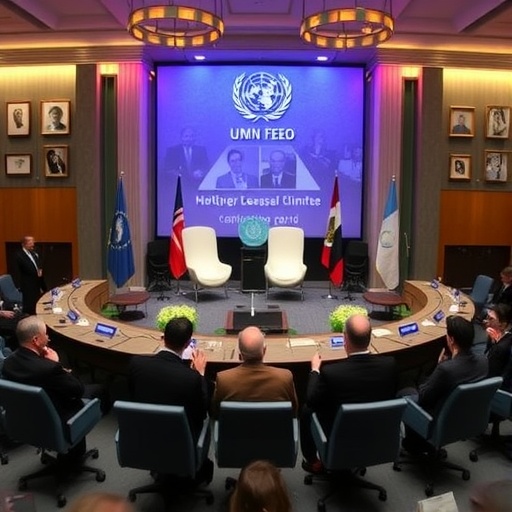
A new analysis of climate diplomacy shows how reform proposals in the UNFCCC can be reshaped—not simply by governments’ formal positions, but by shifting preferences among the process’s most influential actors. The study, appearing in Nature Climate Change, examines how key parties and stakeholders adjust what they want from institutional change, and how those adjustments reverberate through negotiation dynamics.

The authors argue that “preference reform” is best understood as a strategic response to evolving constraints and opportunities inside the UNFCCC. Rather than treating reform as a one-way effort to modernize rules, the work frames reform as an interactive bargaining outcome, where actors anticipate future outcomes and recalibrate their stances accordingly.

Using the UNFCCC negotiation context as a laboratory, the research highlights how preferences can change when actors perceive renegotiation leverage—such as when political support strengthens for certain mechanisms or when implementation details become more salient. In this setting, even widely discussed goals may be translated into different institutional designs depending on who expects gains and losses.

Technically, the paper emphasizes the role of expectations in shaping negotiation behavior: actors do not merely react to current proposals, but forecast how reforms will affect future bargaining positions. This can lead to preference convergence around workable compromises—or divergence when actors anticipate that delays, sequencing, or scope adjustments will shift burdens in their favor.

The findings also suggest that reforms are more likely to succeed when they align with the interests of pivotal parties who can influence agenda-setting and consensus-building. In practical terms, institutional change may hinge less on rhetoric and more on who controls the “terms of exchange” during negotiation rounds.

By mapping how preferences evolve across actors, the study provides a framework for interpreting negotiation volatility, including periods when reform momentum accelerates or stalls. It implies that observing only stated commitments may miss the underlying strategic shifts that determine whether reforms become actionable.

For policymakers, the work offers a cautionary message for climate negotiations: reform design cannot be separated from political incentives and bargaining foresight. If reform packages do not account for how preferences will likely change under different institutional scenarios, implementation risk rises.

For the public, the relevance is simple but urgent: the architecture of climate governance is not static. As preferences among key UNFCCC actors move, the path from aspiration to mechanism—and ultimately to emissions-relevant action—can change shape quickly.

Subject of Research: UNFCCC reform preferences among key actors

Article Title: Reform preferences of key actors in the UNFCCC process

Article References: Koliev, F., Nasiritousi, N., Buylova, A. et al. Reform preferences of key actors in the UNFCCC process. Nat. Clim. Chang. (2026). https://doi.org/10.1038/s41558-026-02723-9

Image Credits: AI Generated

DOI: https://doi.org/10.1038/s41558-026-02723-9

Tags: actor expectationsClimate diplomacyclimate negotiation analysisclimate policy preferencesfuture bargaining outcomesinstitutional changenegotiation dynamicsnegotiation leveragereform implementationstakeholder influencestrategic bargainingUNFCCC reform
Share26Tweet16
Previous Post

Lipids in Ovarian Cancer Ascites Impair T Cell Activation by Disturbing TCR Dynamics

Next Post

Metasurface Platform Enables Independent, Concurrent Emissivity Control in MWIR and LWIR

Related Posts

Global Carbon Dioxide Emissions from Navigable Rivers
Climate

Global Carbon Dioxide Emissions from Navigable Rivers

July 26, 2026
Centuries-long cooling after achieving net-zero greenhouse gas emissions
Climate

Centuries-long cooling after achieving net-zero greenhouse gas emissions

July 26, 2026
Intercity links boost urban mobility resilience during extreme rainfall
Climate

Intercity links boost urban mobility resilience during extreme rainfall

July 17, 2026
Protecting marine species while developing cost-effective renewable energy
Climate

Protecting marine species while developing cost-effective renewable energy

July 17, 2026
Targeted tropical forest restoration can reduce water losses from deforestation
Climate

Targeted tropical forest restoration can reduce water losses from deforestation

July 15, 2026
Rising Global Heat Stress Threatens Growing Human Populations
Climate

Rising Global Heat Stress Threatens Growing Human Populations

June 23, 2026
Next Post
Metasurface Platform Enables Independent, Concurrent Emissivity Control in MWIR and LWIR

Metasurface Platform Enables Independent, Concurrent Emissivity Control in MWIR and LWIR

  • Mothers who receive childcare support from maternal grandparents show more

    Mothers who receive childcare support from maternal grandparents show more parental warmth, finds NTU Singapore study

    27656 shares
    Share 11059 Tweet 6912
  • University of Seville Breaks 120-Year-Old Mystery, Revises a Key Einstein Concept

    1061 shares
    Share 424 Tweet 265
  • Bee body mass, pathogens and local climate influence heat tolerance

    682 shares
    Share 273 Tweet 171
  • Researchers record first-ever images and data of a shark experiencing a boat strike

    546 shares
    Share 218 Tweet 137
  • Groundbreaking Clinical Trial Reveals Lubiprostone Enhances Kidney Function

    531 shares
    Share 212 Tweet 133
Science

Embark on a thrilling journey of discovery with Scienmag.com—your ultimate source for cutting-edge breakthroughs. Immerse yourself in a world where curiosity knows no limits and tomorrow’s possibilities become today’s reality!

RECENT NEWS

  • Endocytosis-Independent Biomolecule Delivery: Direct Translocation Past Cellular Barriers
  • São Paulo Archipelago Acts as Breeding Haven for Endangered Sharks
  • Teen diets boost emissions; older adults drive global climate surge
  • Planetary-Mass Exosatellite Detected Orbiting Substellar Companion

Categories

  • Agriculture
  • Anthropology
  • Archaeology
  • Athmospheric
  • Biology
  • Biotechnology
  • Blog
  • Bussines
  • Cancer
  • Chemistry
  • Climate
  • Earth Science
  • Editorial Policy
  • Marine
  • Mathematics
  • Medicine
  • Pediatry
  • Policy
  • Psychology & Psychiatry
  • Science Education
  • Social Science
  • Space
  • Technology and Engineering

Subscribe to Blog via Email

Enter your email address to subscribe to this blog and receive notifications of new posts by email.

Join 5,146 other subscribers

© 2025 Scienmag - Science Magazine

Welcome Back!

Login to your account below

Forgotten Password?

Retrieve your password

Please enter your username or email address to reset your password.

Log In
No Result
View All Result
  • HOME
  • SCIENCE NEWS
  • CONTACT US

© 2025 Scienmag - Science Magazine

Discover more from Science

Subscribe now to keep reading and get access to the full archive.

Continue reading
