


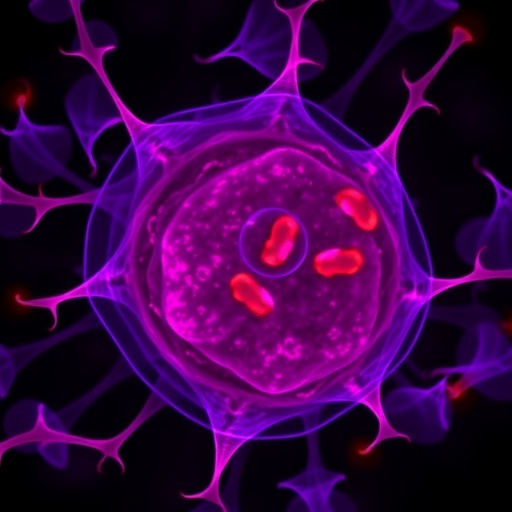
Tumor-killing T cells can be remarkably potent, yet in ovarian cancer they often fail to mount effective responses. A new study in Nature Metabolism points to an underappreciated culprit: the complex lipid mixture found in patients’ ascites fluid. Rather than blocking T cells through classic checkpoints alone, the researchers show that membrane lipids can interfere with the physical choreography required for activation.
The work focuses on T cell receptor (TCR) dynamics—how receptors cluster at the immunological synapse and transmit signals after antigen recognition. Using T cells stimulated in ovarian cancer ascites, the team observed both phenotypic and biophysical disruptions consistent with impaired activation.
Patient-derived ascites exhibited an altered lipid profile, including changes in phosphatidylcholine (PC) and phosphatidylethanolamine content. These shifts were linked to measurable membrane property changes, suggesting the tumor environment reshapes the cell surface in ways that alter signaling geometry.
To identify which lipids are directly used or consumed by T cells in this context, the authors applied untargeted lipidomics. This comprehensive approach revealed specific lipid species whose availability changes during stimulation in ascites.
Among the species implicated, 18:0–18:2 PC emerged as a key inhibitory factor. The study reports that this lipid can impair T cell activation even at physiological concentrations, indicating it is not merely a correlate of inflammation but a functional barrier.
Mechanistically, the researchers uncovered how ascites lipids disrupt nanoscale TCR clustering. By perturbing receptor organization at the synapse, the lipids reduce the probability that productive signaling microdomains form.
A crucial therapeutic insight followed: pre-activated T cells were able to overcome these lipid-induced constraints. This suggests that adoptive cell strategies that begin from an activated state may be less vulnerable to lipid-mediated immune suppression.
Together, the findings offer mechanistic clarity for why T cell-based therapies underperform in ovarian cancer. They also propose an actionable direction—engineering or selecting T cells to bypass early activation steps that are especially sensitive to lipid-driven TCR disruption.
Cite Scienmag News
Nathaniel Bowman. (July 26, 2026). Lipids in Ovarian Cancer Ascites Impair T Cell Activation by Disturbing TCR Dynamics. Scienmag. https://scienmag.com/lipids-in-ovarian-cancer-ascites-impair-t-cell-activation-by-disturbing-tcr-dynamics/
Nathaniel Bowman. "Lipids in Ovarian Cancer Ascites Impair T Cell Activation by Disturbing TCR Dynamics." Scienmag, 26 July 2026, https://scienmag.com/lipids-in-ovarian-cancer-ascites-impair-t-cell-activation-by-disturbing-tcr-dynamics/. Accessed 4 September 2026.
Nathaniel Bowman. "Lipids in Ovarian Cancer Ascites Impair T Cell Activation by Disturbing TCR Dynamics." Scienmag. July 26, 2026. https://scienmag.com/lipids-in-ovarian-cancer-ascites-impair-t-cell-activation-by-disturbing-tcr-dynamics/


