

Friday, July 17, 2026
Science
No Result
View All Result
  • Login
  • HOME
  • SCIENCE NEWS
  • CONTACT US
  • HOME
  • SCIENCE NEWS
  • CONTACT US
No Result
View All Result
Scienmag
No Result
View All Result
Home Science News Psychology & Psychiatry

Gamma and beta rhythms and 1/f slope shift with depression severity

July 17, 2026
in Psychology & Psychiatry
Reading Time: 2 mins read
0
Gamma and beta rhythms and 1/f slope shift with depression severity

Gamma and beta rhythms and 1/f slope shift with depression severity

65
SHARES
587
VIEWS
Share on FacebookShare on Twitter
ADVERTISEMENT

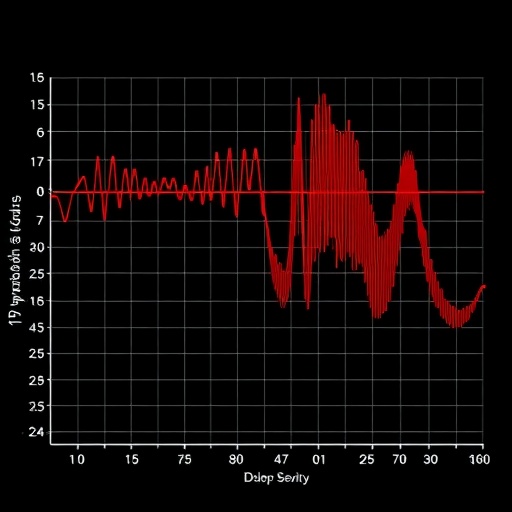
A new study published in Translational Psychiatry suggests that the brain’s electrical “fingerprints” shift systematically with how severe depression symptoms are. Using changes in neural oscillations—rhythmic patterns detected in the brain’s ongoing activity—researchers report that both gamma and beta power, along with the so‑called 1/f slope of neural signals, vary across individuals positioned along a depression-severity spectrum.

The work focuses on two complementary aspects of electrophysiology. Gamma-band activity (fast oscillations) and beta-band activity (slower, higher-amplitude rhythms) can reflect how effectively neural circuits synchronize. By contrast, the 1/f slope is a broadband property: it characterizes how signal power decays across frequencies, often interpreted as a proxy for excitation–inhibition balance and overall neural network dynamics.

Rather than treating depression as a binary condition, the researchers evaluated participants across varying degrees of symptom severity. This approach allowed them to map how neural signatures change gradually, potentially revealing biological markers that track with clinical worsening—or improvement—over time. In essence, the findings imply that depression may involve not only mood-related brain changes, but also alterations in the spectrum-wide organization of neural activity.

Importantly, the study reports that both gamma and beta power are not static traits. They scale with severity, indicating that the brain’s rhythmic “coupling” properties may become disrupted as symptoms intensify. Such scaling could have implications for why some treatments work better than others, depending on the baseline neurophysiological state of a patient’s brain.

Equally notable is the involvement of the 1/f slope. Because 1/f features are sensitive to how neural populations balance excitation and inhibition, shifts in this slope may point to fundamental changes in network responsiveness. Together with band-specific power, the broadband 1/f slope provides a richer picture than either measure alone.

The study’s translational relevance lies in its potential to support objective, electrophysiology-based stratification. If validated in larger cohorts, these spectral markers could help identify subtypes of depression that share common brain dynamics, guiding more precise clinical decisions and accelerating intervention testing.

Beyond diagnosis, these results hint at a future where brain-spectrum metrics become tools for monitoring treatment response. If gamma, beta, and 1/f slope shift with severity, they may also move in the opposite direction as therapy reduces symptoms—turning recordings into a feedback mechanism rather than a one-time snapshot.

For now, the findings open a compelling route: depression may be understood as a continuum of spectral brain organization, captured through changes in both oscillatory rhythms and broadband signal structure.

Subject of Research: Depression severity and brain electrophysiology (gamma/beta power and 1/f slope)

Article Title: Gamma and beta power and the 1/f slope vary across a spectrum of depression severity.

Article References: https://doi.org/10.1038/s41398-026-04268-z

Image Credits: AI Generated

DOI: https://doi.org/10.1038/s41398-026-04268-z

Tags: 1/f slopebrain electrical activitybrain signal power decaydepression severity biomarkerselectrophysiology in depressionexcitation inhibition balancegamma and beta powerneural network dynamicsneural oscillation spectrumneural oscillationsneural synchronizationneurophysiological markers of depression
Share26Tweet16
Previous Post

Japanese Paleolithic should be better represented in Western stories of Asia’s expansion

Next Post

Protecting marine species while developing cost-effective renewable energy

Related Posts

Orienting Selective Attention Within Long-Term Contextual Memories
Psychology & Psychiatry

Orienting Selective Attention Within Long-Term Contextual Memories

July 16, 2026
Separating Human Projection from Machine Cognition Is Key to LLM Understanding
Psychology & Psychiatry

Separating Human Projection from Machine Cognition Is Key to LLM Understanding

July 16, 2026
Traumatic Experiences Linked to Depression Symptoms in LGBTQ+ People in China
Psychology & Psychiatry

Traumatic Experiences Linked to Depression Symptoms in LGBTQ+ People in China

July 16, 2026
Social Isolation Disrupts Prefrontal Excitatory–Inhibitory Balance, Impairs Novel Social Memory in Male Mice
Psychology & Psychiatry

Social Isolation Disrupts Prefrontal Excitatory–Inhibitory Balance, Impairs Novel Social Memory in Male Mice

July 16, 2026
Reanalysis of Longitudinal Studies on How Intergroup Contact Shapes Attitudes
Psychology & Psychiatry

Reanalysis of Longitudinal Studies on How Intergroup Contact Shapes Attitudes

July 15, 2026
Psilocybin Alters Human Brain Synaptic Plasticity, New Research Finds
Psychology & Psychiatry

Psilocybin Alters Human Brain Synaptic Plasticity, New Research Finds

July 15, 2026
Next Post
Protecting marine species while developing cost-effective renewable energy

Protecting marine species while developing cost-effective renewable energy

  • Mothers who receive childcare support from maternal grandparents show more

    Mothers who receive childcare support from maternal grandparents show more parental warmth, finds NTU Singapore study

    27656 shares
    Share 11059 Tweet 6912
  • University of Seville Breaks 120-Year-Old Mystery, Revises a Key Einstein Concept

    1061 shares
    Share 424 Tweet 265
  • Bee body mass, pathogens and local climate influence heat tolerance

    682 shares
    Share 273 Tweet 171
  • Researchers record first-ever images and data of a shark experiencing a boat strike

    546 shares
    Share 218 Tweet 137
  • Groundbreaking Clinical Trial Reveals Lubiprostone Enhances Kidney Function

    531 shares
    Share 212 Tweet 133
Science

Embark on a thrilling journey of discovery with Scienmag.com—your ultimate source for cutting-edge breakthroughs. Immerse yourself in a world where curiosity knows no limits and tomorrow’s possibilities become today’s reality!

RECENT NEWS

  • TAL-Net Temporal Attention LSTM Predicts U.S. Urban Electricity Use and Emissions
  • Electromechanical docking systems enable thin-film robotic and electronic module transfers
  • Sleeve Gastrectomy Triggers Adipose Browning by Modulating Asprosin and ATF3-Nrf2
  • Predictable Microbial Shifts Build Community-Wide Resilience to Environmental Stress

Categories

  • Agriculture
  • Anthropology
  • Archaeology
  • Athmospheric
  • Biology
  • Biotechnology
  • Blog
  • Bussines
  • Cancer
  • Chemistry
  • Climate
  • Earth Science
  • Editorial Policy
  • Marine
  • Mathematics
  • Medicine
  • Pediatry
  • Policy
  • Psychology & Psychiatry
  • Science Education
  • Social Science
  • Space
  • Technology and Engineering

Subscribe to Blog via Email

Enter your email address to subscribe to this blog and receive notifications of new posts by email.

Join 5,146 other subscribers

© 2025 Scienmag - Science Magazine

Welcome Back!

Login to your account below

Forgotten Password?

Retrieve your password

Please enter your username or email address to reset your password.

Log In
No Result
View All Result
  • HOME
  • SCIENCE NEWS
  • CONTACT US

© 2025 Scienmag - Science Magazine

Discover more from Science

Subscribe now to keep reading and get access to the full archive.

Continue reading
