


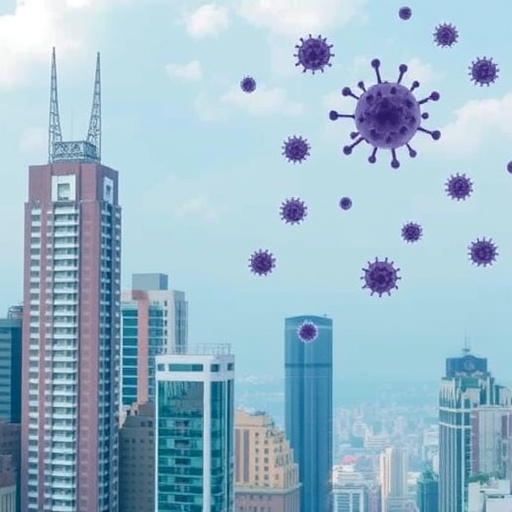
In recent years, urban air pollution management has predominantly targeted chemical pollutants, particularly those associated with fine particulate matter known as PM2.5. These microscopic particles, originating primarily from vehicle exhaust and industrial emissions, have been extensively studied due to their significant impact on respiratory and cardiovascular health. However, pioneering research from The Hong Kong Polytechnic University (PolyU) is shedding light on a critically overlooked dimension of air pollution: the microbial components nestled within PM2.5 that may harbor disproportionate health risks. These microbial elements, including bacteria, fungi, viruses, and cellular debris, constitute a minuscule fraction of the PM2.5 mass but could be potent instigators of inflammatory responses and disease transmission.
A multidisciplinary team led by Prof. Jin Ling, who holds appointments in both the Department of Civil and Environmental Engineering and the Department of Health Technology and Informatics at PolyU, along with Prof. Polly Leung, has undertaken a systematic investigation into the bioactivity of PM2.5’s microbial constituents. Their findings reveal that bacterial endotoxins, structural components derived from the outer membranes of gram-negative bacteria, though constituting less than 0.0001% of PM2.5 mass, activate inflammatory responses in nearly 20% of observed cases. This striking bioactivity to mass ratio renders these endotoxins one of the most toxic elements within urban particulate pollution and challenges conventional paradigms focused solely on mass concentration reduction.
The team’s research, published in the prestigious journal Environmental Science & Technology, articulates a pivotal insight: mitigating urban airborne health risks may necessitate a strategic pivot from simply lowering PM2.5 concentrations toward precisely identifying and targeting these high-potency microbial components. Endotoxins operate by triggering the human respiratory immune system’s inflammatory pathways, which, when persistently activated, may exacerbate or precipitate chronic respiratory conditions such as asthma, chronic obstructive pulmonary disease, and other inflammatory disorders.
Professor Jin Ling emphasized that emerging global clean-air policies have already led to notable reductions in industrial and vehicular pollutant levels. However, as these sources dwindle, the persistent presence and potential amplification of biologically active contaminants—microbes—that have long been neglected in air quality management programs will require urgent attention. Enhanced detection technologies and molecular-level analyses are crucial in identifying these microbial toxins’ precise origins, persistence, and transport mechanisms within urban atmospheres.
Complementing the bacterial findings, Prof. Jin and her research collaborators, including Dr. Franklin Chow and jointly supervised postgraduate researchers, extended their inquiry into the fungal constituents of urban airborne particulates, particularly within PM10 fractions. Their rigorous studies, reported in Environmental Science & Technology Letters, spotlight identified Candida species within urban air samples, notorious for causing opportunistic infections. Alarmingly, their investigation uncovered multidrug-resistant strains of Candida parapsilosis, which bear close genetic resemblance to strains extracted from clinical infections, illustrating a direct environmental-to-human transmission risk through inhalation or dermal exposure.
Candida species’ categorization by the World Health Organization as priority pathogens underscores the critical public health implications of their airborne dispersal. The PolyU team’s findings detail how these fungal cells endure harsh environmental conditions, demonstrating resilience against common antifungal agents, thereby posing a formidable challenge for infection prevention and control in community and healthcare settings alike. Seasonally dynamic airborne concentrations and widespread presence in anthropogenically influenced locales such as wastewater treatment plants, hospitals, and residential ventilation systems further complicate containment efforts.
The revelation that urban ambient air can act as a reservoir and vector for drug-resistant fungal pathogens highlights a broader environmental health crisis that intersects microbial ecology, medicine, and public health policy. Drug resistance emergence is often attributed to clinical misuse of antimicrobials; however, the environmental distribution and selective pressures within urban ecosystems represent significant but underappreciated drivers that can facilitate resistant strain proliferation and dispersal.
In view of these threats, Prof. Jin pointed to the necessity of elucidating fungal reservoirs specific to urban settings and the environmental conditions that exacerbate microbial drug resistance. Such granularity in understanding transmission dynamics and resistance evolution is integral to constructing accurate predictive models. These models will inform targeted interventions downstream, potentially including air filtration advances, urban planning modifications, and public health advisories tailored to periods of heightened airborne microbial prevalence.
The broader implications of this research underscore a paradigm shift in comprehending urban air quality’s biological components. The previously narrow focus on mass-based particulate management is insufficient to address the nuanced and complex interactions between human health and microbial ecology embedded within airborne particulates. The ironclad relationship between environmental microbial exposures and respiratory inflammation demands that policymakers incorporate microbiological toxicity profiles into air quality standards mitigation decisions.
Moreover, the integration of genomic sequencing techniques into environmental monitoring has proven indispensable in distinguishing pathogenic strains with drug resistance capabilities from benign microbial background flora. This molecular resolution paves the way for identifying specific opportunistic pathogens capable of causing outbreaks or exacerbating chronic conditions, allowing health authorities to enact preemptive responses rather than reactive measures.
The PolyU research also highlights the interconnectedness of built environments and microbial pollutant distribution. Ventilation systems, wastewater facilities, and healthcare institutions act as nodes of concentrated microbial dissemination. This knowledge necessitates an interdisciplinary approach encompassing microbiology, environmental engineering, urban ecology, and clinical medicine to holistically tackle airborne microbial contamination.
As urban populations continue to grow, the complexity of airborne microbial interactions with human hosts likewise escalates, necessitating innovative surveillance and mitigation strategies. Public awareness campaigns should augment traditional pollution education with information about these invisible but impactful biological contaminants, fostering community engagement in reducing exposure and supporting policy reforms.
To conclude, this groundbreaking research from Hong Kong Polytechnic University opens a compelling frontier in environmental health sciences, emphasizing that even trace concentrations of microbial toxins like bacterial endotoxins and resilient fungal pathogens bear outsized risks. The future of effective air pollution management must therefore embrace a molecularly informed, health-centric framework that anticipates microbial bioactivity, pathogenic potential, and resistance phenomena within urban atmospheres. This holistic approach will be essential in safeguarding respiratory health and curbing emerging infectious threats in our increasingly urbanized world.
News Publication Date: 15-Sep-2025
Web References:
Cite Scienmag News
Roger Howard. (May 6, 2026). PolyU Study Uncovers Hidden Health Hazards of Urban Airborne Microbes: Low Levels of Bacterial Toxins Linked to Nearly 20% of Inflammatory Responses, Drug-Resistant Fungi Potentially Dispersed by Wind. Scienmag. https://scienmag.com/polyu-study-uncovers-hidden-health-hazards-of-urban-airborne-microbes-low-levels-of-bacterial-toxins-linked-to-nearly-20-of-inflammatory-responses-drug-resistant-fungi-potentially-dispersed-by-wind/
Roger Howard. "PolyU Study Uncovers Hidden Health Hazards of Urban Airborne Microbes: Low Levels of Bacterial Toxins Linked to Nearly 20% of Inflammatory Responses, Drug-Resistant Fungi Potentially Dispersed by Wind." Scienmag, 6 May 2026, https://scienmag.com/polyu-study-uncovers-hidden-health-hazards-of-urban-airborne-microbes-low-levels-of-bacterial-toxins-linked-to-nearly-20-of-inflammatory-responses-drug-resistant-fungi-potentially-dispersed-by-wind/. Accessed 3 September 2026.
Roger Howard. "PolyU Study Uncovers Hidden Health Hazards of Urban Airborne Microbes: Low Levels of Bacterial Toxins Linked to Nearly 20% of Inflammatory Responses, Drug-Resistant Fungi Potentially Dispersed by Wind." Scienmag. May 6, 2026. https://scienmag.com/polyu-study-uncovers-hidden-health-hazards-of-urban-airborne-microbes-low-levels-of-bacterial-toxins-linked-to-nearly-20-of-inflammatory-responses-drug-resistant-fungi-potentially-dispersed-by-wind/


