


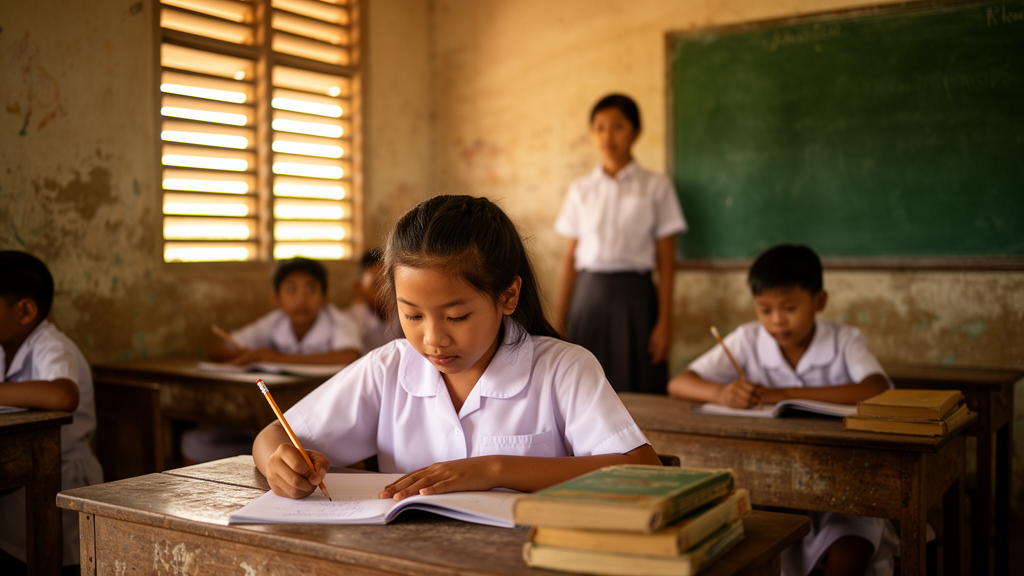
A new study argues that the Philippines’ retreat from mother tongue-based education was not a technical correction but a political act, one that the researchers describe as a form of linguistic depoliticization with consequences that reach the level of cultural and linguistic genocide. Writing in SN Social Sciences, Analiza Liezl Perez-Amurao of Mahidol University International College and Michael Thomas Nelmida of Mahidol University trace how decades of language legislation, congressional debate, and administrative memoranda have shaped, and ultimately dismantled, one of Southeast Asia’s most ambitious multilingual education reforms. Their analysis, published in 2026, uses document analysis and critical discourse analysis to read the country’s language laws not as neutral pedagogical instruments but as artifacts of political legacies and the interests of powerful actors.
The policy at the center of the study is Mother Tongue-Based Multilingual Education, known as MTB-MLE, which was embedded in the Enhanced Basic Education Act of 2013, Republic Act No. 10533. The reform required that the language children speak at home serve as the medium of instruction from kindergarten through the early grades, a design consistent with a large body of international research showing that first-language instruction facilitates meaningful and lifelong learning. Evidence cited in the study includes the well-known Lubuagan case study by Walter and Dekker, which documented measurable learning gains when Kankanaey children were taught in their own language. Yet by 2025, the Department of Education had issued a memorandum discontinuing the use of the mother tongue as the medium of instruction in kindergarten to grade 3, allowing only optional implementation in monolingual classes, and amending the very sections of the 2013 law that had mandated it. Republic Act No. 12027, recorded by the Supreme Court’s e-library in October 2024, formalized the rollback.
What makes the study distinctive is its insistence that this sequence of events cannot be understood through the language of implementation failure alone. Perez-Amurao and Nelmida argue that implementation gaps, the practical difficulties of training teachers, producing materials, and assessing learners in more than a hundred Philippine languages, were reframed by political actors as policy failure. That reframing, they contend, was the crucial move. Once a policy is publicly defined as having failed on its own terms, its rollback appears not as a political choice but as an administrative necessity. The researchers describe this process as lawfare, the use of legal instruments and legislative maneuvering to produce colossal effects on language communities, and they show how congressional records and education commission reports circulated data that reshaped the perceived value of the mother tongues themselves.
The theoretical core of the paper is a refined construct of linguistic depoliticization. In the authors’ account, depoliticization occurs when decisions about language are stripped of their visible political content and presented as technocratic matters, even as they remain deeply embedded in power dynamics. The Philippines’ national language acts, examined through critical discourse analysis in the tradition of Norman Fairclough, reveal recurring patterns of ambivalence: proclamations celebrating linguistic diversity coexisting with executive orders, such as Executive Order No. 335 of 1988, that directed government offices toward the exclusive use of Filipino in official transactions. This ambivalence, the study argues, is not accidental. It reflects the interests of actors whose political legacies favor a narrow, centralized linguistic order, and it echoes what other scholars have called the misuses of essentialism in language policy-making, where languages are reduced to symbols of unity rather than treated as living media of thought.
The stakes of this analysis are framed in unusually strong moral language. Drawing on the literature of cultural genocide, including work by Lawrence Kingston and Robert van Krieken on the destruction of identity among indigenous peoples, the authors argue that the absence of a coherent national language policy infringes on linguistic human rights and produces cultural genocide through linguistic genocide, the deliberate destruction of cultural identity achieved by attacking the languages in which that identity is carried. The Philippines is home to more than a hundred languages, most of them spoken by communities with no institutional protection, and the study situates the country’s obligations within an extensive framework of international instruments: the Universal Declaration of Human Rights, the International Covenant on Civil and Political Rights, the International Covenant on Economic, Social and Cultural Rights, the Convention on the Rights of the Child, the Declaration on the Rights of Persons Belonging to National or Ethnic, Religious and Linguistic Minorities, the United Nations Declaration on the Rights of Indigenous Peoples, and the 1996 Universal Declaration of Linguistic Rights adopted in Barcelona.
The researchers’ methodological approach is worth examining because it demonstrates how policy histories can be reconstructed from official texts. Document analysis, as described in the methodological literature the authors cite, allows researchers to treat laws, memoranda, and commission reports as evidence of both stated intent and unstated assumption. Critical discourse analysis then interrogates how those texts frame problems, assign blame, and legitimize action. Applied to the Philippine record, the method surfaces a striking pattern: the same institutions that documented the challenges of implementing MTB-MLE also produced the evaluative data that justified abandoning it. Implementation-generated data circulating within policy institutions, the study finds, progressively reshaped the value of the mother tongues, recasting them as obstacles to learning rather than as resources for it. The rollback of 2024 and 2025 thus appears in the record not as a sudden reversal but as the endpoint of a long discursive campaign.
The study also situates the rollback within a broader pattern of democratic retrogression in the Philippines. The authors connect the language policy trajectory to the country’s recent political history, including the radical populism associated with Rodrigo Duterte and the Marcosian revisionism documented by historians such as Francisco Jayme Guiang, in which myth-making reshapes collective memory. In such an environment, they suggest, language policy becomes another arena in which historical narratives and national identity are contested and rewritten. The ambivalence of the state toward its own linguistic diversity mirrors a wider ambivalence toward pluralism itself. Democratic retrogression, on this reading, is not only a matter of institutions and elections; it is inscribed in the languages children are permitted to learn in, and therefore in whose knowledge counts as legitimate.
The human consequences are concrete. Millions of Filipino learners, the study notes, continue to be denied inclusive and culturally responsive education. The evidence base for the pedagogical value of mother tongue instruction in the Philippine context is substantial, ranging from the Lubuagan experiment to studies of classroom implementation by public elementary teachers in Masbate and analyses of how language ideologies shape policy implementation published in Asia-Pacific Education Researcher in 2025. Against this backdrop, the discontinuation of mandatory mother tongue instruction in the earliest grades represents, in the authors’ framing, a policy choice that prioritizes political convenience over documented learning outcomes. Recent economic research, including a 2025 National Bureau of Economic Research working paper on the long shadow of early education in the Philippines, underscores how consequential early-grade learning conditions are for lifetime outcomes, adding an economic dimension to what the authors frame primarily as a rights question.
The paper does not stop at diagnosis. It calls for greater accountability among policymakers and advocates for institutional safeguards that would insulate linguistic inclusivity and cultural revitalization from the oscillations of electoral politics. Such safeguards, the study implies, would need to address the structural conditions that allowed the rollback to proceed: the concentration of policy authority, the vulnerability of implementation data to political reframing, and the absence of enforceable rights for linguistic minorities. The Second Congressional Commission on Education, whose reports the authors analyzed, represents one of the few institutional mechanisms capable of sustained scrutiny, but the study suggests that commissions alone cannot substitute for binding legal protection of learners’ linguistic rights.
Ultimately, the study’s contribution lies in naming a phenomenon that is easy to miss: the quiet depoliticization of decisions that are, in substance, profoundly political. When a multilingual democracy rolls back the right of children to learn in their own languages, the move is typically narrated as pragmatism, as a response to logistics or test scores. Perez-Amurao and Nelmida’s analysis of the Philippine record argues that this narration is itself the mechanism, a discursive shield behind which political legacies and actors’ interests operate. By reconstructing the full chain from national language acts through implementation data to the 2024 and 2025 policy reversal, the study offers a template for examining similar rollbacks elsewhere, and it issues a warning that resonates beyond the Philippines: languages do not die only through prohibition and punishment. They can also be killed by memoranda, reframed statistics, and the slow administrative erosion of the right to be taught in the words one first learned to think in.
Subject of Research: The politics of language-in-education policy and the rollback of mother tongue-based multilingual education in the Philippines
Article Title: Philippine linguistic genocide, depoliticization, and policy rollback
Article References: Philippine linguistic genocide, depoliticization, and policy rollback. (n.d.). https://doi.org/10.1007/s43545-026-01680-6
Image Credits: AI Generated
DOI: 10.1007/s43545-026-01680-6
Keywords: language policy, MTB-MLE, Philippines, linguistic genocide, cultural genocide, linguistic depoliticization, mother tongue education, policy rollback, critical discourse analysis, linguistic human rights, multilingual education, educational equity
Cite Scienmag News
Courtney Benton. (October 8, 2026). Politics, Not Pedagogy: How the Philippines Rolled Back Mother Tongue Education. Scienmag. https://scienmag.com/politics-not-pedagogy-how-the-philippines-rolled-back-mother-tongue-education/
Courtney Benton. "Politics, Not Pedagogy: How the Philippines Rolled Back Mother Tongue Education." Scienmag, 8 October 2026, https://scienmag.com/politics-not-pedagogy-how-the-philippines-rolled-back-mother-tongue-education/. Accessed 8 October 2026.
Courtney Benton. "Politics, Not Pedagogy: How the Philippines Rolled Back Mother Tongue Education." Scienmag. October 8, 2026. https://scienmag.com/politics-not-pedagogy-how-the-philippines-rolled-back-mother-tongue-education/


