


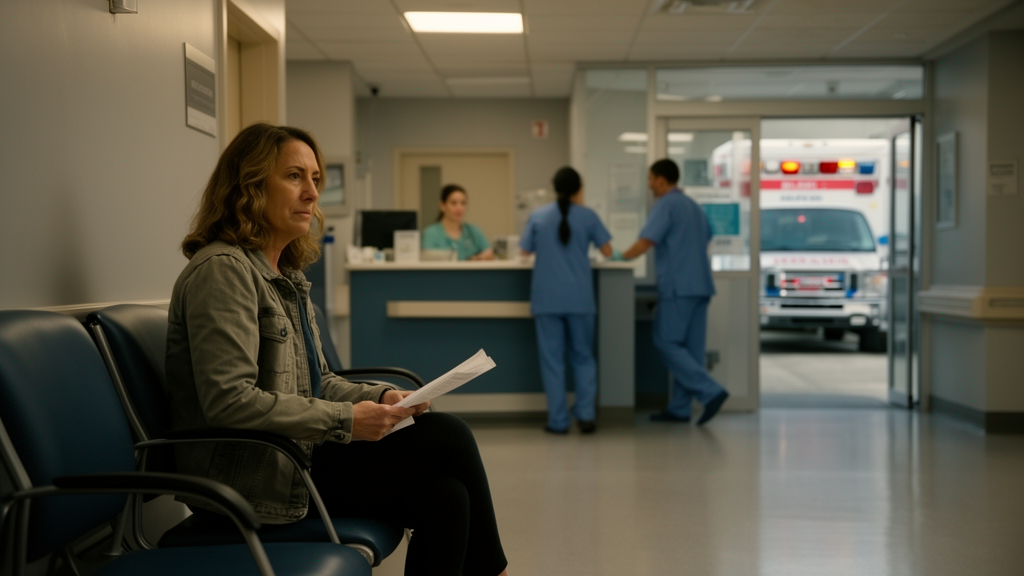
When a woman Veteran wakes at 2 a.m. with crushing abdominal pain, she faces a split-second decision that millions of Americans never have to make: should she drive to the nearest community emergency department, or travel farther to a Veterans Affairs hospital where her records, her coverage, and her history of military service are already known? A sweeping new national study has, for the first time in roughly a decade, mapped how women Veterans across the United States actually answer that question, and the results reveal a health system in which the emergency care of a rapidly growing population is divided along lines of geography, acuity, race, and social vulnerability.
The research, published in the Journal of General Internal Medicine, analyzed an extraordinary dataset: 1.6 million Veterans who made at least one emergency department visit between October 2022 and September 2023, generating 3.2 million individual visits. Of those Veterans, 185,392 were women, accounting for 362,347 emergency visits. The investigators, led by Dr. Jessica Faiz of the VA Greater Los Angeles Healthcare System and UCLA, drew on VA administrative records, community care claims data, and enrollment files to reconstruct where every visit occurred and why. Their central finding is deceptively simple: about 60 percent of women Veterans’ emergency visits took place in VA emergency departments, while the remaining 40 percent occurred in community settings paid for through VA Community Care, the program expanded by the MISSION Act of 2018 that allows Veterans to receive care outside the VA system.
That 60-40 split matters because the two populations flowing through each door are strikingly different. Women Veterans who used VA emergency departments were, on average, younger than their male counterparts, with a mean age of 50.2 years compared with 62.9 years for men. They were also more likely to be Black, representing 33 percent of women emergency users compared with 20.9 percent of men, more likely to be Hispanic, more likely to live in urban areas, and more likely to carry a service-connected disability, at 65.5 percent versus 50.1 percent. Most striking of all, 42.1 percent of women Veterans presenting to emergency departments had a serious mental illness, nearly double the 23.4 percent prevalence among men. The picture that emerges is of a high-need population whose emergencies are intertwined with mental health, housing instability, and the long shadow of military service.
To untangle why some women end up in VA emergency departments and others in community ones, the team deployed logistic regression with generalized estimating equations, a statistical technique that accounts for the fact that the same patient may appear many times in the dataset across repeated visits. The models adjusted for age, race, ethnicity, rurality, comorbidity burden measured by the Elixhauser index across 31 chronic conditions, serious mental illness, housing instability, combat exposure, military service branch, VA enrollment priority group, driving time to the nearest VA emergency department or urgent care clinic, and the frequency of primary care contact in the preceding year. The result is one of the most comprehensive adjusted portraits of emergency care navigation ever assembled for this population.
The diagnosis a woman carries through the door turns out to be one of the strongest predictors of where she will be treated. Women with low-acuity conditions, things like upper respiratory infections, sinusitis, low back pain, and skin disorders, had 62 percent higher odds of being treated in a VA emergency department than in the community. Behavioral health-related visits also tilted toward VA settings, with 10 percent higher odds. The pattern likely reflects the financial predictability of VA care: for non-urgent problems, Veterans may reasonably prefer a system where copays are transparent and coverage is guaranteed, rather than risk surprise bills or gaps in Community Care authorization. In contrast, women presenting with emergency care-sensitive conditions, the time-critical diagnoses such as myocardial infarction and stroke where rapid, high-quality treatment demonstrably reduces death and disability, had 39 percent lower odds of receiving care at a VA facility. Chest pain was the single most common diagnosis among women treated in community emergency departments, while musculoskeletal pain topped the list at VA sites.
Geography exerts an equally powerful force. Women who lived farther from a VA emergency department were substantially more likely to seek care in the community, a finding that aligns precisely with the intent of the MISSION Act, which was designed to relieve Veterans facing geographic barriers to VA facilities. Distance also appears to shape the behavior of women experiencing homelessness, who had 10 percent lower odds of using VA emergency care. The authors suggest that fragmented care and lost continuity with VA services, chronic challenges for homeless-experienced Veterans, may push this group toward whatever emergency department is closest, regardless of affiliation. Notably, women with pregnancy-related diagnoses had the lowest odds of any group of presenting to a VA emergency department, consistent with the fact that most women Veterans receive obstetric care outside the VA system entirely.
Perhaps the most socially consequential finding concerns race and trust. Women Veterans from racially and ethnically minoritized groups had consistently higher odds of using VA emergency departments than White women, even after adjusting for clinical and geographic factors. The researchers offer two non-exclusive explanations: this may signal genuine trust in VA providers, a phenomenon documented in prior studies of women Veterans’ healthcare experiences, or it may reflect structural barriers, cost, insurance status, provider availability, that make community care harder to reach. Either way, the pattern echoes earlier national data showing that minoritized Veterans rely more heavily on VA-provided care across the board. It also raises the stakes for equity in emergency settings, where split-second clinical decisions intersect with providers who, as the broader literature on implicit bias in emergency medicine shows, are not immune to the cognitive shortcuts that can shape outcomes.
Combat exposure emerged as another unexpected predictor. Women Veterans with a history of military combat had 20 percent higher odds of seeking emergency care at VA facilities. The authors speculate that this may reflect the comprehensive post-combat care the VA offers, a stronger institutional connection among combat Veterans, or the higher rates of service-connected disability that qualify them for lower copays. Whatever the mechanism, the finding reinforces a theme running through the entire study: the VA emergency department functions not merely as a treatment site but as an anchor of institutional identity and trust for a subset of women whose needs span trauma, mental health, and physical medicine simultaneously.
The study’s technical rigor is matched by candid acknowledgment of its limits. Administrative data cannot capture clinical nuance, urgency, or patient preference, all of which influence where someone chooses, or is able, to seek care. The researchers could not distinguish ambulance arrivals from walk-ins, a crucial gap because community emergency department use for chest pain or stroke may reflect emergency medical services routing protocols rather than any deliberate choice. The analysis also captured only VA-paid visits, missing care covered by private insurance or Medicare. Missing race and ethnicity data, affecting 8.2 percent of women, were handled through multiple imputation by chained equations, and multicollinearity among predictors was formally assessed using variance inflation factors, all of which fell below 1.7 after collinear variables were removed.
The implications reach far beyond the VA. Because two in five women Veterans’ emergency visits now occur in community settings, and because those community visits are disproportionately the high-acuity, high-admission encounters most likely to require follow-up, the authors argue that care coordination between systems is no longer optional. They call for efficient exchange of emergency records, medication changes, and diagnostic results between community emergency departments and VA primary and specialty care; routine ascertainment of Veteran status at community registration desks; and automated notifications to VA care teams when a Veteran presents in the community. Within the VA itself, they point to the need for expanded behavioral health capacity, round-the-clock ultrasound and gynecologic consultation, and same-day services for lower-acuity concerns. As the population of women using VA healthcare has nearly doubled over the past decade, the study makes clear that the question is no longer whether women Veterans will receive emergency care in both systems, but whether both systems will be ready for them.
Subject of Research: Emergency department utilization patterns among women Veterans across VA and community care settings
Article Title: Where Women Veterans Seek Emergency Care: Patterns and Predictors of VA and Community Emergency Department Use
Article References: Faiz, J., Carvalho, C. J., Urech, T., Wu, S., Breland, J. Y., Frayne, S. M., Washington, D. L., Cordasco, K. M., & Vashi, A. A. (2026). Where Women Veterans Seek Emergency Care: Patterns and Predictors of VA and Community Emergency Department Use. Journal of General Internal Medicine. https://doi.org/10.1007/s11606-026-10847-z
Image Credits: AI Generated
DOI: 10.1007/s11606-026-10847-z
Keywords: women Veterans, emergency department, Veterans Health Administration, VA Community Care, MISSION Act, behavioral health, health equity, care coordination, geographic access, homelessness, mental health, health services research
Cite Scienmag News
Glenn Wilkins. (October 8, 2026). Women Veterans Split Emergency Care Between VA Hospitals and Community ERs, National Study Finds. Scienmag. https://scienmag.com/women-veterans-split-emergency-care-between-va-hospitals-and-community-ers-national-study-finds/
Glenn Wilkins. "Women Veterans Split Emergency Care Between VA Hospitals and Community ERs, National Study Finds." Scienmag, 8 October 2026, https://scienmag.com/women-veterans-split-emergency-care-between-va-hospitals-and-community-ers-national-study-finds/. Accessed 8 October 2026.
Glenn Wilkins. "Women Veterans Split Emergency Care Between VA Hospitals and Community ERs, National Study Finds." Scienmag. October 8, 2026. https://scienmag.com/women-veterans-split-emergency-care-between-va-hospitals-and-community-ers-national-study-finds/


