


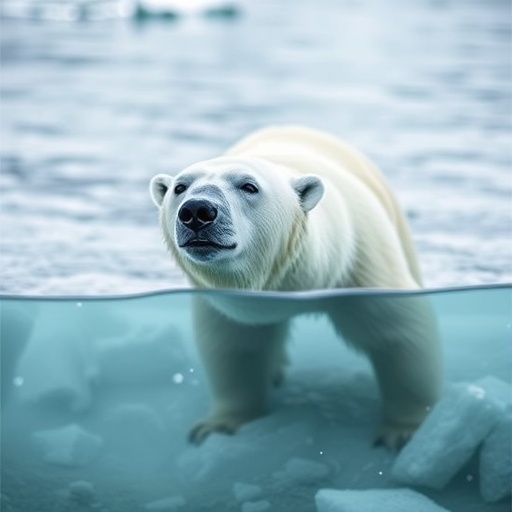
In a surprising revelation that challenges prevailing assumptions about climate change impacts on Arctic wildlife, recent research focusing on the polar bear populations surrounding Svalbard, Norway, indicates an improvement in their physical condition despite the rapid loss of sea ice in the region. This breakthrough study, soon to be published in Scientific Reports, presents a nuanced view of how these iconic apex predators are adapting in an environment increasingly transformed by warming temperatures and melting ice.
For decades, the narrative around polar bears has been one of decline, closely tied to habitat loss due to diminishing sea ice — a platform essential for hunting their primary prey, seals. However, the Barents Sea region, particularly around Svalbard, has exhibited an intriguing divergence from this trend. Since the 1980s, air temperatures in this area have been climbing precipitously, by as much as two degrees Celsius per decade. This warming has drastically reduced the extent and duration of sea ice, a phenomenon generally believed to correlate with weakened polar bear populations. Yet, census data from 2004 reported approximately 2,650 bears with no subsequent notable population decline, until now an ecological enigma prompting deeper investigation.
The team led by Jon Aars undertook an extensive observational study comprising 1,188 body measurement records collected from 770 adult polar bears between 1992 and 2019. The core metric in their analysis was the Body Composition Index (BCI), a reliable indicator of fat reserves and overall health status in these animals. Intriguingly, despite a consistent increase in the number of ice-free days — roughly 100 additional days over the study period corresponding to approximately four extra days per year — the polar bears’ average BCI showed a marked improvement after the year 2000. This counterintuitive finding suggests that polar bears in the Svalbard area have increased fat reserves even as their sea ice habitat contracted, contradicting widespread expectations.
Underlying this phenomenon are several proposed ecological mechanisms. The authors point out that terrestrial ecosystems surrounding Svalbard have undergone partial recovery following historical over-exploitation of certain species by humans. Notably, populations of land-based prey such as the native Svalbard reindeer (Rangifer tarandus) and walrus (Odobenus rosmarus) have rebounded. These species constitute alternative food sources that may supplement the bears’ diets during periods of hunting limitation on the retreating sea ice.
Additionally, the spatial dynamics of marine prey may favor the polar bears despite diminished ice coverage. With sea ice areas reduced and fragmented, ringed seals (Pusa hispida), a principal prey species, tend to concentrate in smaller, more predictable ice patches. This concentration might enhance hunting success rates for polar bears, as prey becomes more accessible within the remaining ice refuges, potentially offsetting the challenges posed by habitat loss.
Nevertheless, the study’s authors caution that this apparent short-term adaptation does not guarantee long-term resilience. Incremental sea ice reductions might eventually impose greater energetic costs on the bears by forcing longer travel distances to reach hunting grounds. This pattern has been observed in other Arctic polar bear populations, where extended swims and terrestrial foraging have been documented, often with negative effects on body condition and reproduction.
The complexity of this ecological interplay underscores the urgent need for sustained, long-term research to elucidate how polar bear populations will respond to continuous climatic shifts. The Svalbard population’s unique response highlights the fact that adaptive capacity and ecological outcomes to rapid environmental change can vary considerably across regions, influenced by local prey availability, ice dynamics, and human impact histories.
Moreover, this research methodology—coupling extensive longitudinal body condition data with detailed environmental metrics like sea ice coverage—is exemplary for interpreting climate-biological interactions at a population level. It allows for more refined assessments beyond simplistic habitat-loss correlations, incorporating multifaceted ecological feedbacks and compensatory mechanisms within Arctic ecosystems.
The implications of this study stretch beyond polar bear conservation to broader ecological and climatological discourse. It challenges blanket assumptions about species responses to habitat loss, urging scientists and policymakers to consider localized ecological contexts and the potential for unexpected resilience in certain populations. As the Arctic continues to warm at an unprecedented pace, studies like these are integral to informing adaptive management strategies and global conservation priorities.
In summary, the body condition improvement observed among Svalbard polar bears during an era of rapid sea ice loss illustrates a complex nexus of ecological factors shaping wildlife futures under climate change. The polar bears’ sustained or even enhanced fat reserves appear linked to terrestrial prey recovery and altered prey distribution patterns, providing a temporary buffer against environmental adversity. However, future trajectories remain uncertain, and continued research will be vital to anticipate the shift from adaptation to potential decline and to guide conservation measures appropriately.
News Publication Date: 29-Jan-2026
Web References: http://dx.doi.org/10.1038/s41598-025-33227-9
Cite Scienmag News
Margaret Porter. (February 1, 2026). Polar Bears in Svalbard: Natural Insulation Shields Against Sea Ice Loss. Scienmag. https://scienmag.com/polar-bears-in-svalbard-natural-insulation-shields-against-sea-ice-loss/
Margaret Porter. "Polar Bears in Svalbard: Natural Insulation Shields Against Sea Ice Loss." Scienmag, 1 February 2026, https://scienmag.com/polar-bears-in-svalbard-natural-insulation-shields-against-sea-ice-loss/. Accessed 4 September 2026.
Margaret Porter. "Polar Bears in Svalbard: Natural Insulation Shields Against Sea Ice Loss." Scienmag. February 1, 2026. https://scienmag.com/polar-bears-in-svalbard-natural-insulation-shields-against-sea-ice-loss/


