


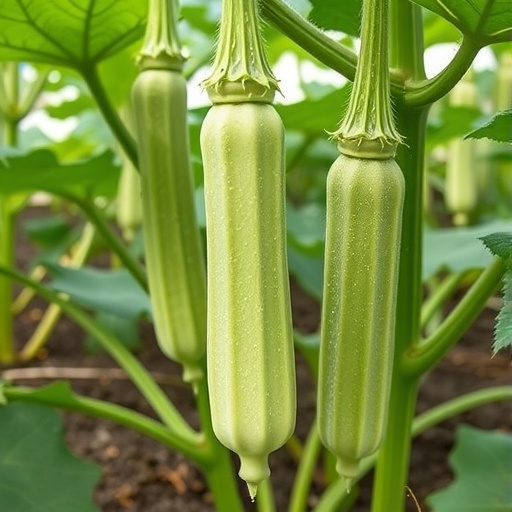
In Nigeria, a simple change in how densely okra is planted—and how weeds are controlled—could dramatically reshape the economics of one of Africa’s most important vegetable crops. A two-year field experiment has found that planting okra at 166,667 plants per hectare and combining a pre-emergence application of the herbicide metolachlor with supplementary hoe weeding produced the strongest overall balance of crop growth, weed suppression, yield and profit. The combination outperformed less intensive weed-control programs and generated a reported gross profit of $1,349.60, suggesting that the most productive strategy is not necessarily the one that produces the largest harvest, but the one that delivers the best return after labour and input costs are deducted.
The findings come from researchers working at the Federal University of Agriculture, Abeokuta, Nigeria, who conducted field trials during the wet seasons of 2020 and 2021. Okra, Abelmoschus esculentus, is cultivated widely across tropical, subtropical and warm-temperate regions for its immature edible pods. Nigeria is among the world’s major producers, yet average yields in the country remain far below the global average. The researchers identify weed infestation as one of the most damaging constraints. Weeds compete with young okra plants for water, mineral nutrients, sunlight and physical space, while also providing shelter for pests and disease-causing organisms. Previous studies have estimated that uncontrolled weed competition can reduce okra yields by anywhere from roughly half to more than 90 percent, depending on weed species, density and timing.
The experiment was designed to test whether plant population and weed management could work together rather than being treated as separate decisions. The researchers used a split-plot arrangement within a randomized complete block design, a standard agricultural method that allows scientists to test interactions between two treatment factors while accounting for variation across a field. Three okra populations were evaluated: 55,555, 111,111 and 166,667 plants per hectare. All seeds were sown in rows 0.60 metres apart, with 0.30 metres between planting holes. The different populations were created by placing one, two or three seeds in each hole. The okra cultivar used was LD88, obtained from Nigeria’s National Horticultural Research Institute in Ibadan, and every treatment was replicated three times in each growing season.
Six weed-control regimes were compared. Some plots received metolachlor at 1.0 kilograms of active ingredient per hectare before weeds emerged; others received the same herbicide followed by supplementary hoe weeding. Additional plots were hoed at three, six and nine weeks after planting, at three and six weeks, or only at three weeks. A final set of plots was left untreated as a weedy control. Metolachlor is a pre-emergence herbicide that acts primarily during the early establishment of susceptible weed seedlings. By suppressing weeds before they emerge, it can protect the vulnerable first weeks of okra growth, when the crop’s canopy is still too small to shade the soil. Hoeing later in the season can then remove weeds that escape the initial herbicide treatment or emerge after its activity declines.
The results showed that denser planting helped okra compete biologically with weeds. At 166,667 plants per hectare, the crop produced a more rapidly closing canopy, reducing the amount of light reaching the soil surface and making conditions less favourable for newly emerging weeds. This population had the lowest total weed biomass in both years and lower late-season weed cover than the less densely planted treatments. The effect illustrates a central principle of crop–weed ecology: a crop can suppress weeds not only through external inputs such as herbicides or cultivation, but also through its own use of space, light and soil resources. The researchers nevertheless found that high density came with a trade-off. Individual pods were slimmer, or had a smaller girth, as plants competed more intensely with one another for nutrients and water.
That trade-off did not reduce total production. Although the least densely planted okra produced the largest individual pods, the denser populations produced more fruits per unit of land. Planting at 111,111 plants per hectare or above resulted in similar yields, and both exceeded the yield from 55,555 plants per hectare. The researchers attribute this pattern to the difference between individual-plant performance and field-level productivity: fewer plants may have more resources available and produce larger fruits, but a greater number of plants can generate more harvestable pods overall. In the highest-density treatment, the fruits were reportedly acceptable in the market despite their smaller size. The researchers therefore concluded that the additional seed cost associated with dense planting was more than offset by the resulting increase in revenue.
Weed control had an even more pronounced effect. The untreated weedy plots consistently produced the weakest plants, the shortest stems, the fewest surviving stands, the smallest pods and the lowest numbers of fruits. Relative to the highest yield, leaving weeds uncontrolled caused a 99.2 percent reduction across the two seasons. A single hoe weeding at three weeks after planting still resulted in a 67.2 percent yield reduction, while hoeing at three and six weeks produced a 24.5 percent reduction. These figures demonstrate why timing matters. Removing weeds once does not prevent later-emerging plants from competing with okra during flowering and fruit formation. The crop must remain sufficiently weed-free through much of its development, particularly because okra grows slowly in its early stages and may not establish enough leaf area to recover from prolonged competition.
The strongest biological performance came from either three hoe weedings at three, six and nine weeks after planting or metolachlor followed by supplementary hoe weeding. Both strategies produced similar fruit yields and counts, while also reducing broadleaf weeds, grasses, sedges and total weed biomass more effectively than the less intensive treatments. The integrated approach had a particular advantage in timing: metolachlor provided an early weed-free period, while later hoeing targeted weeds that emerged after the initial treatment. Three rounds of hoeing achieved comparable control by repeatedly disrupting weed growth, but required much more labour. In the trial’s economic analysis, manual weeding at three, six and nine weeks accounted for 58.2 percent of total production costs, compared with 48.1 percent for two hoe weedings.
That difference between yield and profitability was crucial. The plots weeded three times generated the highest revenue because they produced one of the largest harvests, but their labour costs reduced the final margin. Metolachlor combined with supplementary hoe weeding produced a slightly lower or similar yield at a substantially lower cost, resulting in the highest reported gross profit: $1,349.60, compared with $1,248.30 for three hoe weedings. The analysis used a market price of $0.320 per kilogram of okra and calculated gross margin as revenue minus variable production costs. Production costs increased as plant population rose because more seed was required, but revenue and profit also increased because dense stands produced more fruit. The study suggests that farmers should evaluate weed-control choices by net return rather than harvest weight alone.
The researchers caution that the recommendation is specific to the tested production conditions and should not be interpreted as a universal prescription. The trials took place on sandy-loam soil with a pH of about 6.5 to 6.7 at Abeokuta, under wet-season rainfall of approximately 1,018 to 1,034 millimetres and mean temperatures near 26 to 31 degrees Celsius. Herbicide performance can change with soil texture, rainfall, weed species, crop variety and application timing. Metolachlor must also be used according to local regulations and label instructions, and the study explicitly warns against exceeding 1.0 kilogram of active ingredient per hectare because overdosing could injure the crop and increase environmental risks. Even with those limitations, the experiment offers a practical lesson with broad relevance: combining crop competition with carefully timed weed suppression can protect yield while reducing dependence on repeated manual labour. For okra growers facing severe weed pressure, the most profitable field may be the one where the crop closes the canopy quickly, the weeds are attacked early and the economics are calculated from the final margin rather than the size of the harvest alone.
Cite Scienmag News
Alan Morgan. (August 27, 2026). Plant Density, Weed Control Affect Okra Growth, Yield, Profitability and Weed Infestation. Scienmag. https://scienmag.com/plant-density-weed-control-affect-okra-growth-yield-profitability-and-weed-infestation/
Alan Morgan. "Plant Density, Weed Control Affect Okra Growth, Yield, Profitability and Weed Infestation." Scienmag, 27 August 2026, https://scienmag.com/plant-density-weed-control-affect-okra-growth-yield-profitability-and-weed-infestation/. Accessed 3 September 2026.
Alan Morgan. "Plant Density, Weed Control Affect Okra Growth, Yield, Profitability and Weed Infestation." Scienmag. August 27, 2026. https://scienmag.com/plant-density-weed-control-affect-okra-growth-yield-profitability-and-weed-infestation/


