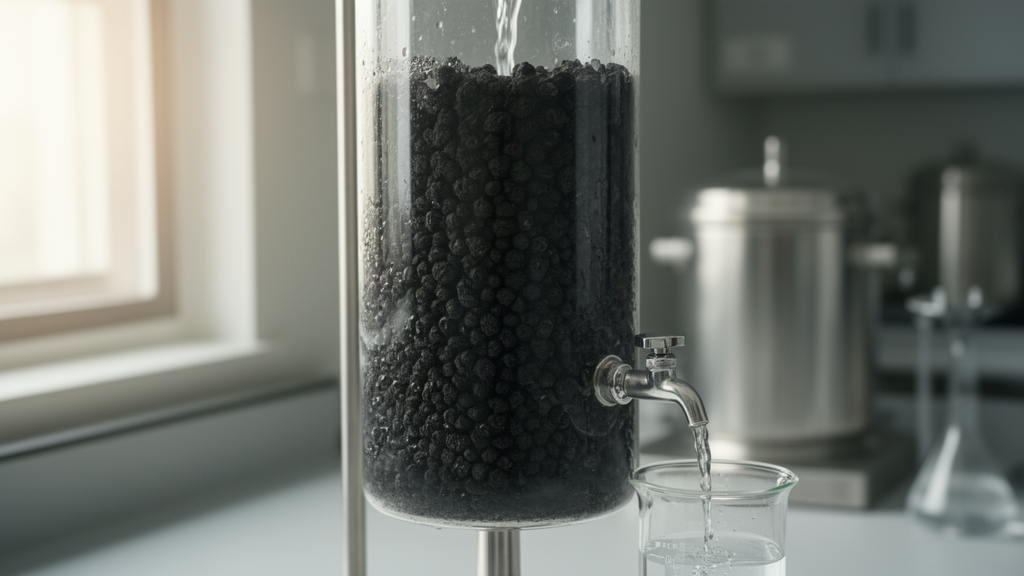
Researchers have turned an abundant forestry waste product into a low-cost adsorbent that removes manganese from contaminated water, and they have used statistical optimization to squeeze near-maximum performance out of it. In batch experiments, the resulting KOH-activated pinecone biochar removed up to 83.59 percent of Mn(II) ions from a 15 mg/L manganese solution under a precisely defined set of operating conditions.
The study, published in the journal Discover Molecules, addressed a contamination problem with both natural and industrial roots. Manganese enters groundwater through the weathering of manganese-rich rocks and through mining, alloy production, and metal processing. Concentrations as high as 2.8 mg/L have been reported in regions of Bangladesh, while Indian states including Orissa, Tamil Nadu, Maharashtra, and West Bengal frequently record levels above 0.5 mg/L. Similar exceedances have been documented in China, Argentina, and Iran. Although manganese is an essential trace micronutrient, chronic intake through drinking water can cause severe neurological effects, muscle rigidity, tremors, impaired coordination, and cognitive dysfunction. Elevated manganese also discolours water, imparts a metallic taste, and fouls distribution systems. The World Health Organization recommends a drinking-water limit of 0.4 mg/L, and India’s Bureau of Indian Standards sets a stricter limit of 0.3 mg/L under IS:10500-2012.
Conventional manganese treatment options include ion exchange, membrane filtration, oxidation-precipitation, electrocoagulation, and flotation, but these methods carry high energy demands, operational complexity, maintenance costs, and the risk of generating secondary pollutants. Adsorption offers a simpler and cheaper alternative, yet commercial activated carbon is expensive and typically derived from non-renewable feedstocks. Biochar made from agricultural and forestry residues provides a tunable surface area, pore structure, and functional group composition at a fraction of the cost, and valorizing pinecone waste aligns with circular economy principles. The authors state that, to their knowledge, this is the first study to investigate KOH-activated Pinus roxburghii pinecone biochar (KOH-PCB) for Mn(II) removal using RSM-based process optimization.
Characterization revealed why the activated material performs well. Scanning electron microscopy showed that raw biochar had a relatively compact, smooth surface lacking visible porosity, whereas KOH activation produced an extensively etched, porous architecture with a network of cavities and open pores. The researchers attribute this transformation to gas-evolving redox reactions between KOH and the carbon matrix during thermal treatment, which create fissures and increase surface roughness, exposing far more adsorption sites. Fourier transform infrared spectroscopy documented the accompanying chemical changes: the raw biochar displayed broad O-H stretching near 3400 cm⁻¹, aliphatic C-H bands near 2920 and 2850 cm⁻¹, a carbonyl C=O band around 1730 cm⁻¹, and aromatic C=C bands between 1600 and 1500 cm⁻¹. After activation, the O-H and C-H intensities dropped sharply, new bands appeared at 1384 and 875 cm⁻¹ corresponding to potassium carbonate formation, and the band at 1030 cm⁻¹ weakened, reflecting cleavage of ether bonds. These oxygen-containing functional groups, including hydroxyl, carbonyl, and ether moieties, serve as the binding sites for manganese ions.
The Box-Behnken design evaluates the main, interaction, and quadratic effects of multiple variables simultaneously with a limited number of experimental runs, and, as a design property, it excludes treatment combinations at the extreme corners of the experimental region, which is useful when extreme operating conditions are impractical.
The fitted model revealed how each parameter shapes manganese uptake. Removal efficiency increased with pH, peaking near pH 8, an effect the authors attribute to deprotonation of surface hydroxyl and carbonyl groups, which increases electrostatic attraction and coordination with Mn²⁺ ions. Raising the adsorbent dosage from 1 to 5 g/L markedly improved removal by supplying more active binding sites, and the ANOVA reported an F-value of 108.04 for dosage, higher than that of pH, while the effects of stirring speed and contact time were statistically lower than those of the other factors. Stirring speed enhanced diffusion of Mn(II) ions toward the biochar surface, but the benefit plateaued beyond roughly 250 rpm, likely because excessive turbulence can desorb ions already bound to the surface. Contact time improved removal up to about 45 minutes, after which the curve flattened as active sites approached saturation. Analysis of variance confirmed the model was highly significant, with an F-value of 31.29 and a p-value below 0.0001, while the quadratic terms were all significant, underscoring the non-linear character of the process. Interaction terms such as pH-dosage, pH-stirring speed, and dosage-contact time were not statistically significant, with p-values exceeding 0.05.
Solving the gradient condition of the fitted surface, and confirming a maximum through Hessian matrix analysis in which all eigenvalues were negative, yielded the optimum: pH 8.0, an adsorbent dosage of 5 g/L, a stirring speed of 229.4 rpm, and a contact time of 45.6 minutes. The quadratic regression model achieved a coefficient of determination of 0.9614, which the authors report as indicating a strong correlation between experimental and predicted removal values.
Isotherm and kinetic modelling added mechanistic depth. Equilibrium data were fitted to the Langmuir, Freundlich, and Temkin models, with the Freundlich isotherm showing a slightly higher coefficient of determination, 0.96 versus 0.93 for Langmuir. The Freundlich constant n was 4.76, indicating favourable adsorption on a moderately heterogeneous surface, while the Langmuir affinity constant of 0.85 L/mg reflected strong binding and the maximum monolayer capacity reached 9.31 mg/g. The Temkin equilibrium binding constant was 233.07, indicating strong initial interactions between Mn(II) ions and the KOH-PCB surface, and the authors state that the relatively high adsorption energy suggests specific surface interactions such as ligand exchange and surface complexation. Kinetic analysis showed the pseudo-second-order model described the data better than the pseudo-first-order model, with its predicted equilibrium capacity of 6.83 mg/g closely matching the experimentally determined value of 6.72 mg/g. This points to chemisorption involving electron sharing or exchange between the oxygen-containing functional groups and Mn(II) ions. The intraparticle diffusion model fit poorly, with a coefficient of determination of only 0.33, indicating that intraparticle diffusion was not the sole rate-controlling step; the authors attribute the kinetics to a combination of mass-transfer and surface-reaction processes, with the non-zero intercept indicating a contribution of boundary-layer resistance.
Based on these results, the authors propose that Mn(II) adsorption proceeds through a combination of electrostatic attraction, ion exchange, and surface complexation. At the optimum pH of 8.0, partial deprotonation of surface hydroxyl groups increases the negative charge of the biochar, and protons associated with those groups can be replaced by Mn²⁺ ions to form stable surface complexes. Lone-pair electrons on the oxygen atoms of carbonyl and hydroxyl groups can also coordinate directly with Mn(II) ions to form inner-sphere complexes. Changes in FTIR peak intensities after adsorption support the direct involvement of these functional groups in binding.
Reusability testing showed the material retains practical value over repeated use. Across three consecutive adsorption-desorption cycles using 20 mM hydrochloric acid as the desorbing agent, adsorption efficiency gradually declined with successive regeneration cycles, falling below 80 percent after the third cycle. The decline stems from incomplete desorption of strongly bound Mn(II) and progressive blockage of active sites and pores, since inner-sphere complexes are only partially released during acid regeneration. FTIR analysis of the residual sludge confirmed the participation of hydroxyl, carbonyl, and ether groups in metal binding. The authors conclude that pinecone-derived activated biochar is a viable, sustainable, and low-cost adsorbent for manganese remediation that valorizes an underutilized forestry residue within a circular economy framework.
Subject of Research: Optimization of Mn(II) adsorption from water using KOH-activated pinecone biochar designed via Box-Behnken response surface methodology
Article Title: Multi-parameter optimization of Mn(II) adsorption onto KOH-activated Pinus roxburghii biochar using Box-Behnken methodology
Article References: Choudhary, V., Dharmendra, & Kumar, S. (2026). Multi-parameter optimization of Mn(II) adsorption onto KOH-activated Pinus roxburghii biochar using Box-Behnken methodology. Discover Molecules, 3(1), Article 33. https://doi.org/10.1007/s44345-026-00075-7
Image Credits: AI Generated
DOI: 10.1007/s44345-026-00075-7
Keywords: manganese removal, biochar, Pinus roxburghii, KOH activation, adsorption, Box-Behnken design, response surface methodology, water treatment, pinecone waste, isotherm modelling, adsorption kinetics, circular economy
Cite Scienmag News
Bethany Barker. (October 28, 2026). Pinecone Biochar Strips Manganese From Water at 83.59% Efficiency. Scienmag. https://scienmag.com/pinecone-biochar-strips-manganese-from-water-at-83-59-efficiency/
Bethany Barker. "Pinecone Biochar Strips Manganese From Water at 83.59% Efficiency." Scienmag, 28 October 2026, https://scienmag.com/pinecone-biochar-strips-manganese-from-water-at-83-59-efficiency/. Accessed 29 October 2026.
Bethany Barker. "Pinecone Biochar Strips Manganese From Water at 83.59% Efficiency." Scienmag. October 28, 2026. https://scienmag.com/pinecone-biochar-strips-manganese-from-water-at-83-59-efficiency/