


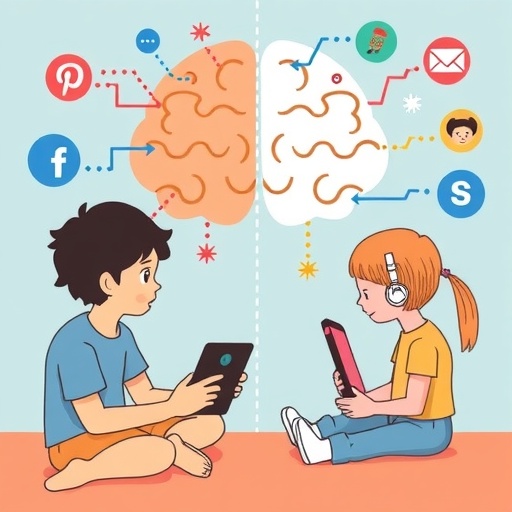
In a groundbreaking study poised to reshape our understanding of childhood development, researchers have unveiled how different types of extracurricular engagement distinctly influence the brain’s architecture and psychological well-being in children. The study, published in Translational Psychiatry, meticulously dissects how physical-digital versus social-nonsocial activities differentially sculpt young brains and affect mental health trajectories, highlighting the nuanced interplay between activity type, social context, and neurodevelopment.
The research marks a pivotal advance in developmental neuroscience by synergizing complex neuroimaging techniques with detailed psychological assessments to tease apart the subtle yet profound effects of extracurricular engagement. Children’s activities outside of formal schooling, often seen as mere hobbies or pastimes, emerge here as critical drivers that can accelerate or hinder key neural processes related to cognition, emotional regulation, and social functioning.
Central to the study’s inquiry was the distinction between physical-digital extracurriculars—activities that blend tactile, motion-based engagement often mediated by technology, such as interactive video games or augmented reality experiences—and social-nonsocial activities, which involve varying degrees of interaction but lack digital or physical intensity, like solitary reading groups or traditional board games. This bifurcation allowed for a rigorous exploration of how sensory-motor stimulation paired with digital complexity contrasts with predominantly social or solitary engagements in shaping the child brain.
Utilizing advanced longitudinal magnetic resonance imaging (MRI) data from a diverse cohort of children aged 7 to 12, the investigators traced the developmental trajectories of key brain regions. These included the prefrontal cortex, associated with executive functions such as decision-making and impulse control, and the limbic system, crucial for emotional processing and memory formation. The study observed that physical-digital engagement uniquely enhanced synaptic density and neural connectivity within sensorimotor and attentional networks.
Conversely, social-nonsocial engagement showed a distinct pattern, predominantly bolstering connectivity within brain regions linked to social cognition and empathy, such as the temporoparietal junction and medial prefrontal cortex. This divergence underscores that while both engagement types promote brain growth, they do so via separate neural pathways and mechanisms, each essential for balanced cognitive and emotional development.
Perhaps most strikingly, children involved primarily in physical-digital extracurriculars exhibited marked improvements in visuospatial skills and working memory capacity, suggesting these activities not only entertain but actively train underlying neural substrates associated with problem-solving and multitasking. However, these cognitive gains were occasionally accompanied by elevated markers of stress, such as increased amygdala reactivity, hinting at a complex cost-benefit trade-off.
On the psychological front, participation in social-nonsocial activities correlated with reduced symptoms of anxiety and depression, as measured by standardized clinical scales. These findings reinforce longstanding theories proposing that social connectedness and cooperative play are buffers against emotional distress, promoting resilience as children navigate the complexities of interpersonal relationships during key developmental windows.
The study’s integrative approach also incorporated behavioral analyses alongside neuroimaging to elucidate links between brain changes and real-world functioning. For example, children deeply engaged in physical-digital extracurriculars displayed enhanced adaptability and cognitive flexibility in problem-solving tasks, yet some showed diminished social responsiveness in peer interactions, spotlighting potential implications for social integration.
Importantly, the researchers emphasize the importance of balance and moderation. While physical-digital activities stimulate crucial cognitive domains, excessive immersion without robust social interaction might inadvertently tip the scales toward social detachment or heightened stress responses. Likewise, social-nonsocial pursuits without enrichment from sensory or cognitive challenges may limit certain aspects of brain plasticity critical for academic and technical skill acquisition.
Methodologically, the study’s use of multimodal imaging allowed an unprecedented peek into both gray and white matter development, revealing how different extracurricular engagements influence myelination patterns—a key process enhancing neural transmission speed and efficacy. These microstructural changes underpin the macroscopic improvements noted in cognitive and emotional faculties, emphasizing the biological foundation of behavioral outcomes.
The research team also took care to control for confounding variables including socioeconomic status, parental involvement, and baseline cognitive function, thereby strengthening the causal claims linking extracurricular activity type to neuropsychological development. This rigor lends credence to calls for policymakers and educators to reconsider how out-of-school activities are designed and promoted.
From a public health perspective, these findings carry wide-reaching implications. They argue for incorporating diverse, thoughtfully curated activity portfolios in childhood routines to promote holistic brain health and psychological well-being. Integrating physical-digital and social-nonsocial engagements may optimize the developmental milieu, leveraging the strengths of each to raise resilient, well-rounded individuals.
Future investigations will likely delve into the mechanistic underpinnings further, possibly exploring gene-environment interactions modulating responsiveness to various extracurriculars or extending follow-up durations to track long-term consequences into adolescence and adulthood. Additionally, refining digital tools to minimize stress while maximizing cognitive benefits could revolutionize educational technologies tailored for youth.
Ultimately, this landmark study not only enriches scientific discourse but also resonates with parents, educators, and clinicians seeking evidence-based guidance on supporting children’s growth amid an increasingly digital world. By decoding the distinct neural signatures and psychological outcomes associated with extracurricular engagement types, it champions a more intentional approach to childhood enrichment.
In an era where digital devices pervade every aspect of life, understanding how to harmonize technological and social experiences is paramount. This research provides a crucial stepping stone towards crafting environments where physical, digital, social, and nonsocial interactions collectively nurture developing brains and minds, forging healthier futures.
The study’s title succinctly encapsulates its core inquiry: “Physical-Digital and social-nonsocial extracurricular engagement: differential effects on brain development and psychological outcomes in children.” It stands as a testament to the powerful influence that seemingly routine activities wield, heralding a future where neuroscience informs childhood enrichment with precision and care.
As we move forward, embracing the complexity of childhood neurodevelopment necessitates continued dialogue between science, technology, and society. This study lays the foundation for such conversations, illuminating how the spaces children inhabit beyond the classroom shape their mental architecture and emotional resilience, ultimately influencing the adults they will become.
Cite Scienmag News
Glenn Wilkins. (April 16, 2026). Physical vs. Digital Activities Impact Kids’ Brain, Behavior. Scienmag. https://scienmag.com/physical-vs-digital-activities-impact-kids-brain-behavior/
Glenn Wilkins. "Physical vs. Digital Activities Impact Kids’ Brain, Behavior." Scienmag, 16 April 2026, https://scienmag.com/physical-vs-digital-activities-impact-kids-brain-behavior/. Accessed 3 September 2026.
Glenn Wilkins. "Physical vs. Digital Activities Impact Kids’ Brain, Behavior." Scienmag. April 16, 2026. https://scienmag.com/physical-vs-digital-activities-impact-kids-brain-behavior/


