


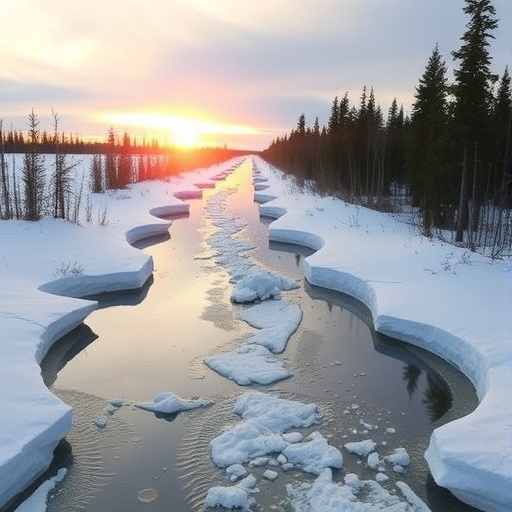
Permafrost is a daunting opponent to infrastructure stability, particularly in the fragile ecosystems of Northern Alaska. As climate change accelerates the thawing of permafrost, researchers are racing against time to understand the implications of this phenomenon. Recent advancements in high-resolution geomechanical modeling reveal an alarming increase in infrastructure risks attributable to permafrost degradation. The study undertaken by Wang, Xiao, and Nicolsky provides crucial insights into how ongoing environmental changes could affect existing and future constructions in these vulnerable regions.
In their groundbreaking study, the researchers utilized cutting-edge geomechanical modeling techniques that integrate various subsurface conditions. This sophisticated approach allows them to simulate different scenarios of permafrost thaw and its implications for infrastructure stability. The urgency of their findings stems from the reality that the permafrost layer acts as a foundational support for many structures, including roads, buildings, and oil pipelines. As it melts, the ground becomes unstable, leading to costly damages and significant safety hazards.
One of the critical revelations from the study is the rate at which permafrost is expected to thaw in response to rising global temperatures. The research predicts that certain areas of Northern Alaska may experience accelerated degradation patterns, posing an immediate risk to vital infrastructures. As temperatures continue to climb, the rate of thaw could exceed current budgetary plans for maintenance and refurbishment of these critical assets, resulting in catastrophic failures if proper measures are not implemented swiftly.
Another significant aspect of the study is its geographic focus. The areas assessed in the modeling exercise encompass several key infrastructures, including the Alaska Highway, which serves as a vital transportation corridor. This highway, along with numerous smaller roads, is already feeling the effects of climate change. With projections suggesting that permafrost will thaw more rapidly than previously believed, the integrity of this transportation network comes under threat, necessitating urgent attention from policymakers.
What sets this research apart is its high-resolution modeling, which provides detailed insight into the layers of permafrost beneath the surface. Traditional models often generalized conditions across broader areas, which can obscure the specific risks associated with unique local topographies and soil types. By drilling down to these finer details, the researchers have set new standards for assessing geomechanical risks associated with permafrost, allowing for more informed decision-making in infrastructure planning.
What’s particularly concerning is the potential cascading effects of infrastructure deterioration as it relates to ecological impacts. The study suggests that compromised roads and pipelines can lead to increased environmental degradation, including the release of greenhouse gases previously trapped in the permafrost. This feedback loop not only exacerbates climate change; it can also severely hinder mitigation efforts by obstructing transportation and access to essential resources necessary for addressing these environmental challenges.
The findings also call into question existing engineering approaches, which may not sufficiently account for the nuances of a warming climate. Current designs often rely on historical data that fails to forecast the rapid changes underway. The study suggests that engineers must adapt their methodologies to incorporate climate adaptability, ensuring that future constructions can withstand the uncertainties posed by permafrost thaw.
Furthermore, the researchers explored potential adaptive measures to mitigate risks associated with permafrost degradation. This includes designing structures that are resilient to ground movement, employing thermos-regulatory systems that could help maintain permafrost integrity, and utilizing materials that can withstand temperature fluctuations. By proactively integrating these features into planning phases, future investments in infrastructure could be safeguarded against the impacts of thawing permafrost.
An equally important aspect of the study is its implications for local communities. Indigenous populations and remote settlements in Northern Alaska heavily rely on the stability of the infrastructure for their day-to-day lives. The loss of fundamental services due to infrastructure failures could have life-altering consequences for these communities. Hence, the research highlights the need for inclusive consultation processes that engage local voices in planning and decision-making.
Given the extensive and multifaceted implications of their findings, the authors of the study stress the need for immediate action. Policymakers must prioritize adaptations that address the challenges of climate change and permafrost degradation. As global temperatures rise, strategies need to be developed not only to repair existing infrastructures but also to fundamentally rethink how we approach the construction of new buildings and pathways in these vulnerable terrains.
In conclusion, Wang, Xiao, and Nicolsky’s research underlines the urgent nature of the challenges posed by permafrost degradation. High-resolution geomechanical modeling has illuminated the complexities involved in understanding and responding to the risks associated with thawing permafrost in Northern Alaska. Without timely and decisive measures, the infrastructure that sustains these communities faces grave threats, underscoring the need for a concerted global response to the realities of climate change.
The research sheds light on an issue that is not just about structural integrity but also about the resilience of communities residing in these precarious environments. As we move forward, it becomes imperative that we listen to the insights drawn from dedicated research like this one. Our ability to adapt to these inevitable changes will ultimately determine the sustainability of our infrastructure and the communities that depend on it.
Shifting landscapes, treacherous thaws, and accelerating climate change put Northern Alaskan infrastructures under siege. The implications of this study extend far beyond academia, issuing a rallying cry for industry leaders, engineers, and environmentalists alike to recognize the approaching crisis and to act decisively before it is too late. The legacy of our actions today will resonate for generations to come, forging a path through the uncertainty and into a more sustainable future.
In the face of immense challenges, the trajectory of urban planning, infrastructure development, and emergency response strategies will need to evolve. The researchers’ work can provide the foundation for this evolution, leading us toward more resilient communities and effective governance mechanisms. Time is of the essence, and stakeholders across sectors must unite to navigate this complex terrain.
Cite Scienmag News
Violet Maxwell. (January 24, 2026). Permafrost Thaw Threatens Northern Alaska Infrastructure Safety. Scienmag. https://scienmag.com/permafrost-thaw-threatens-northern-alaska-infrastructure-safety/
Violet Maxwell. "Permafrost Thaw Threatens Northern Alaska Infrastructure Safety." Scienmag, 24 January 2026, https://scienmag.com/permafrost-thaw-threatens-northern-alaska-infrastructure-safety/. Accessed 4 September 2026.
Violet Maxwell. "Permafrost Thaw Threatens Northern Alaska Infrastructure Safety." Scienmag. January 24, 2026. https://scienmag.com/permafrost-thaw-threatens-northern-alaska-infrastructure-safety/


