


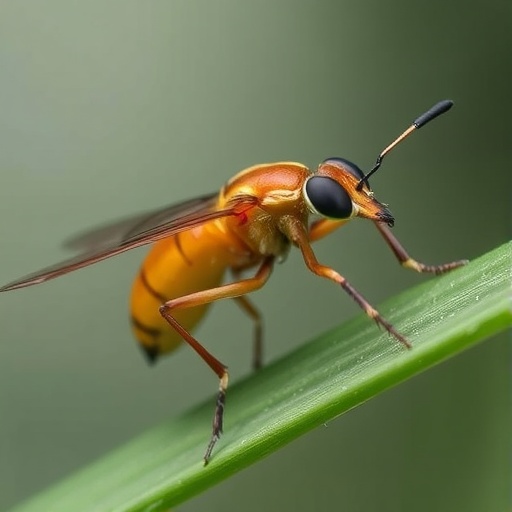
In an era increasingly dominated by environmental challenges, the unseen consequences of air pollution reach far deeper than the obvious degradation of natural landscapes and human health. A groundbreaking study conducted by Langford, Williams, and Casas, recently published in Communications Earth & Environment, reveals the subtle yet profound ways in which air pollution disrupts insect chemical communication. This new research offers a vivid lens through which to consider the intricate and delicate interactions underlying ecosystems, where airborne pollutants interfere with the language of scent, echoing ecological and evolutionary alarms.
Insects rely heavily on chemical signals — pheromones — to navigate their environment, locate mates, find food sources, and avoid predators. These pheromones are minute molecules emitted into the air, traveling through atmospheric currents to reach intended recipients often at remarkable distances. However, the study highlights that the increasing prevalence of air pollutants such as nitrogen oxides, ozone, and particulate matter alters the chemical integrity of these signals. Pollutants chemically react with pheromone molecules, degrading them, masking their presence, or even changing their structure in irreversible ways. This phenomenon undermines the ability of insects to successfully interpret crucial communication cues.
The researchers meticulously inspected various insect species known for their reliance on chemical signaling, including moths and bees. Their findings elucidate that not all species are impacted equally; instead, the effects are differential, depending on the molecular nature of the pheromones, the environmental context, and species-specific ecological adaptations. For instance, moth species emitting pheromones with more reactive chemical groups suffered greater signal degradation in environments with high ozone levels. Conversely, some bee species relying on more robust chemical signals showed relative resistance, suggesting varying vulnerability within insect communities.
Methodologically, the research employed advanced atmospheric chemistry modeling combined with controlled laboratory experiments. By simulating pollutant concentrations representative of urban, suburban, and rural settings, the scientists recreated the atmospheric journeys pheromones undertake. They tracked the degradation rates with sophisticated mass spectrometry and gas chromatography techniques, mapping out chemical transformations that occur in polluted air. This comprehensive approach allowed for an unprecedented understanding of how each pollutant type interacts with specific pheromone molecules over time and space.
The implications are profound: as pheromone signals diminish or distort, insect behaviors essential to reproduction and survival are compromised. The breakdown of communication leads to reduced mating success, inefficient foraging, and increased vulnerability to predators — all factors contributing to population declines already observed in many insect species globally. Given insects’ roles as pollinators, prey, and ecosystem engineers, these disruptions cascade beyond individual species to impact broader ecological networks and even agricultural productivity.
Moreover, the study emphasizes a feedback loop exacerbating environmental degradation. Insects that fail to reproduce effectively cannot perform their ecological services, leading to poorer pollination and diminished plant diversity, which in turn affects carbon sequestration and stabilizes the climate. Such complexities underscore the interwoven nature of chemical, biological, and atmospheric sciences in understanding environmental crises.
One of the more startling revelations lies in the spatial variability of these effects. Urban centers with elevated pollutant concentrations impose harsher chemical environments compared to rural areas, potentially creating ecological “communication deserts” where signaling molecules degrade rapidly and signals become undetectable. This spatial disparity could lead to fragmentation of insect populations and reduce genetic flow, further threatening biodiversity.
In terms of solutions, Langford and colleagues advocate for integrating insect chemical communication considerations into air quality management and conservation strategies. Pollution mitigation efforts, particularly those targeting ozone and reactive nitrogen species, are paramount not only for human health but equally for preserving the invisible chemical dialogues of insect communities. Enhanced monitoring of atmospheric compositions combined with ecological surveys could guide interventions to protect vulnerable species and habitats.
The study also reveals opportunities for innovative technological advancements. Developing artificial pheromone analogs resistant to chemical breakdown could support insect conservation and agricultural pest control by stabilizing signal propagation even in polluted environments. Similarly, biotechnological approaches to enhancing chemical resilience in pheromone production or signaling pathways might offer new avenues for ecological adaptation amidst ongoing environmental stressors.
What makes this research uniquely compelling is its demonstration of how anthropogenic pollutants reach into the microscopic world of insect communication, affecting processes fundamental to life on Earth while eluding everyday human perception. By shining light on this invisible disruption, the authors invite a new dimension of environmental awareness that bridges atmospheric chemistry with ecology, urging interdisciplinary collaboration to mitigate unforeseen ecological damages.
Furthermore, the study questions previously held assumptions about the uniformity of pollution impacts, instead presenting a nuanced picture where species-specific chemical interactions dictate ecological outcomes. This paradigm shift calls for more targeted ecological risk assessments and tailored conservation efforts that recognize the complexity and variability inherent in chemical communication systems.
Notably, the research builds upon a rich body of chemical ecology but fills a critical gap by quantifying atmospheric chemical interactions in real-world conditions, moving beyond speculative or qualitative assessments. The approach offers a model for future studies investigating other signaling modalities susceptible to environmental interference, such as acoustic signals disrupted by noise pollution.
As the climate crisis converges with rising air pollution, these findings highlight a concerning synergy capable of accelerating insect declines. Changes in temperature and humidity can affect chemical reaction rates and pheromone volatility, further complicating communication. This interplay underscores the urgent need for integrated policies addressing both climate change and air quality to safeguard the integrity of biological signaling.
In conclusion, Langford, Williams, and Casas provide a clarion call urging scientists, policymakers, and the public to consider air pollution’s cryptic yet devastating consequences on insect chemical communication. By unraveling the molecular dialogues beneath our atmosphere, their work opens new frontiers in environmental science and underscores that the invisible, intangible traces of pollution are changing the very ways life talks, mates, and survives. Protecting these delicate chemical conversations is vital for preserving biodiversity, ecological resilience, and ultimately, humanity’s own future on this planet.
Cite Scienmag News
Gavin Prescott. (May 16, 2026). How Air Pollution Disrupts Insect Chemical Signals. Scienmag. https://scienmag.com/how-air-pollution-disrupts-insect-chemical-signals/
Gavin Prescott. "How Air Pollution Disrupts Insect Chemical Signals." Scienmag, 16 May 2026, https://scienmag.com/how-air-pollution-disrupts-insect-chemical-signals/. Accessed 4 September 2026.
Gavin Prescott. "How Air Pollution Disrupts Insect Chemical Signals." Scienmag. May 16, 2026. https://scienmag.com/how-air-pollution-disrupts-insect-chemical-signals/


