


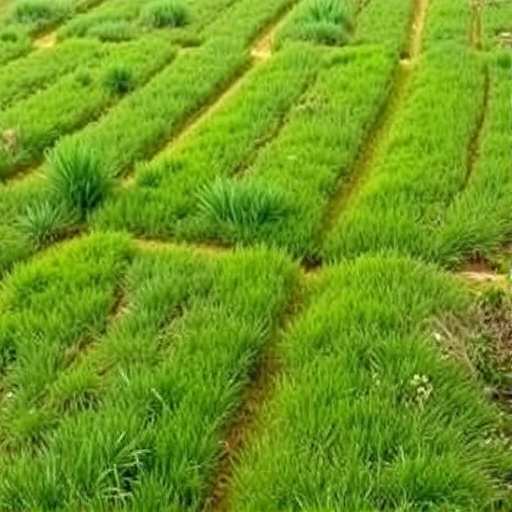
Over recent decades, the global landscape of grasslands has undergone profound transformation, marked particularly by the intensification of fragmentation. A pioneering study led by Zhang, Li, Yan, and colleagues, published in Communications Earth & Environment in 2026, delves deep into the accelerating fragmentation of grasslands worldwide and its divergent impacts on vertebrate biodiversity. This research represents one of the most comprehensive assessments to date, shedding new light on the spatial and ecological dynamics shaping one of Earth’s most vital biomes.
Grasslands cover approximately 20-40% of the Earth’s terrestrial surface, functioning as critical habitats for a rich array of vertebrate species. These ecosystems provide essential services, including carbon sequestration, soil preservation, and support for agricultural economies. However, anthropogenic pressures such as agricultural expansion, urban development, and infrastructure projects have increasingly dissected continuous grassland habitats into smaller, isolated patches. Zhang et al.’s study methodically quantifies these changes, utilizing advanced remote sensing technologies combined with a global biodiversity database, offering an unprecedented temporal and spatial resolution in fragmentation analysis.
The research leverages satellite imagery spanning multiple decades alongside machine learning algorithms to detect patterns of grassland loss and fragmentation at a global scale. This approach enables a dynamic understanding of landscape changes not just in static snapshots, but as processes unfolding over time. The study highlights that fragmentation is not merely about the reduction of habitat area but involves the increasing isolation of patches, altering ecological connectivity and habitat quality in profound ways that standard deforestation metrics often overlook.
One of the study’s critical findings is that fragmentation intensity does not occur uniformly across the globe. The authors identify “hotspots” where fragmentation rates are accelerating most rapidly, often coinciding with regions under intense agricultural pressures or urban expansion. Contrastingly, some regions with relatively stable or well-managed landscapes exhibited slower fragmentation or even partial recovery, underscoring the role of policy and land management in mediating ecological outcomes.
These uneven fragmentation dynamics have complex consequences for vertebrate biodiversity. The study integrates species distribution models to assess how different taxa respond to these changing landscapes. Some species, especially highly specialized or habitat-sensitive vertebrates such as certain grassland birds and small mammals, show significant declines correlated with increased fragmentation. Meanwhile, generalist species or those able to utilize edge habitats sometimes exhibit resilience or even population increases, illustrating the multifaceted nature of biodiversity responses.
Moreover, the paper emphasizes that fragmentation impacts extend beyond species richness to affect community composition, gene flow, and ecosystem functionality. Fragmented habitats often experience altered predator-prey dynamics, reduced reproductive success, and increased vulnerability to invasive species. These ecological shifts potentially disrupt food webs and nutrient cycles integral to grassland health, illustrating how spatial patterns of fragmentation cascade into broader ecosystem instability.
A key innovation of Zhang et al.’s research is their application of a novel connectivity index tailored to grassland environments. This metric combines patch size, isolation distance, and matrix permeability, providing a more ecologically meaningful measure for vertebrate movement potential. By applying this index globally, the study offers tangible insights into which landscapes are most at risk of functional breakdown and where conservation efforts might be prioritized to maintain connectivity.
Importantly, the paper discusses how human land-use strategies can modulate fragmentation impacts. For instance, integrating wildlife corridors into agricultural matrices, promoting sustainable grazing, and safeguarding remnant patches have shown promise in mitigating adverse effects. The researchers advocate for landscape-scale planning approaches that reconcile human livelihoods with biodiversity conservation, emphasizing the necessity for interdisciplinary frameworks involving ecologists, policymakers, and local communities.
The implications of this research resonate strongly with ongoing debates about biodiversity loss and ecosystem resilience amid climate change. Grassland fragmentation decreases ecosystem adaptability by hindering species’ abilities to shift ranges in response to changing climatic conditions. The authors argue that preserving contiguous grassland networks is essential to enhance ecological resilience, support genetic diversity, and maintain ecosystem services critical for human well-being.
Furthermore, the study’s findings bear relevance to sustainable development goals by highlighting grasslands as hotspots of both biodiversity and human economic activity. The dual pressures of feeding a growing global population and conserving natural habitats demand innovative trade-offs and interventions, such as agroecological intensification and restoration ecology practices that can reverse fragmentation trends.
In addition to its empirical contributions, the study serves as a call to action for the global scientific and conservation community. Zhang et al. identify significant data gaps, particularly in under-studied tropical and temperate grasslands where vertebrate biodiversity may be most vulnerable. They underscore the importance of expanding monitoring networks and refining predictive models to better anticipate future fragmentation trajectories and their cumulative impacts.
In conclusion, this groundbreaking work points to a future where grasslands continue to be shaped by human choices, either falling prey to further fragmentation or recovering under concerted conservation efforts. The uneven consequences for vertebrate biodiversity revealed by this study highlight the urgency of global cooperation to manage landscapes intelligently. By bridging remote sensing, biodiversity assessment, and ecological theory, Zhang and colleagues provide a powerful scientific foundation upon which to build targeted interventions aimed at safeguarding the ecological and societal values embedded in the world’s grasslands.
As governments and conservation organizations worldwide grapple with balancing development and environmental stewardship, this research offers invaluable tools and insights. It exemplifies how cutting-edge technology, coupled with deep ecological understanding, can illuminate hidden patterns and guide decisive action. The fate of global grasslands and their vertebrate inhabitants now hinges on our ability to translate this knowledge into effective policies, creating landscapes that sustain life in all its complexity.
Cite Scienmag News
Margaret Porter. (May 16, 2026). Grassland Fragmentation Threatens Vertebrate Biodiversity Unevenly. Scienmag. https://scienmag.com/grassland-fragmentation-threatens-vertebrate-biodiversity-unevenly/
Margaret Porter. "Grassland Fragmentation Threatens Vertebrate Biodiversity Unevenly." Scienmag, 16 May 2026, https://scienmag.com/grassland-fragmentation-threatens-vertebrate-biodiversity-unevenly/. Accessed 4 September 2026.
Margaret Porter. "Grassland Fragmentation Threatens Vertebrate Biodiversity Unevenly." Scienmag. May 16, 2026. https://scienmag.com/grassland-fragmentation-threatens-vertebrate-biodiversity-unevenly/


