


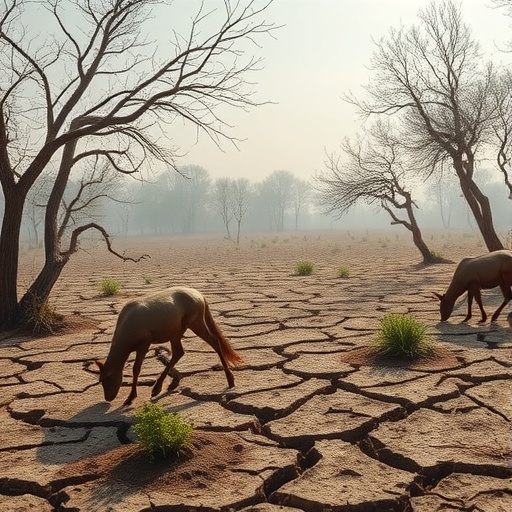
As global temperatures continue their relentless climb due to anthropogenic climate change, the repercussions for ecosystems and biodiversity have become increasingly dire. Among these consequences, drought emerges as a particularly insidious threat to terrestrial vertebrates, whose survival hinges on stable and accessible freshwater resources. A pioneering study conducted by He, Sun, Wei, and colleagues, published in Nature Communications in 2026, offers compelling evidence that limiting future global warming can dramatically decrease the drought exposure experienced by these critical wildlife populations, thus illuminating a potential path to safeguarding biodiversity in an era of climate uncertainty.
Terrestrial vertebrates—encompassing mammals, birds, reptiles, and amphibians—are intricately dependent on their hydrological environment for survival, reproduction, and migration. Drought, characterized by prolonged periods of abnormally low precipitation and diminished soil moisture, directly threatens these species by reducing habitat suitability, increasing physiological stress, and constraining food availability. The study in question leverages sophisticated climate models integrated with ecological niche analyses to quantify how future scenarios of greenhouse gas emissions and temperature increases will modulate drought exposure across global terrestrial vertebrate populations.
Using an ensemble of earth system models aligned to the Representative Concentration Pathways (RCPs) and Shared Socioeconomic Pathways (SSPs), the researchers analyzed drought metrics such as precipitation deficits and soil moisture anomalies projected over the 21st century. These climate variables were then superimposed onto spatial distribution datasets of thousands of vertebrate species, enabling the identification of those populations most vulnerable under different warming trajectories. The innovation of this integrative approach lies in its ability to bridge climatology and conservation biology, generating robust forecasts that are directly translatable to conservation policy and action.
The results are stark yet hopeful. Under a high-emission scenario approximating 4°C warming above preindustrial levels by 2100, an alarmingly large portion of terrestrial vertebrate habitats will experience severe, recurrent drought conditions. This exposure not only rises in frequency but also intensifies in magnitude, creating a cascade of biological stressors that may push many species towards local or global extinction thresholds. Conversely, scenarios that limit warming to below 2°C exhibit a marked attenuation of drought severity and frequency, suggesting that ambitious mitigation efforts could substantially reduce the existential threats facing myriad vertebrate species.
A critical insight from the study is the spatial heterogeneity of drought risk. Tropical and subtropical regions, rich in biodiversity hotspots, are predicted to face disproportionate increases in drought stress, amplifying existing threats such as habitat fragmentation and land-use change. Moreover, montane ecosystems, often considered refugia for climate-sensitive species, are not immune—projected changes in snowmelt dynamics and soil moisture could undermine their protective role. The analysis underscores the necessity of regionally tailored conservation strategies that incorporate projected climatic stressors into management plans.
Biological responses to drought are multifaceted, encompassing physiological, behavioral, and demographic dimensions. Reduced water availability can impair thermoregulation, reproductive success, and immune function, while behavioral adaptations such as altered migratory or feeding patterns may not suffice in severely degraded environments. The study emphasizes the urgency of integrating mechanistic understanding of species’ drought tolerance into models predicting future vulnerability, thereby refining risk assessments and prioritizing conservation resources more effectively.
Interestingly, this research also touches on the feedback loops between vegetation dynamics and drought conditions. Vegetation acts as a critical mediator of microclimates and water cycles; however, drought-induced stress can lead to vegetation dieback, which in turn exacerbates soil moisture deficits and local climate extremes. Such vegetation-climate feedbacks pose additional threats to terrestrial vertebrates through habitat degradation and reduced primary productivity, highlighting the interconnectedness of ecological and climatic systems.
From a methodological viewpoint, the researchers confronted challenges inherent in coupling climate outputs with biological data. Resolution disparities, uncertainties in species range maps, and variability in physiological drought sensitivities necessitated rigorous validation and sensitivity analyses. Their approach, employing cross-validation with historical drought and species occurrence data, strengthens the confidence in their projections, setting a new standard for interdisciplinary climate-biodiversity research.
The implications of this study extend beyond academic inquiry, directly informing international biodiversity conservation frameworks and climate policy agendas. It provides empirical support for the conservation community’s calls to adhere to the Paris Agreement’s temperature goals, framing them not only as climate mitigation targets but as essential for the preservation of terrestrial vertebrate diversity. This interconnection between global climate policy and local biodiversity outcomes illustrates an urgent, multifaceted challenge facing humanity.
Importantly, the authors highlight the role of adaptive management strategies in mitigating drought impacts. In addition to emission reductions, protecting and restoring freshwater habitats, establishing climate corridors, and enhancing landscape connectivity emerge as essential actions. These strategies can buffer species from climatic extremes and enable movement to more hospitable environments, thus increasing resilience in the face of unavoidable warming.
Furthermore, the study anticipates future research trajectories, advocating for enhanced monitoring of groundwater reserves, incorporating intraspecific variation in drought tolerance, and expanding the scope to include aquatic vertebrates. In doing so, a more comprehensive understanding of hydrological impacts across ecosystems can be developed, empowering more nuanced and effective conservation responses.
The urgency of addressing drought exposure for terrestrial vertebrates cannot be overstated. Climate-induced drought threatens to unravel ecosystem functions and services vital not only to wildlife but also to human societies. This research cements the importance of immediate and concerted global action to curtail warming and implement adaptive management, painting a hopeful yet cautionary picture of the intertwined fates of climate and biodiversity.
By systematically illuminating the mechanistic links between global warming thresholds and drought stress on terrestrial vertebrates, He and colleagues have charted a critical course for future conservation under climate change. Their findings serve as a clarion call for policymakers, conservationists, and the public alike: the battle against climate change is also a battle for the diverse animal kingdoms inhabiting our planet’s fragile terrestrial realms.
In this unprecedented era of environmental transformation, studies such as this one push the boundaries of interdisciplinary science, leveraging complex datasets and advanced modeling to decode nature’s responses to human actions. The message is unequivocal—limiting future warming is paramount not only to slow climate change but to preserve the rich tapestry of wildlife that sustains ecological balance and enriches human existence.
In conclusion, the evidence presented reaffirms the critical window available to humanity for decisive climate action. As nations convene and environmental policies evolve, integrating these scientific insights into actionable frameworks holds the key to fostering resilient ecosystems capable of weathering the droughts and other climatic perturbations that lie ahead.
Cite Scienmag News
Margaret Porter. (May 16, 2026). Limiting Warming Lowers Drought Risk for Vertebrates. Scienmag. https://scienmag.com/limiting-warming-lowers-drought-risk-for-vertebrates/
Margaret Porter. "Limiting Warming Lowers Drought Risk for Vertebrates." Scienmag, 16 May 2026, https://scienmag.com/limiting-warming-lowers-drought-risk-for-vertebrates/. Accessed 3 September 2026.
Margaret Porter. "Limiting Warming Lowers Drought Risk for Vertebrates." Scienmag. May 16, 2026. https://scienmag.com/limiting-warming-lowers-drought-risk-for-vertebrates/


