


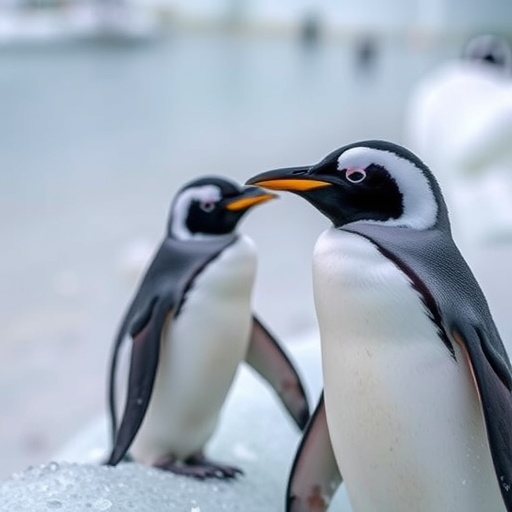
In a groundbreaking study blending wildlife biology and environmental science, Magellanic penguins roaming the Patagonian coast of Argentina have been transformed into living sentinels of their own ecosystem’s chemical health. Equipped with innovative silicone passive samplers strapped around their legs, these penguins provided unprecedented real-time data on the presence and spread of per- and polyfluoroalkyl substances (PFAS), commonly referred to as “forever chemicals.” This method marks a significant advancement beyond traditional invasive sampling techniques like blood draws or feather analysis, offering a minimally intrusive yet highly informative window into environmental pollution.
The researchers from the University of California, Davis, and the State University of New York at Buffalo implemented this study during the penguins’ breeding seasons between 2022 and 2024. The silicone bands, designed to absorb contaminant molecules directly from the environment, were gently affixed to 54 individual Magellanic penguins. As the birds went about their natural behaviors—diving for fish, navigating coastal waters, and nesting on rocky shores—the samplers continuously collected chemical residues from water, air, and physical substrates. This passive sampling thus captured a molecular snapshot of the contaminants these marine animals encounter daily in their habitat.
Upon retrieval, the silicone samplers were analyzed at SUNY Buffalo’s laboratories, revealing a disturbing ubiquity of PFAS compounds. Notably, more than 90% of the collected bands tested positive for these synthetic fluorinated chemicals, highlighting how pervasive these pollutants have become even in remote ecosystems far from industrial hubs. PFAS chemicals are notorious for their environmental persistence and bioaccumulative nature, raising profound concerns about their long-term ecological and health impacts.
Dr. Ralph Vanstreels, a wildlife veterinarian at UC Davis and co-corresponding author, expressed enthusiasm about this pioneering approach. He noted that prior methods for assessing contaminant exposure generally involved invasive procedures, which could stress or harm the animals under study. The silicone bands, by contrast, leverage the penguins’ natural movements to survey their surroundings with minimal interference. “The penguins effectively select the sampling sites themselves, revealing hotspots of contamination naturally, which is a game-changer in environmental monitoring,” Dr. Vanstreels elaborated.
Intriguingly, chemical analyses indicated a complex mixture of both legacy PFAS compounds and newer replacement chemicals introduced after the phasing out of older substances. This finding suggests dynamic shifts in pollutant profiles over time, driven by regulatory changes and industrial innovation. The detection of GenX and other contemporary PFAS variants points to ongoing industrial emissions, emphasizing that substituting one chemical for another may not eliminate environmental risks but rather shift their nature or distribution.
Senior author Professor Diana Aga, a distinguished chemist at SUNY Buffalo, highlighted the broader implications of these results. She emphasized that newer PFAS compounds, despite being marketed as safer alternatives, remain environmentally persistent and readily disperse into even the planet’s most isolated ecosystems. This global dissemination poses serious challenges for wildlife conservation and environmental health since these chemicals can bioaccumulate and potentially disrupt biological functions in exposed organisms far downstream of emission sources.
By harnessing these non-invasive silicone samplers, scientists now have a powerful tool applicable to a diverse range of aquatic environments, including those notoriously difficult to sample effectively due to challenging geography or logistics. Besides monitoring background PFAS contamination, this method could be pivotal in responding to acute pollution events such as oil spills, maritime accidents, or industrial releases, providing swift assessments of chemical impact zones that guide mitigation efforts.
Looking ahead, the research team aims to expand this sentinel species approach to other marine and aquatic birds with differing ecological niches and behaviors. For example, cormorants, which dive deeper into ocean waters than penguins, may offer complementary insights into vertical pollutant gradients and deep-water contamination. This approach could enable a multi-species monitoring network delivering fine-scale spatiotemporal data on chemical burdens affecting marine ecosystems, enhancing conservation strategies and public awareness.
Marcela Uhart, director of Latin American programs at UC Davis’s Wildlife Health Center and a coauthor, underscored the transformative potential of this innovation for communicating conservation challenges. “Turning penguins into environmental sentinels creates an accessible narrative linking wildlife health with global chemical pollution. This resonates not only with scientists but also the general public, policymakers, and stakeholders invested in protecting marine biodiversity and oceanic environments,” she explained.
This study was supported financially by the Houston Zoo, and involved a collaborative international team including ecologists and chemists from institutions in Argentina under CONICET and researchers from both UC Davis and SUNY Buffalo. The integration of chemistry, veterinary science, and ecology in this work exemplifies interdisciplinary research necessary to tackle complex issues like environmental pollution in a changing world.
The implications of this research stretch beyond academic interest, presenting a scalable, adaptable environmental diagnostic platform that may revolutionize how scientists monitor chemical contaminants across the globe. As pressure mounts to regulate persistent pollutants and develop sustainable chemical alternatives, tools that map contamination patterns in real time empower more informed decisions to safeguard both wildlife and human communities alike.
By leveraging the oceanic journeys of penguins and other marine birds, scientists have unlocked a dynamic method that turns nature’s own survivors into vigilant guardians of the environment’s chemical pulse—offering hope for unraveling the tangled legacy of persistent pollutants and advancing global conservation efforts.
Cite Scienmag News
Russell Cooper. (April 8, 2026). Penguin ‘Toxicologists’ Detect PFAS Chemicals in Pristine Patagonia Environment. Scienmag. https://scienmag.com/penguin-toxicologists-detect-pfas-chemicals-in-pristine-patagonia-environment/
Russell Cooper. "Penguin ‘Toxicologists’ Detect PFAS Chemicals in Pristine Patagonia Environment." Scienmag, 8 April 2026, https://scienmag.com/penguin-toxicologists-detect-pfas-chemicals-in-pristine-patagonia-environment/. Accessed 3 September 2026.
Russell Cooper. "Penguin ‘Toxicologists’ Detect PFAS Chemicals in Pristine Patagonia Environment." Scienmag. April 8, 2026. https://scienmag.com/penguin-toxicologists-detect-pfas-chemicals-in-pristine-patagonia-environment/


