


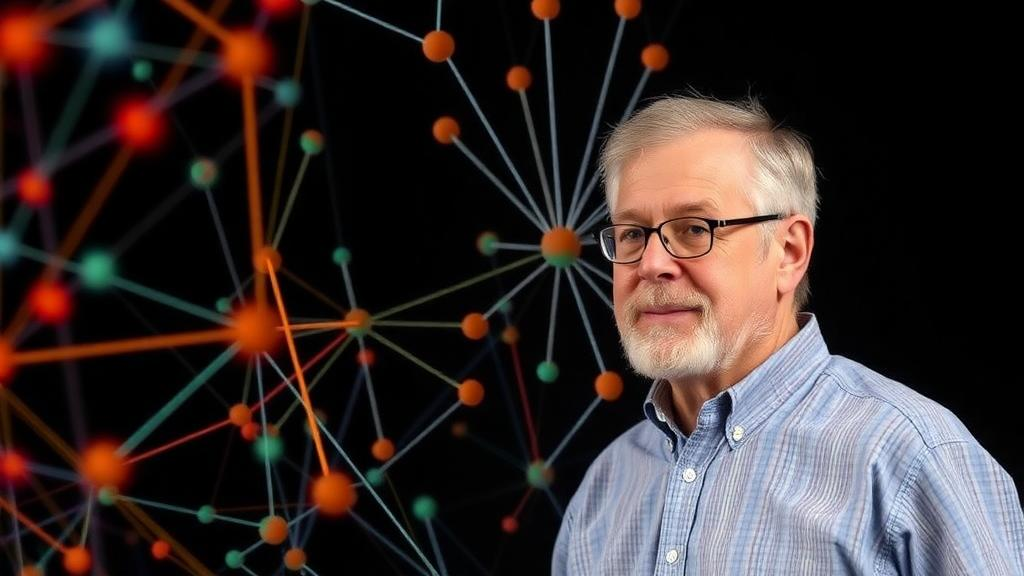
The global life sciences community is mourning Peer Bork, the visionary computational biologist whose work helped define an entire discipline and whose influence stretched from protein networks to the microbes of Europe’s coastlines. Bork passed away recently at the age of 62, leaving what colleagues describe as a profound void in science and in the lives of the many researchers he mentored, collaborated with, and inspired over a career spanning more than three decades. Writing about him in the past tense, as his longtime collaborator Jan O. Korbel has noted, still feels unnatural to those who knew him.
For many scientists, Bork was above all a pioneer who helped establish computational biology as a major discipline in the life sciences. For those who worked alongside him more closely, he was something more personal: a mentor and manager, a collaborator, a scientific compass, and a friend. His influence shaped not only entire research fields but also the intellectual journeys and careers of generations of scientists, many of whom now lead laboratories and companies across the world.
Bork’s scientific career was remarkable in its breadth, its depth, and his foresight regarding future developments in biology. Born in 1963 in the former East Germany, he began his scientific life working with Jens Reich in Berlin at the Central Institute for Molecular Biology of the Academy of Sciences of the German Democratic Republic, where he completed his PhD research in biochemistry. It was an unusual starting point for someone who would go on to become one of the most influential figures at the intersection of biology and computation, but it instilled in him an early appreciation for rigorous, quantitative thinking applied to living systems.
Following Germany’s reunification in 1990, Bork moved quickly. In 1991, he joined the European Molecular Biology Laboratory in Heidelberg with an EMBO fellowship, working with Chris Sander. In doing so, he entered a research environment he later referred to as uniquely enabling, providing fertile ground for his talent and vision to pursue a seamless interdisciplinary integration of biology and computation. Over more than three decades at EMBL, he produced groundbreaking science and contributed substantially to shaping the institution itself. He served for many years as Head of the Structural and Computational Biology Unit, later became Director of EMBL Heidelberg, and thereafter served as EMBL’s Interim Director General.
His scientific contributions spanned an extraordinary range of topics, including genome analysis, protein function and structure prediction, protein interaction networks, drug–target relationships, microbiome research, evolutionary biology, and planetary biology. Among many seminal contributions, Bork played a key role in developing computational approaches for predicting protein function and interaction networks, as well as for the analysis of metagenomes, the complete collection of genetic material from all organisms in a given environmental sample. These methods transformed how researchers extract biological meaning from the flood of sequence data generated by modern genomic technologies, turning raw information into testable hypotheses about how proteins work, how they interact, and how organisms relate to one another.
Bork’s scientific curiosity rarely stopped at the established boundaries of fields. Long before research on microbiomes became mainstream, he recognised the immense biological and medical importance of microbial communities. He helped demonstrate that microbiomes are not merely collections of microorganisms but dynamic ecosystems that influence environmental processes and human health. His work identifying gut microbial community structures, so-called enterotypes, changed how scientists conceptualise microbial variation among individuals, suggesting that human gut communities fall into recognisable patterns with potential consequences for health and disease. His contributions to disease research using microbiome analysis were equally remarkable: by identifying microbial markers associated with conditions such as colon or pancreatic cancer and obesity, his research helped open new avenues for diagnostic and therapeutic exploration.
One of his most inspiring initiatives was the Traversing European Coastlines, or TREC, project, an initiative that drew inspiration from the Tara Oceans project, in which Bork had been involved from the very beginning. TREC brings together scientists from diverse disciplines to systematically study Europe’s coastal ecosystems while also engaging the public in scientific discovery. Bork designed, kick-started, and led TREC as its scientific director until his recent passing. He often drew parallels between ecological and microbial communities, seeing both as interconnected systems whose complexity demands collaborative exploration to gain a better understanding of our planet. Today, the analysis of thousands of samples generated through the TREC project continues as part of his enduring legacy, a reminder that the scientific programmes he built were designed to outlast any single career.
Bork’s achievements were recognised globally. He received numerous prestigious awards, including the Novozymes Prize, the ISCB Accomplishments by a Senior Scientist Award, and the Royal Society and Académie des Sciences Microsoft Award. He was elected to Germany’s National Academy of Sciences, to EMBO, and to the Academia Europaea, and he held honorary doctorates and professorships across Europe and Asia. He served on the editorial boards of numerous scientific journals, including the board of reviewing editors of Science and the Editorial Board of Cell, and was one of the founding editors of Molecular Systems Biology. He secured two ERC Advanced Grants and co-founded several successful biotech companies. Yet, despite this extraordinary list of honours, it became clear from his interactions with colleagues that what he was most proud of was his science and, above all, the people around him, including the young scientists he advised and his collaborators.
Bork had a remarkable ability to identify potential in young scientists, often before they recognised it themselves. He encouraged intellectual risk-taking and fostered an environment in which curiosity was valued over convention. He reminded students, postdocs and colleagues to pursue the most meaningful questions rather than the safest or most fashionable ones. For him, mentoring was not simply about completing projects but about enabling young researchers to develop independent scientific identities. Alumni from his group felt this connection for many years; he took great pride in staying in touch with them, often speaking about their successes and inviting them to join him at scientific meetings long after they had established independent careers. The success of this philosophy is evident in the many scientists who trained under him and later assumed leadership roles across academia and industry. His mentorship was formally recognised with the Nature Award for Creative Mentoring in 2008.
His approach to science was deeply intertwined with his personality. He embodied the philosophy of work hard and play hard in the truest sense, being both a competitive scientist and an enthusiastic gamer. At EMBL, his research group became notorious for dedicated computer gaming sessions right after lunch, with Bork often right in the middle of the action. Colleagues recall the joy in his eyes when he won a computer game, often succeeding in situations that at first seemed hopeless, and later taking pleasure in talking through what allowed him to secure his win with the lab. These characteristics reflected his scientific spirit: a constant desire to explore novel data types, to push established field boundaries through landmark publications, to refine scientific narratives until they got the point right, and ultimately to take his research where no one had gone before. Beyond his own laboratory, Bork had a remarkable ability to build collaborative communities, seeing EMBL not merely as an institution but as a living network of people united by curiosity and shared purpose. His legacy is visible everywhere: in the tools and databases scientists use every day, in the conceptual frameworks guiding systems biology and microbiome research, and in the collaborative and interdisciplinary ethos at EMBL. Bork often emphasised that science is a collective and generational endeavour, and in that sense his work continues, in the people he inspired and through the collaborations he nurtured. His absence will be felt for many years to come, but his influence on science, on EMBL, and on the many people whose careers he shaped will endure far longer.
Subject of Research: The life, career and scientific legacy of computational biologist Peer Bork
Article Title: Scientific obituary: Peer Bork
Article References: Korbel, J. O. (2026). Scientific obituary: Peer Bork. Molecular Systems Biology, 22(5), 621-623. https://doi.org/10.1038/s44320-026-00204-x
Image Credits: AI Generated
DOI: 10.1038/s44320-026-00204-x
Keywords: Peer Bork, computational biology, EMBL, microbiome, enterotypes, metagenomics, protein interaction networks, TREC, Tara Oceans, mentorship, systems biology, bioinformatics
Cite Scienmag News
Morgan Morrow. (October 2, 2026). Peer Bork, computational biology pioneer who mapped life’s networks, dies at 62. Scienmag. https://scienmag.com/peer-bork-computational-biology-pioneer-who-mapped-lifes-networks-dies-at-62/
Morgan Morrow. "Peer Bork, computational biology pioneer who mapped life’s networks, dies at 62." Scienmag, 2 October 2026, https://scienmag.com/peer-bork-computational-biology-pioneer-who-mapped-lifes-networks-dies-at-62/. Accessed 4 October 2026.
Morgan Morrow. "Peer Bork, computational biology pioneer who mapped life’s networks, dies at 62." Scienmag. October 2, 2026. https://scienmag.com/peer-bork-computational-biology-pioneer-who-mapped-lifes-networks-dies-at-62/


