


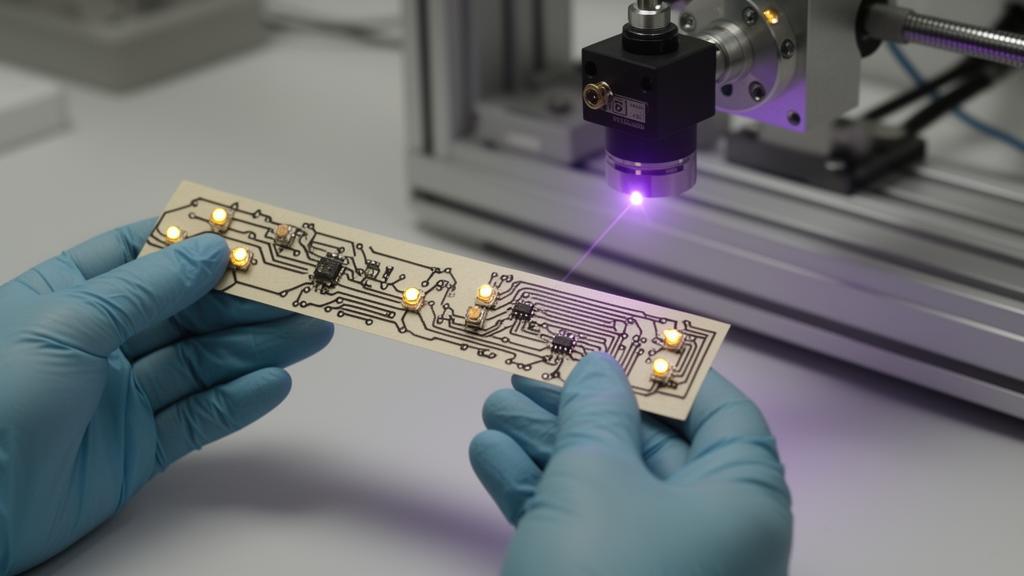
A team of researchers at the National University of Singapore has found a way to turn an ordinary sheet of kraft paper into working electronic circuitry, using nothing more than a pulsed ultraviolet laser and the lignin already inside the paper. The study, published in npj Flexible Electronics, describes a simple, additive-free method for patterning laser-induced graphene directly onto lignin-rich paper under ambient conditions, producing electrodes that survive a thousand bending or stretching cycles while retaining stable electrical performance. In an era when short-lived consumer gadgets pile up in landfills, the prospect of electronics built on biodegradable paper and fabricated with a single processing step is attracting attention well beyond the materials science community.
The core of the technique is laser-induced graphene, or LIG, a porous carbon material first created by zapping polymer sheets with a laser in a way that converts their carbon content into graphene flakes. Conventional LIG production typically relies on infrared or carbon dioxide lasers and works best on synthetic polymer substrates such as polyimide, which are neither cheap nor environmentally friendly. The Singapore team, led by Truong-Son Dinh Le, Von Luigi Valerio, Y-Van Tran and Chwee Teck Lim, took a different route. They used a 355-nanometer ultraviolet pulsed laser, whose short wavelength and high photon energy allow fine, localized heating of the paper surface, driving a photothermal conversion of the lignin-rich cellulose matrix into conductive graphitic carbon without any catalyst, precursor film, or chemical additive.
The choice of substrate matters enormously. Kraft paper is rich in lignin, the aromatic polymer that gives wood its rigidity, and those aromatic rings are precisely the carbon feedstock the laser needs to build graphene-like structures. Under optimized laser settings, the resulting porous LIG electrode exhibits a sheet resistance of 147 plus or minus 5 ohms per square, a thickness of about 43 micrometers, and an ablation depth of 20 to 30 micrometers. Those numbers describe a conductor that is thin enough to flex with the paper yet robust enough to carry useful currents, and the team reports that the electrodes maintain stable electrical performance after 1000 bending or stretching cycles, a benchmark that many flexible electronics struggle to meet.
What makes the approach particularly elegant is its simplicity. There is no lamination step, no ink printing, no vacuum deposition, and no post-processing wash. The laser writes the circuit straight onto the paper, and the paper itself supplies the raw material. Because the process runs at ambient temperature and pressure in open air, it sidesteps the cleanroom infrastructure and solvent handling that make conventional microfabrication expensive and waste-intensive. The researchers describe the method as additive-free, meaning that everything needed to form the conductive material is already present in the substrate, and the only input is laser energy delivered in a digitally controlled pattern.
To show that the platform is more than a laboratory curiosity, the team demonstrated a family of working devices built entirely on paper. Flexible and stretchable electronic circuits were patterned as interconnects and functional elements, and the paper substrate itself was engineered to stretch, allowing circuits to deform without losing conductivity. The researchers also fabricated eco-friendly photodetectors, light-sensing devices that convert illumination into an electrical signal, and electrothermal transducers, which exploit the resistive heating of the graphene network to generate controlled warmth. Together these demonstrations span sensing, actuation, and circuitry, the essential building blocks of soft electronic systems.
The stretchable devices deserve particular attention. Flexibility and stretchability are usually achieved in conventional electronics by mounting rigid components on elastomeric films, which complicates recycling and adds petrochemical materials to the waste stream. Here, the stretchability arises from the interplay between the porous, crack-tolerant graphene network and the fibrous paper architecture, so the device deforms as a coherent whole. The reported stability across 1000 cycles of bending or stretching suggests that the LIG-on-paper system can withstand the mechanical abuse that wearable and disposable devices routinely encounter, from crumpling in a pocket to repeated flexing on skin.
Scalability is where the paper platform could become genuinely disruptive. Direct laser writing is inherently compatible with roll-to-roll manufacturing, the continuous web-based process used to print newspapers, packaging, and increasingly flexible electronics. A laser head rastering across a moving roll of kraft paper could, in principle, churn out meter after meter of patterned circuitry at low cost, without the batch processing and cleanroom overhead of silicon or thin-film approaches. The authors point to this compatibility as a pathway toward scalable and low-cost production, a claim that aligns with the broader industrial push toward printed and paper-based electronics for packaging, logistics, and single-use diagnostics.
The environmental argument is equally central to the work. The proliferation of short-lifetime consumer electronics has intensified the global electronic waste challenge, with billions of disposable sensors, tags, and wearables discarded each year, many containing metals and polymers that are difficult or impossible to recycle. Paper offers an abundant, biodegradable, and eco-friendly alternative substrate, and the LIG patterning process adds no toxic chemicals to the mix. A photodetector or temperature sensor printed on kraft paper could, at the end of its life, simply decompose or be composted, dramatically shrinking the footprint of disposable electronics. For applications such as smart packaging, environmental monitoring, and single-use medical diagnostics, where the device lifespan is measured in days or weeks, that end-of-life advantage could outweigh any performance gap with conventional materials.
The researchers also see a future for the platform in soft robotics, where lightweight, compliant, and biodegradable actuating elements are highly desirable. Electrothermal transducers on paper could serve as heating elements that drive shape-changing polymer actuators, while patterned LIG traces could carry signals through a soft robotic body. Because the entire actuator-sensor-circuit stack can live on a single paper substrate, the approach opens the door to robots and disposable devices whose structural material and electronic material are one and the same, simplifying both fabrication and disposal.
The study, conducted within the Department of Biomedical Engineering and affiliated institutes at the National University of Singapore, was supported by the Institute for Health Innovation and Technology, the NUS Start-Up Grant, the Mechanobiology Institute, the National Research Foundation of Singapore, and the Institute for Functional Intelligent Materials. Published as open access in npj Flexible Electronics, the work establishes paper-based laser-induced graphene as a credible sustainable platform for flexible electronics, disposable sensors, and soft robotic systems. If roll-to-roll laser writing of paper circuits matures as the authors envision, the humble sheet of kraft paper, already one of humanity’s cheapest and most recycled materials, may soon carry not just groceries but the invisible wiring of a more sustainable electronic world.
Subject of Research: Laser-induced graphene circuitry patterned on kraft paper for sustainable flexible electronics
Article Title: Flexible, stretchable and sustainable paper electronics enabled by ultraviolet laser-induced graphene
Article References: Le, T.-S. D., Valerio, V. L., Tran, Y.-V., & Lim, C. T. (2026). Flexible, stretchable and sustainable paper electronics enabled by ultraviolet laser-induced graphene. npj Flexible Electronics. https://doi.org/10.1038/s41528-026-00649-y
Image Credits: AI Generated
DOI: 10.1038/s41528-026-00649-y
Keywords: laser-induced graphene, paper electronics, flexible electronics, ultraviolet laser, sustainable materials, electronic waste, kraft paper, photodetectors, electrothermal transducers, roll-to-roll manufacturing, stretchable circuits, disposable sensors
Cite Scienmag News
Denise Maddox. (October 9, 2026). Paper Circuits Drawn by Ultraviolet Laser Turn Trash Into Flexible Electronics. Scienmag. https://scienmag.com/paper-circuits-drawn-by-ultraviolet-laser-turn-trash-into-flexible-electronics/
Denise Maddox. "Paper Circuits Drawn by Ultraviolet Laser Turn Trash Into Flexible Electronics." Scienmag, 9 October 2026, https://scienmag.com/paper-circuits-drawn-by-ultraviolet-laser-turn-trash-into-flexible-electronics/. Accessed 9 October 2026.
Denise Maddox. "Paper Circuits Drawn by Ultraviolet Laser Turn Trash Into Flexible Electronics." Scienmag. October 9, 2026. https://scienmag.com/paper-circuits-drawn-by-ultraviolet-laser-turn-trash-into-flexible-electronics/


