


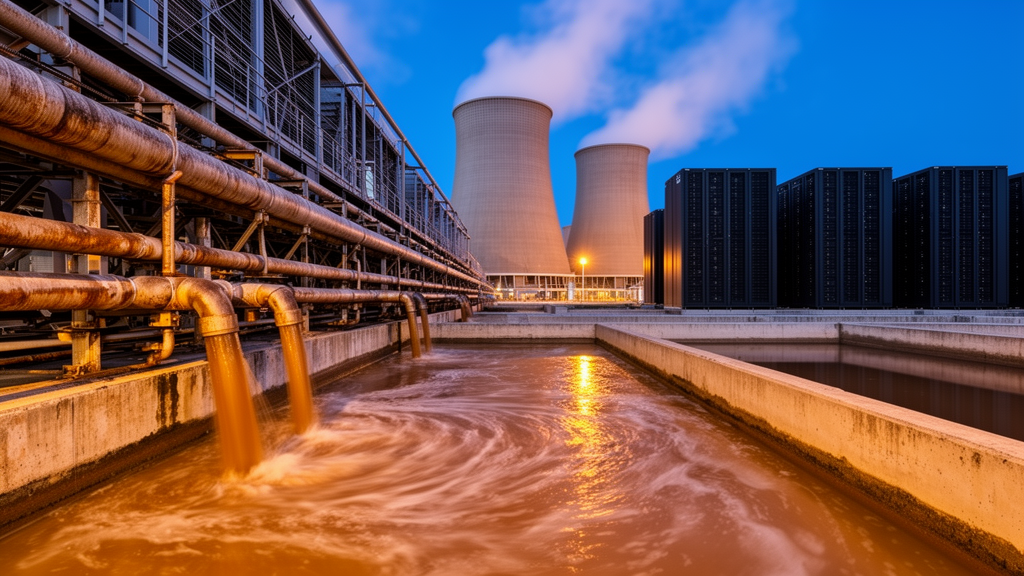
Behind every chatbot query, video stream, and cloud computation lies an enormous physical footprint that most users never see. Data centers, the industrial-scale buildings that house the servers powering the digital economy, consume staggering amounts of electricity, but they also consume something less obvious: water. Cooling systems that keep thousands of processors from overheating rely on evaporative processes that can pull millions of gallons from local supplies each year. As artificial intelligence accelerates the construction of new facilities, particularly in water-stressed regions like Texas, the question of where all that water will come from has become a pressing environmental and political issue. New research from The University of Texas at Austin suggests a surprising answer may already be flowing beneath the surface: the vast quantities of salty, contaminated water that industries currently pump, transport, and bury as waste.
The study, published in Water Research by researchers in the Cockrell School of Engineering’s Walker Department of Mechanical Engineering, examined whether desalination technology could transform brackish groundwater and oilfield wastewater into a viable cooling resource for data centers. The findings are striking in their practicality. Rather than waiting for breakthrough technologies, the researchers concluded that existing, commercially mature desalination systems could relieve pressure on municipal water supplies at a cost that represents only a small fraction of a data center’s overall operating budget and energy footprint. The work is part of a broader effort at UT Austin to give regulators, communities, and companies objective tools for evaluating data center projects before permits are granted.
At the heart of the analysis is a fundamental engineering trade-off between the two dominant families of desalination. The first, reverse osmosis, pushes water through semi-permeable membranes that block salt ions and other dissolved contaminants. Membrane systems are the workhorses of modern desalination because they are relatively energy-efficient, requiring pressure rather than phase change to separate freshwater from brine. Their limitation is osmotic pressure itself: as source water becomes saltier than seawater, the pressure needed to drive water through the membrane climbs steeply, and membranes foul and degrade. The second approach, thermal desalination, boils water and condenses the vapor, leaving salts behind. This distillation route handles hypersaline brines that membranes cannot, but it demands far more energy and suffers from scaling, the accumulation of mineral deposits on heat-exchange surfaces that chokes performance and drives up maintenance costs.
The researchers found that even the most energy-intensive treatment option consumes only a small slice of a data center’s total energy demand. That counterintuitive result reframes the debate: water treatment is not an energy problem for these facilities, it is a design and sourcing problem. A data center that treats brackish groundwater on site with a two-stage reverse osmosis train can achieve high freshwater recovery at low cost and modest energy use, while a facility relying on hypersaline produced water may need thermal processes and accept higher treatment expenses. In either case, the energy penalty is dwarfed by the computing load itself, meaning that water-stressed communities need not choose between digital infrastructure and their aquifers if treatment is engineered correctly.
Texas offers a particularly compelling case study because of its oil and gas industry. Hydraulic fracturing in the Permian Basin generates enormous volumes of produced water, the salty brine that flows back to the surface alongside oil and gas. Vaibhav Bahadur, a professor of mechanical engineering and one of the study’s leaders, quantified the scale of the problem in vivid terms: the Permian produces the equivalent of 1,200 Olympic-sized swimming pools of this wastewater every day. Currently, that water is trucked or piped over long distances and injected deep underground into disposal wells, a practice that raises the risk of induced seismicity and is rapidly exhausting available disposal capacity. Bahadur warned that disposal space could run out as early as 2030, making beneficial reuse not just attractive but necessary. Cleaning produced water for data center cooling, he argued, is a way to solve two problems at once.
To make such comparisons rigorous, the research team developed a new metric called Saline Water Utilization Intensity, or SWUI. The metric quantifies how heavily a given data center project draws on stressed local water sources under different desalination strategies, allowing engineers and regulators to compare scenarios on a common scale. Rather than relying on generic claims about sustainability, SWUI captures the actual environmental burden imposed on a specific watershed or aquifer, and how that burden shifts when a facility switches from municipal freshwater to treated brackish water or recycled industrial wastewater. The researchers applied the metric to three real-world data center scenarios in Texas, and the results were instructive.
The standout performer was a project in Longview, Texas, which achieved the lowest stress levels on local water sources of the three cases studied. That facility would source brackish groundwater, water too salty for drinking or agriculture but far less saline than seawater, and treat it with two-stage reverse osmosis. The two-stage design pushes the concentrate from the first membrane pass through a second, extracting additional freshwater from the same volume of source water and shrinking the brine waste stream. Because brackish water requires much lower operating pressures than seawater, energy consumption stays modest and costs remain low. The Longview case demonstrates that the best outcomes arise when source water chemistry, treatment technology, and facility siting are analyzed together rather than in isolation.
The research arrives at a moment of intense scrutiny for the industry in Texas. In September, Governor Greg Abbott directed the Texas Commission on Environmental Quality to pause new data center permits while the state evaluates their impacts on local communities. Shortly afterward, the Texas Attorney General’s office announced an investigation into the water use of hundreds of existing data center developments across the state. Against that backdrop, Bahadur and his colleagues at the Bureau of Economic Geology’s COMPASS consortium are working to equip decision-makers with analytical tools rather than anecdotes. The consortium is developing software to model individual projects, analyzing water demand, power usage, and environmental impacts in the same way the desalination study did, so that permitting decisions rest on quantified evidence.
The urgency of that mission was on display when Bahadur and Ning Lin, the Bureau of Economic Geology’s chief economist, testified before the Texas Senate’s Committee on Water, Agriculture, and Rural Affairs. Lin emphasized that local officials frequently lack objective analysis of water and power usage when weighing data center proposals, leaving communities to negotiate from a position of ignorance. The researchers hope their modeling tools will change that dynamic, giving elected officials the ability to forecast how a proposed facility would affect local aquifers and to require treatment strategies, such as desalination of non-potable sources, as conditions of approval. The goal, they say, is to protect and benefit communities rather than simply accommodate whatever the market proposes.
The broader significance of the study lies in its rejection of technological fatalism. Data center water consumption is often framed as an unavoidable cost of the AI boom, something communities must simply absorb. The UT Austin analysis shows instead that the problem is tractable with technology that has existed for decades, provided that planners match the right treatment process to the right water source and account honestly for cost, energy, and local hydrology. Salty groundwater and industrial wastewater, long treated as liabilities to be buried, could become assets that sustain digital growth without draining the taps of neighboring towns. As Bahadur put it, parts of this problem can be solved with the tools already at hand; the only question is whether the industry and its regulators are willing to pay the modest price of doing so.
Subject of Research: Using desalination of saline and produced water to meet data center cooling demands
Article Title: Can salty, dirty water cool data centers?
Article References: Can salty, dirty water cool data centers?. (n.d.). Original publication
Image Credits: AI Generated
DOI: Not provided
Keywords: data centers, desalination, reverse osmosis, produced water, water stress, cooling systems, Permian Basin, brackish groundwater, thermal desalination, Texas, Water Research, sustainability
Cite Scienmag News
Denise Maddox. (October 9, 2026). Salty, Dirty Water Could Quench Data Centers’ Thirst for Cooling. Scienmag. https://scienmag.com/salty-dirty-water-could-quench-data-centers-thirst-for-cooling/
Denise Maddox. "Salty, Dirty Water Could Quench Data Centers’ Thirst for Cooling." Scienmag, 9 October 2026, https://scienmag.com/salty-dirty-water-could-quench-data-centers-thirst-for-cooling/. Accessed 9 October 2026.
Denise Maddox. "Salty, Dirty Water Could Quench Data Centers’ Thirst for Cooling." Scienmag. October 9, 2026. https://scienmag.com/salty-dirty-water-could-quench-data-centers-thirst-for-cooling/


