


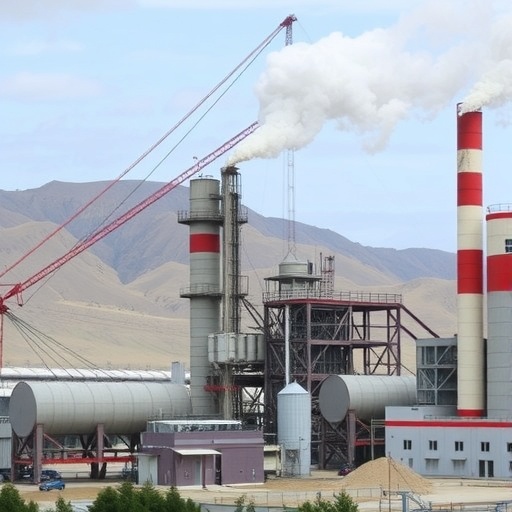
Pakistan’s cement industry emitted approximately 38.45 million tonnes of carbon dioxide in the 2023 fiscal year, yet even after equipping its plants with roughly 370 megawatts of waste heat recovery capacity and nearly 417 megawatts of solar power, the sector still produces cement at an emission intensity of 884 kilograms of CO2 per tonne. That striking disconnect between apparent green progress and stubbornly high emissions lies at the heart of a comprehensive new review published in Clean Technologies and Environmental Policy, which offers the most integrated assessment to date of one of Pakistan’s most important—and most carbon-intensive—industries.
The study, led by Muhammad Sumair of the University of Engineering and Technology Taxila, together with Tanzeel-ur Rashid, Muhammad Idrees, Müslüm Arıcı, Zhijiang Wang and Muzaffar Ali, synthesizes plant-level inventory data, technology deployment records and the national policy landscape into a single picture of where Pakistan’s cement emissions come from and what it would take to cut them deeply. Unlike earlier work that examined individual dimensions of the sector in isolation, the new review explicitly combines emissions quantification, technology assessment and an analysis of the institutional and regulatory barriers that have stalled decarbonization.
The chemistry of cement making makes it one of the hardest industrial processes to decarbonize. Cement is produced by heating limestone, or calcium carbonate, in a kiln to about 1,450 degrees Celsius, transforming it into clinker, the binding ingredient in concrete. Roughly 60 percent of the CO2 released in this process does not come from burning fuel at all—it comes from the calcination reaction itself, in which the limestone chemically decomposes and releases CO2 as an unavoidable byproduct. The review finds that clinker calcination alone accounts for nearly 59 percent of Pakistan’s sectoral emissions, meaning that even a cement plant powered entirely by renewable electricity would still emit the bulk of its current carbon footprint. Globally, the cement industry is responsible for approximately 5 to 8 percent of all CO2 emissions, making it a critical target for climate mitigation everywhere, but especially in rapidly urbanizing economies like Pakistan’s where construction demand continues to climb.
The sector’s clinker factor—the ratio of clinker to total cement produced—stands at 0.93 in Pakistan, a figure that reveals just how much room for improvement remains. Clinker is the carbon-heavy core of cement, and substituting supplementary cementitious materials such as fly ash, slag or calcined clays allows manufacturers to produce the same volume of cement with less clinker. Leading cement-producing countries have pushed their clinker factors substantially lower through widespread blending, but Pakistan’s producers remain heavily reliant on near-pure clinker. The review identifies clinker-factor reduction as one of the three key levers for deep decarbonization, alongside alternative fuel utilization and carbon capture, utilization and storage, known as CCUS. Research on local kaolinite-rich clays for producing LC3—a limestone calcined clay cement that can dramatically cut clinker demand—has already begun in Pakistan, suggesting a promising domestic pathway.
On the energy side, the sector’s recent track record is genuinely impressive, and yet insufficient. Waste heat recovery systems, which capture the hot exhaust gases leaving kilns and convert them into electricity, have reached approximately 370 megawatts of installed capacity across the industry. Solar installations have climbed to nearly 417 megawatts. These measures target the fuel-combustion and electricity-related share of emissions, roughly the 40 percent of the footprint not locked into calcination chemistry. But because that share is the minority of total emissions, efficiency gains and renewables alone cannot deliver the deep cuts required. The emission intensity of 884 kilograms of CO2 per tonne of cement has remained stubbornly high despite this deployment, a mathematical consequence of the fact that process emissions dominate the ledger.
Alternative fuels offer another partial solution with significant untapped potential. Cement kilns, by virtue of their extremely high operating temperatures and long residence times, can co-process waste materials that would otherwise end up in landfills or open dumps—refuse-derived fuel, biomass, used tires and industrial wastes among them. Pakistan generates substantial quantities of municipal solid waste and agricultural residues that could substitute for the coal that currently fires most kilns. Studies cited in the review point to biogas potential from livestock manure and to refuse-derived fuel as viable substitutes, and neighboring countries have moved faster on this front. But fuel switching in Pakistan remains limited, constrained by unreliable waste collection infrastructure, competition for biomass resources, and the absence of policy incentives that would make alternative fuels economically attractive relative to cheap domestic coal.
Carbon capture, utilization and storage represents the endgame technology for cement decarbonization, the only approach capable of neutralizing process emissions at scale. The review notes assessments of CO2 storage potential across the Indian subcontinent and points to international momentum, including India’s launch of five carbon utilization testbeds for its cement sector. Pakistan’s prospects for CCUS remain speculative, however, hampered by the enormous capital costs of capture technology, the lack of CO2 transport and storage infrastructure, and—critically—the absence of any carbon pricing or financing mechanism that would reward emitters for capturing CO2. Without climate finance targeted at hard-to-abate sectors, the review argues, CCUS will remain out of reach for Pakistani producers competing in a price-sensitive domestic market.
Perhaps the most sobering findings concern governance rather than technology. The review highlights that Pakistan lacks a dedicated sectoral emissions inventory for cement, meaning that the national picture of industrial emissions rests on estimates and fragmented reporting rather than systematic, verified plant-level data. Monitoring, reporting and verification systems—known as MRV frameworks, the institutional backbone of any credible climate policy or carbon market—are weak. Institutional responsibilities are split across agencies with little coordination, and policy support for industrial decarbonization is thin. Pakistan’s updated Nationally Determined Contributions and its third NDC acknowledge the challenge, and the country has participated actively in international climate negotiations, but the gap between stated ambition and on-the-ground implementation capacity remains wide. The review calls for mandatory plant-level emissions reporting, periodic inventory development, stronger institutional coordination and targeted climate-finance mechanisms as the institutional prerequisites for any successful transition.
There is also an external pressure that gives urgency to these recommendations. The European Union’s Carbon Border Adjustment Mechanism will place a carbon price on imported goods, including cement, effectively penalizing producers from countries without robust emissions accounting. For an export-oriented industry, the inability to demonstrate verified carbon intensity could translate directly into lost market access. The review’s authors argue that building credible MRV systems is not merely an environmental nicery but an economic imperative, positioning Pakistani producers to respond to carbon-conscious international markets rather than be excluded from them.
What emerges from this assessment is a portrait of an industry that has done the achievable things well—recovering waste heat, installing solar panels, improving energy efficiency—and now faces the genuinely hard things: reformulating its core product, capturing its unavoidable process emissions, and building the transparent accounting systems without which neither investors nor policymakers can steer the transition. The technical pathways are mapped. The review’s contribution is to make clear that in Pakistan, the binding constraints are no longer primarily technological. They are institutional, financial and political—and until they are addressed, one of the world’s most carbon-intensive industries will continue to emit at near-record intensity, one tonne of clinker at a time.
Cite Scienmag News
Sloane Callahan. (August 30, 2026). Pakistan’s cement industry decarbonization hinges on policy and implementation. Scienmag. https://scienmag.com/pakistans-cement-industry-decarbonization-hinges-on-policy-and-implementation/
Sloane Callahan. "Pakistan’s cement industry decarbonization hinges on policy and implementation." Scienmag, 30 August 2026, https://scienmag.com/pakistans-cement-industry-decarbonization-hinges-on-policy-and-implementation/. Accessed 3 September 2026.
Sloane Callahan. "Pakistan’s cement industry decarbonization hinges on policy and implementation." Scienmag. August 30, 2026. https://scienmag.com/pakistans-cement-industry-decarbonization-hinges-on-policy-and-implementation/


