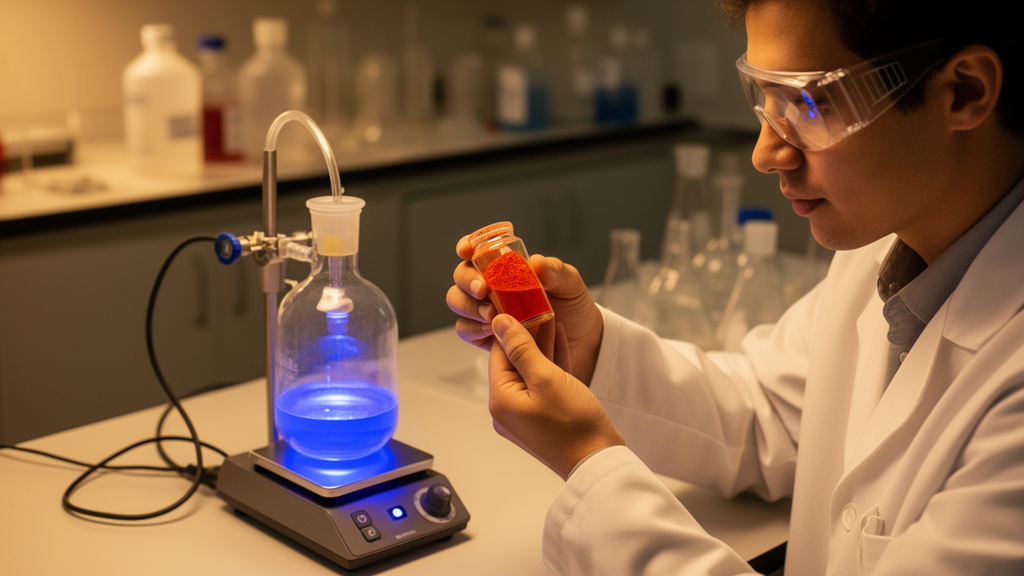
Chemists have long been drawn to quinacridone, the cheap, non-toxic industrial pigment behind vivid reds and violets, as a possible organic photocatalyst. Its derivatives absorb visible light strongly and carry redox potentials well suited to light-driven chemistry. Yet the pigment has a stubborn flaw: the parent scaffold is nearly insoluble, its molecules locked together by strong pi-pi stacking and an extended network of intermolecular hydrogen bonds, and quinacridone-based photocatalysts have tended to degrade rapidly under the oxidative conditions of homogeneous catalysis.
The work, led by Alessandro Iannini and Pierluca Galloni, began with the synthetic bottleneck itself. Making soluble N-substituted quinacridone derivatives has traditionally demanded harsh conditions: large excesses of alkylating agents, large excesses of strong or nucleophilic bases, prolonged reaction times, and demanding purifications. Those requirements weigh heavily on the sustainability, scalability, and practical deployment of quinacridone-based photocatalysts. The researchers systematically varied the base, the amount of alkylating agent, and the presence of tetrabutylammonium bromide, a phase-transfer catalyst, in the N-alkylation of quinacridone with 3,5-di-tert-butylbenzyl bromide as a model reagent.
The optimization revealed a marked sensitivity to the choice of base. Sodium hydroxide gave good yields but only with excess alkyl halide, plausibly because hydroxide competes as a nucleophile. Lithium carbonate proved ineffective and potassium carbonate yielded only traces even in large excess, consistent with their poor solubility in dimethylformamide, which prevents efficient generation of the reactive quinacridone anion. Switching to cesium carbonate changed the picture entirely: high yields were obtained with only three equivalents of alkylating agent, base loading could be reduced, and the reaction proceeded reliably at a moderate 50 degrees Celsius on shorter timescales. The phase-transfer catalyst turned out not to be strictly required, although its presence accelerated the color transition from the deep blue of deprotonated quinacridone to the orange of the alkylated product. The optimized protocol was also applied to N,N’-dibutylquinacridone, improving the sustainability of that synthesis as well, and it even delivered monoalkylated derivatives in appreciable amounts, compounds the authors note could serve as photocatalysts with a reactive N-H handle for hydrogen atom transfer chemistry.
The star product of the new protocol is QA-1, an N,N’-bis-(3,5-di-tert-butylbenzyl)quinacridone obtained in 71 percent isolated yield. The bulky substituents were chosen deliberately to suppress the intermolecular hydrogen bonding and pi-pi stacking that make the parent pigment insoluble. Characterization confirmed the design intent. Ultraviolet-visible spectroscopy showed a broad absorption band in the visible region with molar extinction coefficients on the order of ten thousand per molar per centimeter, and both absorption and fluorescence shifted markedly toward the red when the solvent was changed from dichloromethane to hexafluoroisopropanol, signaling strong interactions between the chromophore and the medium. Cyclic voltammetry in hexafluoroisopropanol placed QA-1’s ground-state reduction and oxidation potentials at minus 0.87 and plus 0.98 volts versus silver/silver chloride, closely matching the benchmark dibutyl derivative, with nearly identical excited-state redox values as well.
Computer modeling added structural insight. Density functional theory calculations showed that in the most stable conformer the two aromatic substituent groups sit on opposite sides of the molecule, avoiding pi-pi stacking and thereby aiding solubility. The quinacridone core itself is not flat but zig-zag shaped, and solvation induced appreciable changes in key dihedral angles, suggesting a partial bending of the core upon dissolution. The calculated HOMO-LUMO gap in dichloromethane came to about 2.9 electron volts, comparable with the experimental value of 2.4 electron volts, and the frontier orbitals remained localized on the quinacridone skeleton regardless of solvent.
With the catalyst in hand, the team turned to the reaction it was built for: the selective oxidation of sulfides to sulfoxides, a widely used benchmark transformation in visible-light photocatalysis and a reaction of real synthetic importance. Screening with methyl p-tolyl sulfide as the model substrate showed that the oxidation proceeds efficiently only in a narrow set of conditions. In hexafluoroisopropanol, quantitative formation of the sulfoxide was achieved within one hour under an oxygen atmosphere, even at a catalyst loading of just 0.1 mole percent. In alternative solvents, including nitriles, chlorinated solvents, acetone, and dimethylformamide, only trace or negligible yields appeared. The authors attribute hexafluoroisopropanol’s special role to its high polarity and strong hydrogen-bond-donating character, which are known to influence photochemical oxidations involving polar or radical intermediates, and note that electrochemical evidence shows the solvent can also modulate the redox properties of quinacridone derivatives in ways that facilitate photoinduced electron transfer. Replacing pure oxygen with air still worked, though completion took longer.
The substrate scope proved broad. Aryl methyl sulfides bearing electron-neutral or electron-donating substituents converted smoothly, typically in quantitative yields within an hour, and chloro-substituted derivatives were equally well tolerated. Diarylic sulfides also worked, though they needed longer irradiation times. Benzylic and aliphatic sulfides were successfully oxidized, with simple dialkyl sulfides undergoing rapid, essentially quantitative conversion. Heteroaryl substrates such as thianthrene oxidized only slowly and to a limited extent, and strongly electron-withdrawing groups on the aryl ring sharply reduced reactivity, revealing the reaction’s sensitivity to electronic effects at sulfur. Across all examined substrates the chemoselectivity was complete: no overoxidation to sulfones was detected, even when irradiation was extended to sixteen hours.
The most striking result came from stress-testing the catalyst’s endurance. The researchers ran five consecutive one-hour cycles, simply adding a fresh portion of methyl p-tolyl sulfide to the same photocatalyst solution each time without replenishing the catalyst. High sulfoxide yields were maintained throughout, with only a moderate decrease after repeated recharging. Spectrophotometric monitoring showed a drop in the intensity of the main visible absorption band after the first cycle, followed by a more gradual attenuation, suggesting an early loss of active catalyst concentration but limited formation of photodegradation products. The authors describe this operational stability as unprecedented for quinacridone-based photocatalysts in homogeneous photocatalysis, a direct contrast with the rapid deactivation commonly observed for this pigment family under oxidative conditions.
Preliminary scavenging experiments sketch the likely mechanism. Adding a radical cation scavenger strongly suppressed product formation, pointing to sulfur-centered radical cation intermediates generated by photoinduced electron transfer, while a comparable suppression by benzoquinone implicates the superoxide anion radical formed when molecular oxygen accepts an electron. A singlet oxygen scavenger had little effect, suggesting that pathway is minor. Taken together, the evidence supports an oxidative quenching mechanism in which the photoexcited catalyst transfers an electron to the sulfide and molecular oxygen completes the cycle, closely mirroring schemes previously proposed for related quinacridone systems, though the authors caution that further mechanistic studies will be needed to confirm the relative contributions of the different pathways.
The study, published as open access research on 17 June 2026, frames its contribution on two fronts. A simpler, more resource-efficient route to soluble quinacridone derivatives lowers a long-standing synthetic barrier, potentially extending beyond photocatalysis into electronic materials and hybrid solar-driven systems where these pigments are also finding roles. And a quinacridone photocatalyst that combines very low loading, exclusive sulfoxide selectivity, broad substrate tolerance, and multi-cycle reuse without reloading addresses the recovery and reuse questions that the authors note are seldom explored for the organic photocatalysts typically used in this reaction, which often demand extended irradiation times or complex immobilization schemes to be recycled. For a pigment better known for coloring paints than for powering chemical reactions, it is a notable double advance.
Subject of Research: Development of a soluble quinacridone-based organic photocatalyst for selective aerobic oxidation of sulfides to sulfoxides.
Article Title: Highly stable quinacridone-based photocatalyst for selective thioether oxidation
Article References: Iannini, A., Destriere, R. P., Pezzola, S., Tommasi, L., Sabuzi, F., & Galloni, P. (2026). Highly stable quinacridone-based photocatalyst for selective thioether oxidation. Discover Catalysis, 3(1), Article 10. https://doi.org/10.1007/s44344-026-00041-y
Image Credits: AI Generated
DOI: 10.1007/s44344-026-00041-y
Keywords: photocatalysis, quinacridone, sulfoxide, sulfide oxidation, organic synthesis, visible light, HFIP, green chemistry, oxygen, chemoselectivity, N-alkylation, operational stability
Cite Scienmag News
Bethany Barker. (October 29, 2026). Organic Pigment Derivative Powers Stable Light-Driven Sulfoxide Synthesis. Scienmag. https://scienmag.com/organic-pigment-derivative-powers-stable-light-driven-sulfoxide-synthesis/
Bethany Barker. "Organic Pigment Derivative Powers Stable Light-Driven Sulfoxide Synthesis." Scienmag, 29 October 2026, https://scienmag.com/organic-pigment-derivative-powers-stable-light-driven-sulfoxide-synthesis/. Accessed 4 November 2026.
Bethany Barker. "Organic Pigment Derivative Powers Stable Light-Driven Sulfoxide Synthesis." Scienmag. October 29, 2026. https://scienmag.com/organic-pigment-derivative-powers-stable-light-driven-sulfoxide-synthesis/