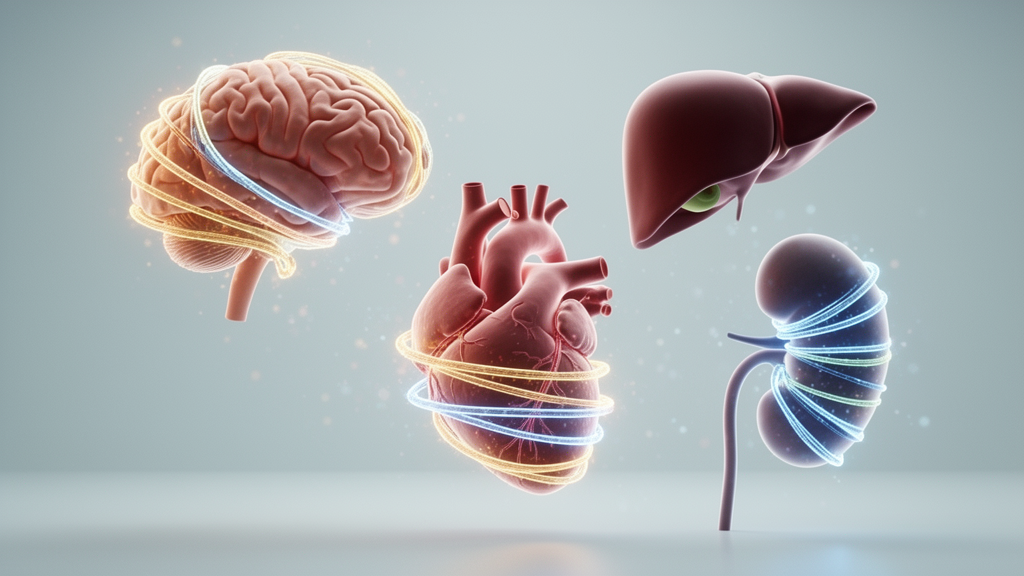
Biological age is no longer treated as a single number. In a study published in Clinical Epigenetics, researchers examined organ-specific biological age gaps, model-derived measures of ageing-related variation calculated separately for different organs, and mapped their genetic relationships with 19 age-related disease or disease-related phenotypes. The findings, based on European-ancestry genome-wide association study summary statistics from the UK Biobank, paint a picture of ageing genetics that is heterogeneous, direction-dependent and multi-scale, rather than governed by one dominant ageing axis.
The team, led by Hongdong Hao, Dian Chen and Huixi Bo among others, applied bidirectional two-sample Mendelian randomization to nine organ-specific biological age gap traits. This statistical approach uses genetic variants as instruments to probe whether an exposure influences an outcome, and, in the reverse direction, whether the outcome influences the exposure.
From 342 planned comparisons, 306 were estimable, and 31 met Tier 1 or Tier 2 prioritisation criteria under a false-discovery-rate-based evidence framework. The prioritised associations were then evaluated with complementary analyses, including alternative Mendelian randomization methods, statistical power assessment, sample-overlap auditing, colocalisation, multivariable Mendelian randomization, and genome-wide and local genetic-correlation analyses.
Several relationships stood out in the forward direction, where the biological age gap was treated as the exposure. Renal biological age gap was prominently associated with cystatin C-based estimated glomerular filtration rate, a measure of kidney function. Cardiovascular biological age gap was associated with coronary artery disease and with large artery stroke. Cardiovascular, metabolic and pulmonary biological age gaps were each associated with type 2 diabetes.
The reverse analyses, in which disease liability was treated as the exposure, showed that type 2 diabetes was associated with metabolic, cardiovascular, brain and hepatic biological age gaps. This bidirectional pattern suggests that, at the genetic level, some disease processes and organ-specific ageing measures may influence one another in both directions, although the strength and reliability of these inferences varied considerably across traits.
A pleiotropy-robust Mendelian randomization analysis preserved the direction of all 31 prioritised associations, a reassuring signal for the overall pattern of effects. However, between-variant heterogeneity was widespread, meaning that different genetic instruments suggested effect estimates that did not always agree.
Colocalisation and genetic-correlation analyses revealed heterogeneous patterns of local and genome-wide sharing between the biological age gap traits and disease phenotypes. Multivariable Mendelian randomization, which attempts to disentangle overlapping exposures, retained only a subset of the associations. In one striking example of locus dependence, the reverse associations involving non-lobar intracerebral haemorrhage depended on a single genetic locus, meaning the signal could vanish if that region were excluded.
The authors conclude that organ-specific biological age gap traits show heterogeneous, direction-dependent and multi-scale genetic relationships with age-related phenotypes. Cardiometabolic and renal relationships were among the most consistently supported, but the study also identifies differential statistical power, widespread heterogeneity, conditional instrument weakness and locus dependence as important limitations. Together, these factors argue against a single dominant ageing axis or simple causal pathways linking organ ageing to disease.
For researchers building biological age clocks, the message is that these measures are informative but genetically complex. For the wider field of ageing biology, the study underscores that the relationship between how old an organ appears and which diseases a person develops cannot be reduced to one shared mechanism.
Subject of Research: Genetic relationships between organ-specific biological age gaps and age-related diseases
Article Title: Organ-specific biological age gaps show heterogeneous and direction-dependent genetic relationships with age-related diseases
Article References: Hao, H., Chen, D., Bo, H., Zhang, X., Xue, H., & Meng, T. (2026). Organ-specific biological age gaps show heterogeneous and direction-dependent genetic relationships with age-related diseases. Clinical Epigenetics. https://doi.org/10.1186/s13148-026-02249-z
Image Credits: AI Generated
DOI: 10.1186/s13148-026-02249-z
Keywords: biological age, organ ageing, Mendelian randomization, UK Biobank, genetics, age-related disease, type 2 diabetes, coronary artery disease, kidney function, genetic correlation, colocalisation, Clinical Epigenetics
Cite Scienmag News
Juliet Wilcox. (October 28, 2026). Organ ageing clocks show direction-dependent genetic links with disease. Scienmag. https://scienmag.com/organ-ageing-clocks-show-direction-dependent-genetic-links-with-disease/
Juliet Wilcox. "Organ ageing clocks show direction-dependent genetic links with disease." Scienmag, 28 October 2026, https://scienmag.com/organ-ageing-clocks-show-direction-dependent-genetic-links-with-disease/. Accessed 28 October 2026.
Juliet Wilcox. "Organ ageing clocks show direction-dependent genetic links with disease." Scienmag. October 28, 2026. https://scienmag.com/organ-ageing-clocks-show-direction-dependent-genetic-links-with-disease/