

Thursday, April 30, 2026
Science
No Result
View All Result
  • Login
  • HOME
  • SCIENCE NEWS
  • CONTACT US
  • HOME
  • SCIENCE NEWS
  • CONTACT US
No Result
View All Result
Scienmag
No Result
View All Result
Home Science News Earth Science

Open waste burning linked to air pollution in Northwestern Greenland

August 27, 2025
in Earth Science
Reading Time: 2 mins read
0
Open waste burning linked to air pollution in Northwestern Greenland
65
SHARES
595
VIEWS
Share on FacebookShare on Twitter
ADVERTISEMENT

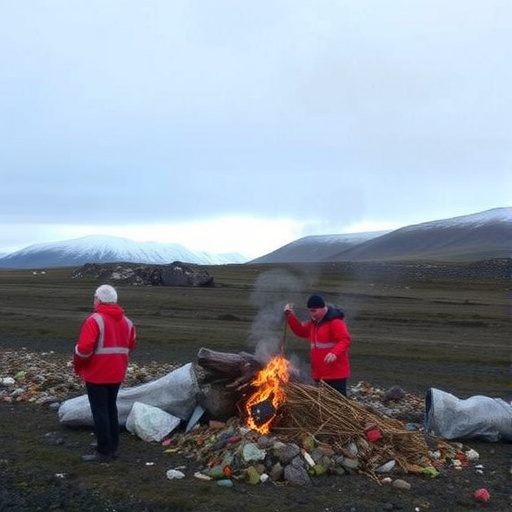
A case study on the effects of open waste burning on air quality in Northwestern Greenland calls attention to the importance of no-one-left-behind sustainable air quality monitoring in the Arctic region. To better understand the air quality risks faced by remote Arctic communities, an international team monitored aerial pollutants at a community in Northwestern Greenland. Their findings, published in Atmospheric Science Letters, reveal that open waste burning elevates the concern of health risks to the community. The study focused on Qaanaaq, a small village in Northwestern Greenland with a population of approximately 600. During the summer of 2022, the team conducted the first-time measurement of particulate matter (PM2.5) in the ambient air there and identified an increase in PM2.5 pollution. PM2.5 refers to tiny particles with a diameter of 2.5 micrometers or less, such as dust and smoke. PM2.5 pollution is closely linked with severe air pollution and is particularly harmful to human health; PM2.5 exposures are correlated with a spectrum of health problems, including respiratory ailments such as asthma and bronchitis, cardiovascular diseases, and even premature death. Monitoring PM2.5 levels is important for assessing air quality and protecting public health. However, compared to the mid-latitudes, the PM2.5 observations in high-latitude regions are relatively left behind (i.e., fewer PM2.5 observations) in terms of the SDG’s mission statement. The research team, which included researchers from Hokkaido University, the University of Tsukuba, Nagoya University, and NASA, and was led by Associate Professor & Distinguished Researcher Teppei J. Yasunari at the Arctic Research Center, used commercially available advanced PM2.5 measurement systems for cold regions, which was updated from their previous research, to collect continuous PM2.5 data spanning the period from July 20 to August 13, 2022. Their analysis uncovered multiple instances of heightened PM2.5 levels, particularly notable from August 8 onwards. These increases were attributed to local open waste burning activities, as evidenced by the visible black smoke emitted from the Qaanaaq dump site on the same day with combined data analyses using NASA’s re-analysis data and NOAA’s HYSPLIT model online simulations. Although further investigation indicated that pollutants originating from sources outside of the study area may have also contributed some during the early stages of the study, the analyses indicated these contributions were minimal, highlighting the significant impact of local pollution sources on air quality in Qaanaaq. The hourly mean PM2.5 concentrations did not reach alarming levels during the measurement period. However, additional analysis based on the NOAA HYSPLIT online dispersion simulations also implied that there were likely particulate matter depositions from the open waste burning to the nearby sea areas, including Baffin Bay, suggesting important research targets in environmental science in the future.  “This is the first time we’ve studied PM2.5 in a small Arctic residential area of Northwestern Greenland where we didn’t know the air quality before. We found out how much pollution increases with PM2.5 during local open waste burning,” Yasunari said. “Now, Qaanaaq uses an incinerator, stopping open waste burning. But, continuous air quality monitoring is crucial because pollution doesn’t choose timing or stop at borders.” He emphasizes the need for healthy air for everyone, Arctic residents included, underlining continuous monitoring as essential for long-term health, in line with the SDGs.

Journal

Atmospheric Science Letters

DOI

10.1002/asl.1231

Method of Research

Observational study

Subject of Research

Not applicable

Article Title

ncreased atmospheric PM2.5 events due to open waste burning in Qaanaaq, Greenland, summer of 2022

Article Publication Date

26-Mar-2024

Tags: air pollution and cardiovascular diseasesair quality monitoring Arcticatmospheric science air qualityenvironmental health in Greenlandimpact of pollutants on remote communitiesmonitoring particulate matter in Arctic regionsNorthwestern Greenland environmental studyopen waste burningPM2.5 pollution health risksQaanaaq community air pollutionrespiratory health effects PM2.5sustainable practices in Arctic
Share26Tweet16
Previous Post

Parental avoidance of toxic exposures could help prevent autism, ADHD in children, new study shows

Next Post

Artificial Intelligence tool successfully predicts fatal heart rhythm

Related Posts

Unveiling Non-Self-Similar Earthquake Dynamics via Fault Asperity — Earth Science
Earth Science

Unveiling Non-Self-Similar Earthquake Dynamics via Fault Asperity

April 30, 2026
Cutting Income Gaps Fuels Brazil’s Healthy Diet Shift — Earth Science
Earth Science

Cutting Income Gaps Fuels Brazil’s Healthy Diet Shift

April 30, 2026
Earth Science

3D Seismic Reveals Upper-Plate Elastic and Geometry

April 29, 2026
Earth Science

Arctic Phytoplankton Blooms Tied to Ice Persistence

April 29, 2026
Earth Science

How Rocks Capture and Remove CO2 from the Atmosphere

April 29, 2026
Earth Science

Where Was Your Backyard Located Millions of Years Ago?

April 29, 2026
Next Post
Artificial Intelligence tool successfully predicts fatal heart rhythm

Artificial Intelligence tool successfully predicts fatal heart rhythm

  • Mothers who receive childcare support from maternal grandparents show more parental warmth, finds NTU Singapore study

    Mothers who receive childcare support from maternal grandparents show more parental warmth, finds NTU Singapore study

    27638 shares
    Share 11052 Tweet 6907
  • University of Seville Breaks 120-Year-Old Mystery, Revises a Key Einstein Concept

    1041 shares
    Share 416 Tweet 260
  • Bee body mass, pathogens and local climate influence heat tolerance

    677 shares
    Share 271 Tweet 169
  • Researchers record first-ever images and data of a shark experiencing a boat strike

    540 shares
    Share 216 Tweet 135
  • Groundbreaking Clinical Trial Reveals Lubiprostone Enhances Kidney Function

    527 shares
    Share 211 Tweet 132
Science

Embark on a thrilling journey of discovery with Scienmag.com—your ultimate source for cutting-edge breakthroughs. Immerse yourself in a world where curiosity knows no limits and tomorrow’s possibilities become today’s reality!

RECENT NEWS

  • Glucose Controls Oligodendrocyte Growth via ACLY Acetylation
  • UC San Diego Study Enhances Accuracy in Predicting Genetic Risk for Type 1 Diabetes
  • FAU Study Uncovers Cellular Secrets Behind Camels’ Heat Resilience
  • American Thoracic Society Launches Groundbreaking Effort to Enhance Bronchiectasis Diagnosis Nationwide

Categories

  • Agriculture
  • Anthropology
  • Archaeology
  • Athmospheric
  • Biology
  • Biotechnology
  • Blog
  • Bussines
  • Cancer
  • Chemistry
  • Climate
  • Earth Science
  • Editorial Policy
  • Marine
  • Mathematics
  • Medicine
  • Pediatry
  • Policy
  • Psychology & Psychiatry
  • Science Education
  • Social Science
  • Space
  • Technology and Engineering

Subscribe to Blog via Email

Enter your email address to subscribe to this blog and receive notifications of new posts by email.

Join 5,145 other subscribers

© 2025 Scienmag - Science Magazine

Welcome Back!

Login to your account below

Forgotten Password?

Retrieve your password

Please enter your username or email address to reset your password.

Log In
No Result
View All Result
  • HOME
  • SCIENCE NEWS
  • CONTACT US

© 2025 Scienmag - Science Magazine

Discover more from Science

Subscribe now to keep reading and get access to the full archive.

Continue reading
