


The fight against cancer is an arms race, and one of the most effective weapons in clinicians’ arsenals is immunotherapy. Immune checkpoint therapy has become the standard for treating several types of cancer. However, the Nobel Prize-winning strategy is ineffective for most pancreatic ductal adenocarcinoma (PDAC) patients.

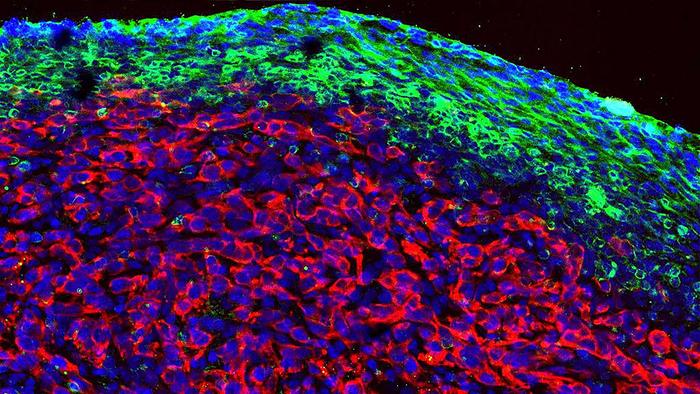
Credit: Fearon lab/Cold Spring Harbor Laboratory
The fight against cancer is an arms race, and one of the most effective weapons in clinicians’ arsenals is immunotherapy. Immune checkpoint therapy has become the standard for treating several types of cancer. However, the Nobel Prize-winning strategy is ineffective for most pancreatic ductal adenocarcinoma (PDAC) patients.
“Immune checkpoint therapy is only an option in rare cases of PDAC,” Cold Spring Harbor Laboratory (CSHL) Professor Douglas Fearon says. “It’s only effective for patients with a specific subtype of PDAC—that’s less than 5% of all cases.”
Until recently, it was thought that PDAC didn’t trigger any kind of immune response. In 2023, Fearon and his team confirmed the opposite. Immune cells do go on the attack. But they struggle to infiltrate the deadly tumors, which allows PDAC to avoid destruction. Now, Fearon and former CSHL postdoc Jiayun Li have discovered that a common chemotherapy supplement called folinic acid weakens the cancer’s defenses in mice. They found that folinic acid elevates levels of two anti-cancer immune molecules within PDAC: natural killer T (NKT) cells and type-I interferons. In mice, this leads to a more effective immune response, slower tumor growth, and longer survival.
“We discovered that NKT cells enabled type-I interferon to be produced and, as a consequence, adaptive immune killing and expansion of T cells would occur,” says Fearon. “T cells respond to tumors, but they typically cannot get in there unless type-I interferon is produced. Folinic acid enhances that response.”
PDAC resists immune cells, using a protective shield built from two proteins—CXCR4 and CXCL12. This defensive wall is virtually impenetrable. But when the team treated PDAC tumors with folinic acid, cracks were revealed. The resulting elevated levels of NKT cells and type-I interferons acted like trail markers, highlighting a way past PDAC’s defenses. Cancer-killing immune cells that had been kept outside the wall were able to slip into the tumor and start fighting back.
The Fearon lab now aims to translate its discovery into new therapeutics. They’ve recently partnered with biotech company Autobahn Labs to develop potential drugs targeting CXCR4 and CXCL12. These may one day make immune checkpoint therapy a regular option in the fight against PDAC.
“Translating observations in mice into human therapy has been difficult,” Fearon says. “But if we’re successful, immunotherapy may one day become a viable choice for all patients with PDAC—and every other solid tumor—not just in the rare cases we see today.”
Journal
Proceedings of the National Academy of Sciences
Article Publication Date
8-Jul-2024
Cite Scienmag News
Nathaniel Bowman. (August 26, 2024). Old chemo drug, new pancreatic cancer therapy? Scienmag. https://scienmag.com/old-chemo-drug-new-pancreatic-cancer-therapy/
Nathaniel Bowman. "Old chemo drug, new pancreatic cancer therapy?" Scienmag, 26 August 2024, https://scienmag.com/old-chemo-drug-new-pancreatic-cancer-therapy/. Accessed 3 September 2026.
Nathaniel Bowman. "Old chemo drug, new pancreatic cancer therapy?" Scienmag. August 26, 2024. https://scienmag.com/old-chemo-drug-new-pancreatic-cancer-therapy/

