


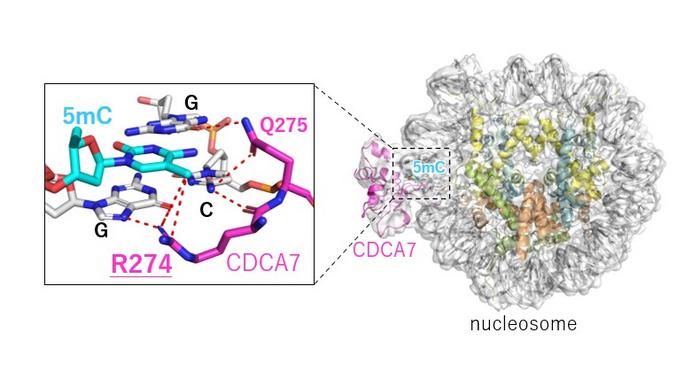
DNA methylation, a process by which methyl groups are added to DNA molecules, is essential for the maintenance of DNA and the overall health of an organism. Disruptions in the standard DNA methylation patterns can lead to immunodeficiency and diseases such as cancer. Helicase lymphoid-specific (HELLS) is an enzyme that facilitates DNA methylation by remodeling the nucleosome – the tightly packed structure of DNA wound around histone proteins. The absence of HELLS or its activator, cell division cycle associated 7 (CDCA7) is known to be a factor that leads to the disruption of DNA methylation. Mutations in the genes that code for HELLS and CDCA7 cause rare disorder immunodeficiency, centromeric instability, and facial anomalies (ICF) syndrome.

Credit: Kyohei Arita, Yokohama City University
DNA methylation, a process by which methyl groups are added to DNA molecules, is essential for the maintenance of DNA and the overall health of an organism. Disruptions in the standard DNA methylation patterns can lead to immunodeficiency and diseases such as cancer. Helicase lymphoid-specific (HELLS) is an enzyme that facilitates DNA methylation by remodeling the nucleosome – the tightly packed structure of DNA wound around histone proteins. The absence of HELLS or its activator, cell division cycle associated 7 (CDCA7) is known to be a factor that leads to the disruption of DNA methylation. Mutations in the genes that code for HELLS and CDCA7 cause rare disorder immunodeficiency, centromeric instability, and facial anomalies (ICF) syndrome.
Understanding why CDCA7-HELLS is crucial for maintaining DNA methylation is vital for gaining insights into the mechanism of disorders such as ICF syndrome. In a recent study published in Science Advances on August 23 2024, researchers have found that CDCA7 can recognize hemimethylation of DNA—a state where one strand of the DNA’s double helix is methylated but not the other—and recruit HELLS to complete methylation of the DNA. The researchers found that the hemimethylation-sensing zinc finger (HMZF) of CDCA7, which has been conserved throughout evolution, is key to its ability to perform maintenance DNA methylation. “We found that the CDCA7 gene, known as the causative gene of ICF syndrome, promotes DNA methylation by controlling the ubiquitination of histone H3 through specific binding to hemimethylated DNA on nucleosomes,” explains Associate Professor Atsuya Nishiyama from the Division of Cancer Cell Biology, The Institute of Medical Science, The University of Tokyo, one of the lead researchers of the study.
Dr. Nishiyama, together with Professor Hironori Funabiki and Dr. Isabel Wassing at The Rockefeller University, Professor Kyohei Arita from Yokohama City University and Professor Makoto Nakanishi from The University of Tokyo, examined the structure of the complex formed by CDCA7 and the nucleosome using single particle cryo-electron microscopy. They found that CDCA7, unlike other DNA methylation activators, uniquely identifies hemimethylated DNA in the outward-facing major groove of the nucleosome core particle (NCP). This discovery explains why mutations in CDCA7 associated with ICF syndrome led to a defective DNA maintenance methylation mechanism.
“Our findings suggest that CDCA7 and HELLS promote DNA methylation in a mechanism distinct from de novo DNA methylation, which is now consolidated by our demonstration that the CDCA7 HMZF domain specifically recognizes hemimethylated CpG, the substrate of the maintenance DNA methyltransferase DNMT1. ICF disease-associated mutations in the CDCA7 gene abolish its hemimethylated DNA binding, supporting the functional importance of hemimethylation detection by the CDCA7 gene,” Dr. Nishiyama notes.
These pioneering findings not only advance potential therapies for ICF syndrome but also open new frontiers in cancer prevention and anti-aging. Disruptions in DNA methylation is linked to cancer, while inefficient methylation is a hallmark of cellular aging. “Our study lays the groundwork for the development of new DNA methylation inhibitors and therapeutic drugs for ICF syndrome. Therapies that artificially regulate CDCA7-dependent DNA methylation may also prevent cancer and aging and help extend healthy lifespan,” Dr. Nishiyama concludes.
Journal
Science Advances
Method of Research
Experimental study
Subject of Research
Cells
Article Title
CDCA7 is an evolutionarily conserved hemimethylated DNA sensor in eukaryotes
Article Publication Date
23-Aug-2024
Cite Scienmag News
Nathaniel Bowman. (August 26, 2024). Unraveling the role of CDCA7 in maintenance of DNA methylation. Scienmag. https://scienmag.com/unraveling-the-role-of-cdca7-in-maintenance-of-dna-methylation/
Nathaniel Bowman. "Unraveling the role of CDCA7 in maintenance of DNA methylation." Scienmag, 26 August 2024, https://scienmag.com/unraveling-the-role-of-cdca7-in-maintenance-of-dna-methylation/. Accessed 3 September 2026.
Nathaniel Bowman. "Unraveling the role of CDCA7 in maintenance of DNA methylation." Scienmag. August 26, 2024. https://scienmag.com/unraveling-the-role-of-cdca7-in-maintenance-of-dna-methylation/

