


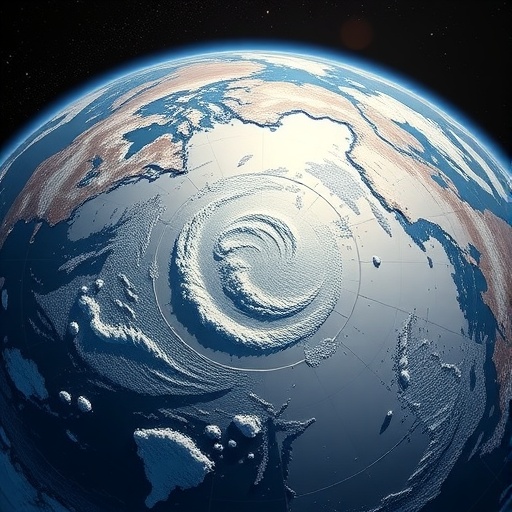
In a groundbreaking new study published in Nature Communications, researchers have unveiled a complex and previously underappreciated link between oceanic fronts and the stark differences observed in polar stratospheric extremes between the Northern and Southern Hemispheres. This pioneering research, conducted by an international team led by Omrani, Ogawa, and Nakamura, sheds fresh light on the dynamic interplay between oceanic and atmospheric processes that govern extreme climate events in Earth’s polar regions.
The polar stratosphere, characterized by cold temperatures and unique atmospheric chemistry, plays a vital role in global climate regulation. Extreme events in the polar stratosphere, such as sudden stratospheric warming (SSW) episodes, are phenomena that drastically alter weather and climate patterns, sometimes propagating their influence into the troposphere and beyond. However, hemispheric disparities in the frequency and intensity of such events have long posed a puzzle for climate scientists. This study provides compelling evidence that oceanic fronts—zones where ocean water masses with different temperatures and salinities meet—play a critical role in shaping these hemispheric contrasts.
One of the pivotal insights of this research is the recognition that oceanic fronts modulate regional atmospheric wave patterns, particularly the planetary-scale Rossby waves that can propagate from the ocean surface into the stratosphere. These wave patterns influence the polar vortex, the strong circumpolar winds that encircle the poles during the winter months. Variations in the behavior of the polar vortex underlie many of the extreme atmospheric events observed in the polar stratosphere.
The Northern Hemisphere, with its complex geography and numerous oceanic fronts such as those found in the North Atlantic and North Pacific, triggers more frequent and intense disruptions to the polar vortex. These disruptions often manifest as sudden stratospheric warming events. In contrast, the Southern Hemisphere’s oceanic fronts, including the Antarctic Polar Front, exhibit a different spatial configuration and ocean-atmosphere interaction dynamics, resulting in a relatively more stable and colder polar vortex with fewer extreme events.
Using state-of-the-art climate models coupled with comprehensive observational datasets, the team mapped how variability in sea surface temperature gradients along these oceanic fronts generates distinctive wave forcings. These forcings then ascend into the stratosphere, shaping the hemispheric asymmetry in polar stratospheric variability. The results reveal a direct causal link, bridging physical oceanography and stratospheric atmospheric dynamics in a novel interdisciplinary framework.
Crucially, the study delved into the mechanistic aspects of wave-mean flow interactions in the stratosphere, emphasizing how enhanced upward propagation of planetary waves from oceanic fronts leads to perturbations in the polar vortex’s strength and stability. These perturbations can weaken the vortex, causing it to break down suddenly and lead to extreme temperature anomalies in the stratosphere. This mechanistic understanding clarifies why the Northern Hemisphere experiences more dynamic stratospheric polar events than the Southern Hemisphere.
Moreover, the researchers highlighted the role of seasonal variability. Oceanic fronts exhibit seasonal shifts in position and intensity, which modulate the generation of planetary waves differently during various times of the year. This seasonality plays a crucial role in determining the timing and likelihood of sudden stratospheric warming events, thereby influencing mid-latitude weather patterns that can have profound societal impacts.
The study’s findings also have significant implications for climate modeling and prediction. By incorporating oceanic frontal variability more accurately into climate models, scientists can improve the reliability of forecasting polar stratospheric temperature extremes. These improvements could enhance seasonal weather prediction capabilities in both hemispheres, helping to anticipate anomalous winter conditions linked to stratospheric variability.
In addition to improving weather predictions, understanding the oceanic front influence on polar stratospheric extremes is pivotal in the context of anthropogenic climate change. As oceanic fronts are sensitive to long-term shifts in ocean circulation and temperature, changes in their characteristics may alter the frequency and intensity of polar stratospheric extreme events. This feedback loop highlights a critical area where ocean-atmosphere interactions may amplify or mitigate global climate impacts.
Significantly, the research team employed a suite of remote sensing observations, including satellite measurements of sea surface temperature and atmospheric wind fields, combined with reanalysis products, to validate their model-based findings. This robust cross-validation strengthens confidence in their conclusions and emphasizes the integrative approach necessary to understand complex Earth system interactions.
The study also opens new avenues for exploring the influence of other oceanic processes on stratospheric dynamics. For instance, mesoscale eddies and oceanic heat transport variability adjacent to fronts could further modulate atmospheric wave propagation, suggesting many layers of interaction yet to be fully unraveled.
Furthermore, the researchers discuss how their findings relate to teleconnection patterns such as the North Atlantic Oscillation (NAO) and Southern Annular Mode (SAM), which are influenced by stratospheric variability. Oceanic fronts potentially act as key regional drivers modulating these large-scale climate oscillations, thereby connecting oceanic processes directly with surface climate variability.
A deeper understanding of how oceanic fronts dictate hemispheric differences also challenges existing paradigms in climate science that often treat oceanic and atmospheric processes in relative isolation. This study represents a salient example of how integrated Earth system science can advance predictive science and reveal nuanced processes that regulate extreme climate behavior.
The implications extend beyond pure science to societal resilience. Since polar stratospheric extremes can influence jet stream behavior and winter storms, better anticipation of these events can inform policy decisions in sectors such as agriculture, energy, and disaster preparedness, potentially mitigating economic losses and enhancing public safety.
Overall, this landmark study by Omrani, Ogawa, Nakamura, and their colleagues revolutionizes understanding of the pivotal role of oceanic fronts in polar stratospheric climate extremes, bridging oceanography and atmospheric science in unraveling hemispheric climatic contrasts. This paradigm-shifting research not only deepens scientific knowledge but also underscores the intricate and interconnected nature of Earth’s climate system in an era of accelerating change.
Cite Scienmag News
Violet Maxwell. (April 20, 2026). Oceanic Fronts Drive Hemispheric Polar Stratosphere Extremes. Scienmag. https://scienmag.com/oceanic-fronts-drive-hemispheric-polar-stratosphere-extremes/
Violet Maxwell. "Oceanic Fronts Drive Hemispheric Polar Stratosphere Extremes." Scienmag, 20 April 2026, https://scienmag.com/oceanic-fronts-drive-hemispheric-polar-stratosphere-extremes/. Accessed 5 September 2026.
Violet Maxwell. "Oceanic Fronts Drive Hemispheric Polar Stratosphere Extremes." Scienmag. April 20, 2026. https://scienmag.com/oceanic-fronts-drive-hemispheric-polar-stratosphere-extremes/


