


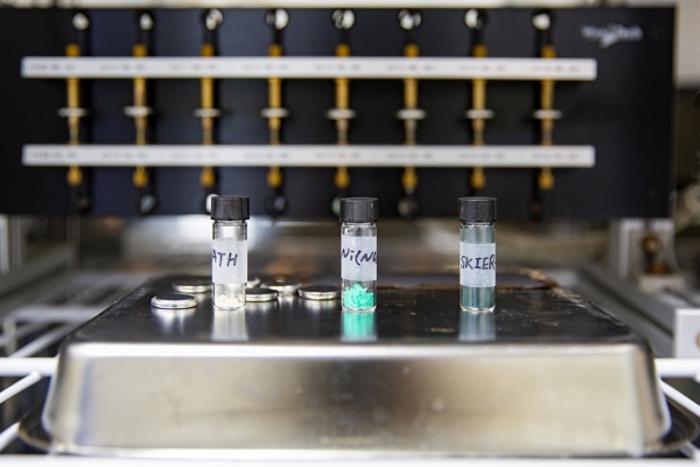
The Korea Institute of Energy Research (KIER) has developed a redox-active metal-organic hybrid electrode material (SKIER-5) for Li batteries that remains stable in cold conditions as low as minus 20 degrees Celsius. By addressing the limitations of graphite as an anode material of conventional Li batteries under freezing conditions, SKIER-5 has the potential to be a superior alternative. This novel material can be used in Li batteries for a variety of applications, including electric vehicles, drones, and ultra-small electronic devices, even in low temperatures.
![[Photo 1]](https://scienmag.com/wp-content/plugins/wp-fastest-cache-premium/pro/images/blank.gif)
Credit: KOREA INSTITUTE OF ENERGY RESEARCH
The Korea Institute of Energy Research (KIER) has developed a redox-active metal-organic hybrid electrode material (SKIER-5) for Li batteries that remains stable in cold conditions as low as minus 20 degrees Celsius. By addressing the limitations of graphite as an anode material of conventional Li batteries under freezing conditions, SKIER-5 has the potential to be a superior alternative. This novel material can be used in Li batteries for a variety of applications, including electric vehicles, drones, and ultra-small electronic devices, even in low temperatures.
Currently, graphite is the conventional material used for anodes in lithium-ion batteries due to its thermodynamic stability and low cost. However, batteries with graphite anodes have significant drawbacks: their storage capacity sharply decreases at subzero temperatures, and dendrites can form on the anode surface during charging. This can lead to thermal runaway and potential explosions.
*Dendrites: A form in which some lithium does not get stored in the anode material but instead accumulates on the anode surface in a branch-like elongated shape. If they grow large enough, they can penetrate the separator that divides the cathode and anode, reaching the cathode and causing a short circuit that can lead to an explosion.
A research team led by Dr. Jungjoon Yoo, Dr. Kanghoon Yim, and Dr. Hyunuk Kim at KIER has developed a redox-active conductive metal-organic framework called ‘SKIER-5’. This framework is assembled from a trianthrene-based organic ligand and nickel ions. SKIER-5 exhibited a discharge capacity five times higher than that of graphite in subzero environments.
SKIER-5 anode achieved a discharge capacity of 440 mAh/g, surpassing the 375 mAh/g of a graphite electrode at room temperature. Notably, after 1,600 charge-discharge cycles, the capacity increased by approximately 1.5 times (600 mAh/g). This is an exceptional result, as discharge capacity typically decreases with repeated charge-discharge cycles.
The research team confirmed the redox mechanism of SKIER-5 using high flux X-ray analysis at the Pohang Accelerator Laboratory. Unlike graphite, SKIER-5, which includes nickel ions and heteroatoms (N, F, S)-based organic ligands, interacts with Li ions to trigger redox reactions involving electron transfer. This process allows for increased electron storage, leading to a higher discharge capacity.
Notably, SKIER-5 achieved a discharge capacity of 150 mAh/g, which is five times higher than that of graphite at minus 20 degrees Celsius. This enhanced performance is attributed to SKIER-5’s lower minimum energy threshold for initiating chemical reactions compared to graphite. Consequently, SKIER-5 maintains stable performance in low-temperature environments where reaction rate typically decrease.
*Activation Energy (eV): The minimum energy required to initiate a chemical reaction, [SKIER-5 (0.23 eV) < Graphite (0.6 eV)].
The operating principle of SKIER-5 was validated using first-principles calculations based on quantum chemistry. The research team first determined the crystalline structure of SKIER-5, which was consistent with X-ray structural analysis, and predicted lithium adsorption sites to predict the material’s theoretical capacity and reaction voltage via calculation. The predicted values closely matched the experimental results, confirming the origin of the excellent performance of SKIER-5’s as a Li battery anode.
This research was supported by the Global Frontier Program of the Ministry of Science and ICT, the Basic Research Program of the Korea Institute of Energy Research, and the Creative Convergence Research Program of the National Research Council of Science & Technology. It was selected as a front cover paper in the world-renowned journal in the field of materials science, Journal of Materials Chemistry A (Impact Factor 10.7).
Journal
Journal of Materials Chemistry
Article Title
Redox-active conductive metal-organic framework with high lithium capacities at low temperatures
Article Publication Date
12-Jul-2024
Cite Scienmag News
Bethany Barker. (August 22, 2024). Novel redox-active metal-organic framework as an anode material for Li batteries operating in freezing conditions. Scienmag. https://scienmag.com/novel-redox-active-metal-organic-framework-as-an-anode-material-for-li-batteries-operating-in-freezing-conditions/
Bethany Barker. "Novel redox-active metal-organic framework as an anode material for Li batteries operating in freezing conditions." Scienmag, 22 August 2024, https://scienmag.com/novel-redox-active-metal-organic-framework-as-an-anode-material-for-li-batteries-operating-in-freezing-conditions/. Accessed 5 September 2026.
Bethany Barker. "Novel redox-active metal-organic framework as an anode material for Li batteries operating in freezing conditions." Scienmag. August 22, 2024. https://scienmag.com/novel-redox-active-metal-organic-framework-as-an-anode-material-for-li-batteries-operating-in-freezing-conditions/

