

Thursday, July 9, 2026
Science
No Result
View All Result
  • Login
  • HOME
  • SCIENCE NEWS
  • CONTACT US
  • HOME
  • SCIENCE NEWS
  • CONTACT US
No Result
View All Result
Scienmag
No Result
View All Result
Home Science News Medicine

AI can speed up drug development

August 22, 2024
in Medicine
Reading Time: 2 mins read
0
AI can speed up drug development
67
SHARES
610
VIEWS
Share on FacebookShare on Twitter
ADVERTISEMENT

Artificial intelligence (AI) can help identify molecules that could serve as new drugs for mental health disorders. AI can be used to predict the three-dimensional structures of important receptors and thereby speed up the development of potential drugs. This is the result of a new study from Uppsala University published in Science Advances.

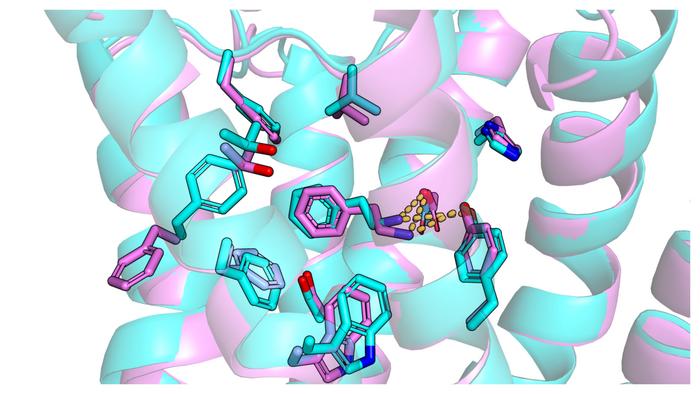
Comparison of the AI model of TAAR1 (turquoise) and a structure of the receptor determined by experiment (purple).

Credit: Alejandro Diaz

Artificial intelligence (AI) can help identify molecules that could serve as new drugs for mental health disorders. AI can be used to predict the three-dimensional structures of important receptors and thereby speed up the development of potential drugs. This is the result of a new study from Uppsala University published in Science Advances.

In drug development, experimental methods are often used to determine the three-dimensional structures of target proteins and to understand how molecules bind to them. This information is needed to design drug molecules efficiently. However, the process to determine structures can be demanding, meaning this strategy cannot always be used.

Thanks to the development of AI methods, the structures of proteins can now be predicted with higher accuracy than previously.

In the study, researchers at Uppsala University used AI to create a model of the unknown three-dimensional structure of a receptor. In this case the TAAR1 receptor, which is an interesting target protein for the development of drugs for mental health disorders. Drug molecules that activate TAAR1 have shown promising results in the treatment of schizophrenia and depression.

Using supercomputers, the researchers then searched chemical libraries containing millions of molecules to find those that best fitted the model. Molecules predicted to bind to the receptor were then tested in experiments by research colleagues at Karolinska Institutet. An unexpectedly large number of the molecules activated TAAR1, and one of the most potent also showed promising effects in animal experiments.

During the final stage of the study, experimental structures for TAAR1 suddenly became available and the researchers were able to compare them with the AI models.

“The accuracy of the structures generated with AI was astonishing – I couldn’t believe it. The results also show that modelling with AI is significantly better than traditional methods. We can now use the same strategy for receptors that we previously could only dream of working with,” explains Jens Carlsson, who led Uppsala University’s part of the study.


Journal

Science Advances

DOI

10.1126/sciadv.adn1524

Method of Research

Computational simulation/modeling

Subject of Research

Not applicable

Article Title

AlphaFold accelerated discovery of psychotropic agonists targeting the trace amine–associated receptor 1

Article Publication Date

7-Aug-2024

Share27Tweet17
Previous Post

Living plastics: a new solution for plastic degradation through synthetic biology

Next Post

Novel redox-active metal-organic framework as an anode material for Li batteries operating in freezing conditions

Related Posts

Most Obesity Drugs Fail to Enhance Life Quality or Heart Health
Medicine

Most Obesity Drugs Fail to Enhance Life Quality or Heart Health

July 9, 2026
Ancient Neuropeptides Control Alloparental Behavior in Ants
Medicine

Ancient Neuropeptides Control Alloparental Behavior in Ants

July 9, 2026
Brain’s Role in Linking Obesity to Gait Abnormalities Explored
Medicine

Brain’s Role in Linking Obesity to Gait Abnormalities Explored

July 9, 2026
New NIR fluorotag CETIF6a enhances tumor labeling and protein profiling
Medicine

New NIR fluorotag CETIF6a enhances tumor labeling and protein profiling

July 9, 2026
Obesity and Dietitian Groups Release Guidelines on Incretin Drug Use
Medicine

Obesity and Dietitian Groups Release Guidelines on Incretin Drug Use

July 9, 2026
Seafloor Spreading Event Revealed by In Situ Seismogeodesy
Medicine

Seafloor Spreading Event Revealed by In Situ Seismogeodesy

July 8, 2026
Next Post
Novel redox-active metal-organic framework as an anode material for Li

Novel redox-active metal-organic framework as an anode material for Li batteries operating in freezing conditions

  • Mothers who receive childcare support from maternal grandparents show more

    Mothers who receive childcare support from maternal grandparents show more parental warmth, finds NTU Singapore study

    27656 shares
    Share 11059 Tweet 6912
  • University of Seville Breaks 120-Year-Old Mystery, Revises a Key Einstein Concept

    1061 shares
    Share 424 Tweet 265
  • Bee body mass, pathogens and local climate influence heat tolerance

    682 shares
    Share 273 Tweet 171
  • Researchers record first-ever images and data of a shark experiencing a boat strike

    546 shares
    Share 218 Tweet 137
  • Groundbreaking Clinical Trial Reveals Lubiprostone Enhances Kidney Function

    531 shares
    Share 212 Tweet 133
Science

Embark on a thrilling journey of discovery with Scienmag.com—your ultimate source for cutting-edge breakthroughs. Immerse yourself in a world where curiosity knows no limits and tomorrow’s possibilities become today’s reality!

RECENT NEWS

  • Most Obesity Drugs Fail to Enhance Life Quality or Heart Health
  • Standard fetal growth charts frequently miss identifying at-risk babies
  • Ancient Neuropeptides Control Alloparental Behavior in Ants
  • Brain’s Role in Linking Obesity to Gait Abnormalities Explored

Categories

  • Agriculture
  • Anthropology
  • Archaeology
  • Athmospheric
  • Biology
  • Biotechnology
  • Blog
  • Bussines
  • Cancer
  • Chemistry
  • Climate
  • Earth Science
  • Editorial Policy
  • Marine
  • Mathematics
  • Medicine
  • Pediatry
  • Policy
  • Psychology & Psychiatry
  • Science Education
  • Social Science
  • Space
  • Technology and Engineering

Subscribe to Blog via Email

Enter your email address to subscribe to this blog and receive notifications of new posts by email.

Join 5,147 other subscribers

© 2025 Scienmag - Science Magazine

Welcome Back!

Login to your account below

Forgotten Password?

Retrieve your password

Please enter your username or email address to reset your password.

Log In
No Result
View All Result
  • HOME
  • SCIENCE NEWS
  • CONTACT US

© 2025 Scienmag - Science Magazine

Discover more from Science

Subscribe now to keep reading and get access to the full archive.

Continue reading
