


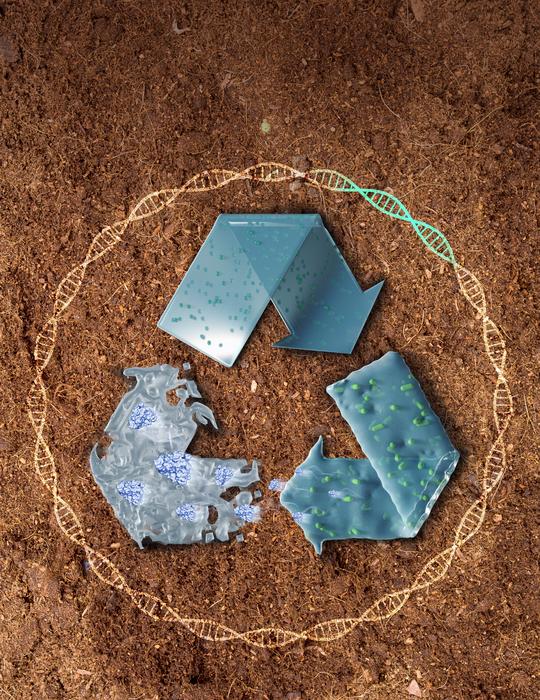
On August 21, 2024, Dr. DAI Zhuojun’s research group at the Shenzhen Institute of Advanced Technology (SIAT), Chinese Academy of Sciences (CAS), published a study titled “Degradable Living Plastics Programmed by Engineered Spores” in Nature Chemical Biology. The study leverages the natural resilience of spores, which can endure extreme environmental conditions, by programming them to secrete plastic-degrading enzymes under specific circumstances. These spores are embedded into plastic matrices through standard plastic processing methods, such as high temperature, high pressure, or the use of organic solvents. In normal conditions, the spores remain dormant, ensuring the plastic’s stable performance. However, when exposed to specific triggers like surface erosion or composting, the spores activate and initiate the degradation process, leading to the plastic’s complete breakdown.

Credit: DAI Zhuojun
On August 21, 2024, Dr. DAI Zhuojun’s research group at the Shenzhen Institute of Advanced Technology (SIAT), Chinese Academy of Sciences (CAS), published a study titled “Degradable Living Plastics Programmed by Engineered Spores” in Nature Chemical Biology. The study leverages the natural resilience of spores, which can endure extreme environmental conditions, by programming them to secrete plastic-degrading enzymes under specific circumstances. These spores are embedded into plastic matrices through standard plastic processing methods, such as high temperature, high pressure, or the use of organic solvents. In normal conditions, the spores remain dormant, ensuring the plastic’s stable performance. However, when exposed to specific triggers like surface erosion or composting, the spores activate and initiate the degradation process, leading to the plastic’s complete breakdown.
Research Background
The invention of plastics has improved our daily lives, but the massive production and improper disposal of plastic waste have made plastic pollution a major environmental issue. In 2016, Yoshida et al. discovered a bacterium, Ideonella sakaiensis, in poly (ethylene terephthalate) (PET)-contaminated soil near a recycling facility in Japan. This bacterium can grow using PET as its main carbon source by producing two key enzymes: PETase and MHETase. Since then, numerous synthetic biology research has been focusing on discovering, designing and evolving the relevant plastic-degrading enzymes, there has been little exploration of innovative methods for creating degradable plastics.
Dormant Spores and Living Plastics
Microorganisms have developed intrinsic mechanism to defend harsh conditions over billions of years. One classical example is the formation of spores that are resilient to dryness, high temperatures and high pressure (similar conditions in plastics processing). Using synthetic biology, the research team engineered Bacillus subtilis with a genetic circuit to control the secretion of a plastic-degrading enzyme (lipase BC from Burkholderia cepacia). Under stress from heavy metal ions, Bacillus subtilis forms spores. The team mixed these engineered spores with poly (caprolactone) (PCL) plastic granules and produced spore-containing plastics through high-temperature extrusion or solvent dissolution. Tests showed that these “living plastics” had similar physical properties to regular PCL plastics. During daily use, the spores remain dormant, ensuring the plastic’s stable performance.
Spore Release and Degradation Initiation
The first key step in plastic degradation is to release the spores embedded in the living plastic for cell reviving. Researchers have first demonstrated two methods of spore release. One method uses an enzyme (lipase CA) to erode the plastic surface. These released spores then germinated and expressed the lipase BC, which bound to the ends of PCL polymer chains and near-completely degraded the PCL molecules (final molecular weight <500 g/mol). The results showed that living plastic could degrade efficiently within 6-7 days, while ordinary PCL plastic subjected only to surface damage (lipase CA) still had a large amount of plastic debris after 21 days.
Another method for spores releasing is composting. In the absence of any additional exogenous agents, living plastics in soil could completely degrade within 25-30 days, while traditional PCL plastic took about 55 days to degrade to a level that was invisible to the naked eye.
Beyond PCL Plastics
As mentioned earlier, PCL’s processing conditions are relatively ‘mild’ among plastics. To verify the system’s general applicability, the team continued to testing other commercial plastic systems. They mixed spores carrying GFP expression plasmids with PBS (polybutylene succinate), PBAT (polybutylene adipate-co-terephthalate), PLA (polylactic acid), PHA (polyhydroxyalkanoates), and even PET (poly (ethylene terephthalate)) and processed the mixture at temperatures as high as 300oC. By releasing the spores through physical grinding, they surprisingly found that the spores could still revive and expressed the GFP. These results have laid a solid foundation for extending the method with other types of plastics.
To validate the potential for scaling up the system, the research team also conducted a small-scale industrial test on PCL system using a single-screw extruder. The generated living PCL still exhibited rapid and efficient degradation property (degrade within 7 days). In the absence of external factors, the living PCL maintained a stable shape, demonstrating its robustness during the service (stable in Sprite for two months). This study provides a novel method for fabricating green plastics that can function steadily when the spores are latent and decay when the spores are aroused and sheds light on the development of materials for sustainability.
Journal
Nature Chemical Biology
Method of Research
Commentary/editorial
Subject of Research
Not applicable
Article Title
Degradable living plastics programmed by engineered spores
Article Publication Date
21-Aug-2024
Cite Scienmag News
Gregory Coleman. (August 22, 2024). Living plastics: a new solution for plastic degradation through synthetic biology. Scienmag. https://scienmag.com/living-plastics-a-new-solution-for-plastic-degradation-through-synthetic-biology/
Gregory Coleman. "Living plastics: a new solution for plastic degradation through synthetic biology." Scienmag, 22 August 2024, https://scienmag.com/living-plastics-a-new-solution-for-plastic-degradation-through-synthetic-biology/. Accessed 3 September 2026.
Gregory Coleman. "Living plastics: a new solution for plastic degradation through synthetic biology." Scienmag. August 22, 2024. https://scienmag.com/living-plastics-a-new-solution-for-plastic-degradation-through-synthetic-biology/

