


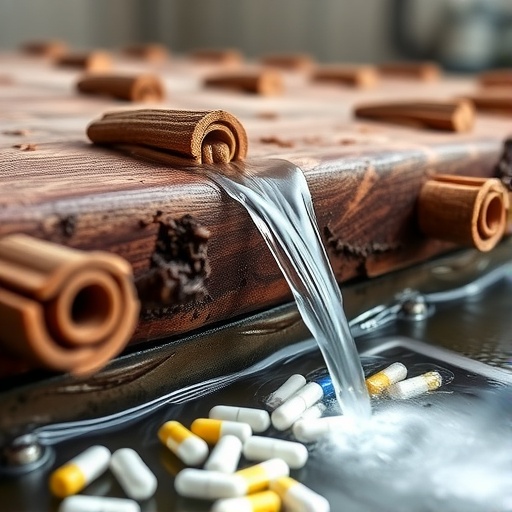
Every year, industrial and domestic effluents discharge roughly 0.3 billion tons of micropollutants into the world’s water bodies, a cocktail that includes antibiotics, hormones, antidepressants, anti-inflammatories and agrochemicals. Many of these compounds resist biodegradation, persist through conventional treatment plants, and accumulate in rivers, groundwater and even drinking water, where even trace concentrations have been linked to genetic and behavioural disruptions in aquatic organisms. Diclofenac, a common painkiller, has been measured at 0.38 to 7.1 micrograms per litre in surface waters worldwide. Against this backdrop, researchers at the University of Oulu in Finland, Chirag Batukbhai Godiya and Tiina Leiviskä of the Chemical Process Engineering group, have published a comprehensive review in Environmental Chemistry Letters arguing that one of the most promising and overlooked weapons against pharmaceutical water pollution may be sitting in the sawmill: wood.
The review, the first dedicated synthesis of wood-derived adsorbents specifically for pharmaceutical removal, catalogues four broad families of materials produced from timber and forestry waste: delignified wood sponges and aerogels, wood-derived biochar, wood-derived activated carbon, and functionalised wood and wood composites. Each exploits the same raw advantage. Wood is abundant, renewable, cheap and naturally hierarchical, composed of 40 to 45 percent cellulose, 20 to 35 percent hemicellulose and 10 to 30 percent lignin, all of which carry reactive hydroxyl and carboxyl groups that can be chemically decorated to tune adsorption behaviour. By weight, wood can also reach porosities above 90 percent and surface areas around 1,349 square metres per gram after processing, while hydrophobic surface treatments can push water contact angles to approximately 150 degrees, a combination that proves decisive for capturing organic drug molecules.
The performance numbers reported across the reviewed literature are striking. Engineered wood sponges achieved adsorption of up to 863.8 milligrams of tetracycline per gram of material and up to 321.3 milligrams of diclofenac per gram, a capability the authors attribute to high surface area, improved hydrophobicity and exceptionally low density. Wood-derived biochar removed up to 397.2 milligrams of the antibiotic sulfamethoxazole per gram, and wood-derived activated carbon removed up to 714.2 milligrams of amoxicillin per gram. Functionalised wood, where the internal surface chemistry is deliberately modified, reached 305.9 milligrams per gram for tetracycline and 350.0 for diclofenac, while wood composites recorded uptakes of 106.4 milligrams per gram for diclofenac and 310.7 for oxytetracycline hydrochloride. These figures place wood-derived materials on par with, and in several cases well ahead of, conventional activated carbons and synthetic adsorbents.
The chemistry behind the sponges is a lesson in elegant simplicity. Wood is first delignified, using enzymes, acids, alkalis, ionic liquids or organic solvents to strip out lignin and hemicellulose, leaving behind a cellulose skeleton with porosity exceeding 96 percent. The removal of lignin opens nanochannels between the fibres, preserving the wood’s intrinsic three-dimensional pore architecture while dramatically enhancing fluid transport. When balsa wood is treated with sulphite and then hydrogen peroxide, the thin cell walls break down entirely, and freeze-drying under ice templating assembles the remnants into a lamellar structure of stacked, interconnected arched layers with a density of just 15 milligrams per cubic centimetre. Reinforcing delignified poplar with polyvinyl alcohol yields aerogels that tolerate 40 percent reversible compression, while chemical vapour deposition of silanes transforms the same scaffold into a superhydrophobic, oleophilic matrix with a water contact angle of 151 degrees.
Biochar follows a different route. Biomass is pyrolysed at 400 to 800 degrees Celsius in an oxygen-depleted environment, releasing volatiles and leaving a solid aromatic carbon rich in adsorption sites. The temperature and feedstock govern the outcome: biochar produced at 600 degrees Celsius reaches 90 to 91 percent carbon content with a yield of roughly 30 percent, while pyrolysis at 800 to 1,000 degrees Celsius pushes carbon content to 94 to 96 percent at a cost in yield. Microwave-assisted pyrolysis and hydrothermal carbonisation offer faster or pre-drying-free alternatives. Post-treatment, such as sulphuric acid oxidation to introduce acidic functional groups or sodium hydroxide washing to increase surface area by 21 to 82 percent, further tailors the material for specific drug molecules.
Activated carbon production adds a second thermal step, activation, which refines the pore network. The review highlights how chemical activation with potassium hydroxide can lift the surface area of wood char from 27.3 to 1,194.4 square metres per gram, far exceeding what steam or carbon dioxide activation achieves on the same feedstock. In one study, dual physicochemical activation of acacia wood carbon using potassium hydroxide followed by microwave-assisted carbon dioxide gasification raised the mesopore surface area from 268.40 to 689.77 square metres per gram and carbon content from 20.92 to 78.60 percent. These numbers matter directly for pharmaceutical capture, since π–π stacking interactions between aromatic drug rings and graphitic carbon domains, along with pore filling, depend on accessible high-energy surfaces.
The review also documents composite strategies that push wood beyond simple carbon. Growing zeolitic imidazolate framework-67 crystals on wood surfaces and carbonising the result produces magnetic, mesoporous composites with saturation magnetisation up to 351.3 electromagnetic units per gram, allowing the spent adsorbent to be retrieved with a magnet. A MXene/wood composite built by impregnating and hot-pressing delignified balsa achieved a tensile strength of 68.1 megapascals, an electrical conductivity of 1,858 Siemens per metre and electromagnetic interference shielding of 32.7 decibels at a thickness of just 0.38 millimetres. Molecularly imprinted basswood membranes embedded with UiO-66 metal–organic frameworks selectively rebound ibuprofen at 120.6 milligrams per gram with separation coefficients above 6.0, thanks to imprinting cavities that match the drug’s shape and hydrogen-bonding pattern.
Mechanistically, the adsorption of pharmaceuticals onto wood-derived materials follows a recognisable set of interactions. Most studies report chemisorption-driven uptake best described by pseudo-second-order kinetics and Langmuir isotherms, indicating monolayer coverage on well-defined binding sites. Tetracycline adsorbs onto citric acid-modified wood most efficiently at pH 5, driven by hydrogen bonding between the wood’s carboxylic hydroxyl groups and the drug’s amide carbonyls, while at neutral pH dipole–dipole interactions between carboxylate groups and protonated dimethylamino groups dominate. Ciprofloxacin favours acidic conditions, where protonated drug molecules engage electrostatically with biochar surfaces, and diclofenac removal is often governed by π–π electron–donor–acceptor interactions, hydrophobic partitioning and pore filling. Perhaps most compelling is a β-cyclodextrin-grafted wood filter, whose interconnected three-dimensional network of microchannels, pits and micropores removed more than 97.5 percent of diclofenac, propranolol, amitriptyline, chlortetracycline and levofloxacin within 90 seconds.
The comparative analysis in the review also reveals that no single wood form wins universally. For tetracycline, the ranking is wood sponges, then functionalised wood, activated carbon, composites and biochar. For diclofenac, activated carbon leads at 490.4 milligrams per gram, followed by biochar, functionalised wood, sponges and composites. For paracetamol, activated carbon again dominates. The pattern reflects a trade-off between surface area, porosity, hydrophobicity and functional group density, and it underscores the authors’ central message: matching the adsorbent architecture to the molecular structure of the target contaminant is essential for optimal performance.
Crucially, the authors are candid about the gap between laboratory promise and industrial deployment. Most studies test concentrations of 5 to 150 milligrams per litre, vastly higher than the microgram-per-litre levels found in real effluents, potentially overestimating practical capacity. Real wastewater carries organic matter, inorganic salts and microorganisms that can foul adsorbent beds, and microbial growth inside wood can degrade flow and performance. Regeneration and safe disposal of spent biochar and activated carbon remain largely unexplored, and some functionalisation routes employ toxic reagents and energy-intensive processes. The reviewers call for green chemistry approaches, life cycle assessments, cost analyses and the use of demolition wood waste and forestry side streams such as sawdust and bark to keep the entire supply chain sustainable.
The broader implications are considerable. Adsorption is already the preferred pharmaceutical-removal technology for its simplicity, reusability and low by-product generation, and wood-derived adsorbents offer a carbon-neutral, scalable route to implementing it at scale. With global initiatives pushing water treatment toward sustainability, the Oulu review positions waste wood not as an environmental burden but as a high-performance platform, a forest product reborn as a water purifier, capable of pulling persistent antibiotics, anti-inflammatories and psychotropic drugs out of the streams that carry them into ecosystems and drinking water supplies.
Cite Scienmag News
Bethany Barker. (September 5, 2026). Wood-based adsorbents remove pharmaceuticals from wastewater, review finds. Scienmag. https://scienmag.com/wood-based-adsorbents-remove-pharmaceuticals-from-wastewater-review-finds/
Bethany Barker. "Wood-based adsorbents remove pharmaceuticals from wastewater, review finds." Scienmag, 5 September 2026, https://scienmag.com/wood-based-adsorbents-remove-pharmaceuticals-from-wastewater-review-finds/. Accessed 5 September 2026.
Bethany Barker. "Wood-based adsorbents remove pharmaceuticals from wastewater, review finds." Scienmag. September 5, 2026. https://scienmag.com/wood-based-adsorbents-remove-pharmaceuticals-from-wastewater-review-finds/


