


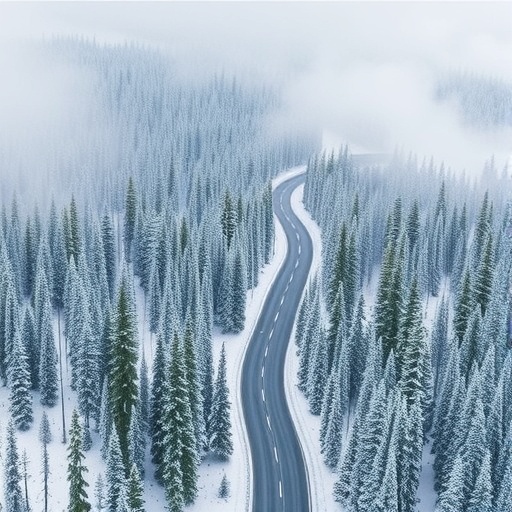
The vast, unbroken forests of Siberia—among the last great wildernesses on Earth—are being quietly carved apart by roads. According to a new study published in Nature Ecology & Evolution, fragmentation of Siberian intact forests driven by road expansion has quadrupled since the year 2000, a finding that carries profound implications for global carbon storage, biodiversity, and the trajectory of one of the planet’s most critical ecosystems. The research, led by Zhang Z.J., Li Z.B., and Wang M. and colleagues, offers the most comprehensive assessment to date of how the steady creep of road networks is dismantling the structural integrity of boreal forests that have remained essentially untouched for centuries.
Intact forest landscapes are defined as expanses of forest large enough and contiguous enough to retain their full complement of native species and ecological processes, free from significant human disturbance. Siberia hosts a substantial fraction of the world’s remaining intact forests, and these landscapes act as enormous reservoirs of carbon stored in both standing biomass and the underlying permafrost soils. When roads cut through these expanses, they do more than clear a narrow strip of trees. Roads act as vectors for further human activity—logging, mining, agricultural conversion, and fire ignition—that radiates outward from the road corridor, often reaching far deeper into the forest than the road itself. Ecologists refer to this phenomenon as the “road effect zone,” and it is the principal mechanism by which a modest amount of physical road construction can translate into disproportionate ecological damage.
The research team assembled satellite-based time series data spanning more than two decades, allowing them to track the construction of new roads and the corresponding fragmentation of intact forest across the full breadth of Siberia. Fragmentation, in the technical sense used by landscape ecologists, refers to the breaking of a large, continuous habitat into smaller, more isolated patches. This can be quantified using metrics such as patch density, edge density, the mean size of remaining forest patches, and the degree of connectivity between them. The study’s central finding is stark: between the turn of the millennium and the present, fragmentation attributable to road expansion in Siberian intact forests has increased fourfold. In practical terms, this means that the road network has densified and extended so rapidly that the average intact patch has shrunk dramatically while the proportion of forest lying within the influence zone of a road has surged.
The fourfold increase is not evenly distributed across the Siberian landmass, and the spatial pattern reveals much about the underlying drivers. The most intense fragmentation is concentrated in the southern boreal zone, where economic development, timber extraction, and proximity to population centers and transport corridors make road building both easier and more profitable. In these regions, previously remote forest tracts have become stitched through with a lattice of logging roads, access tracks, and upgraded transport arteries. Meanwhile, the more remote northern reaches—underlain by continuous permafrost and largely inaccessible—have so far retained larger contiguous blocks, although the study indicates that even these refugia are beginning to show early signs of incursion as climate warming extends the season during which ground conditions permit road construction and heavy vehicle traffic.
The timing of this acceleration is significant. The period after 2000 corresponds with a combination of economic and climatic shifts that jointly favored road expansion. Rising global demand for timber, minerals, and other natural resources created powerful commercial incentives to open new areas to extraction. At the same time, the warming Arctic and subarctic have thawed previously impassable ground, lengthened the operating windows for heavy machinery, and made winter roads—routes usable only when the ground is frozen—less reliable even as other construction techniques have advanced. The interaction of these forces means that the road network is expanding both through deliberate infrastructure investment and through informal, unplanned track creation associated with resource exploration and unauthorized logging.
From an ecological standpoint, the consequences of this fragmentation cascade through multiple levels of the system. Smaller forest patches support smaller populations of wide-ranging species, and the edges created by fragmentation alter microclimates, increasing light penetration, wind exposure, and drying at the forest margin. In boreal systems, edge effects are particularly consequential for fire regimes: disturbed edges dry out faster, accumulate more flammable debris, and serve as ignition points for human-caused fires. Fire, in turn, releases stored carbon, accelerates permafrost thaw, and can shift forest composition from cone-bearing conifers toward deciduous broadleaf species, fundamentally altering ecosystem function. A road network that fragments intact forest thus acts as an amplifier for the region’s already intensifying disturbance regime.
The carbon implications extend beyond fire. Siberian soils hold vast quantities of organic carbon accumulated over millennia, much of it locked in permafrost. Fragmentation and the associated disturbance increase soil respiration and the oxidation of organic matter, converting a long-term carbon sink into a potential source of atmospheric carbon dioxide. The study’s authors emphasize that the loss of intactness is therefore not merely an aesthetic or regional concern; it bears directly on global climate projections, because the fate of boreal carbon stocks is one of the major uncertainties in Earth system modeling. Every hectare of fragmented forest represents a hectare in which the processes that keep carbon locked away are progressively weakened.
The methodological approach underpinning these conclusions deserves attention because it illustrates the current state of the art in remote sensing-based ecology. Rather than relying on coarse land-cover classifications, which can miss narrow linear features such as roads, the researchers used high-resolution satellite imagery to map road networks directly, capturing even unpaved tracks that are invisible to coarser datasets. By combining this road map with time series of forest intactness, they could disentangle the contribution of road expansion from other drivers of landscape change. The longitudinal design—tracking the same regions continuously since 2000—is what allowed the team to compute a genuine rate of change, revealing that the pace of fragmentation has accelerated rather than merely grown in absolute terms. This distinction matters: a fourfold increase since 2000 implies that the current decade is likely seeing more fragmentation per year than any previous period in the observational record.
The study also raises difficult questions about governance and enforcement. Much of the road expansion in Siberian forests appears to occur outside formal planning frameworks. In remote regions, roads are frequently built by resource companies for their own operational purposes, or incrementally by local land users, and such roads may never appear in official registries. The gap between the official road network and the actual one on the ground means that conventional policy tools, which typically regulate designated infrastructure, capture only a fraction of the real fragmentation pressure. The authors’ satellite-based road inventory therefore provides an essential empirical foundation for any future effort to manage road density in the region, since effective policy must begin with an accurate picture of where roads actually exist and where they are spreading fastest.
For the international conservation community, the findings land at a moment of strategic urgency. Intact forest landscapes are a finite resource; once broken apart, their full ecological character is extraordinarily difficult to restore. Global frameworks for biodiversity conservation and forest protection increasingly recognize intactness itself as a conservation target, distinct from simple forest area, precisely because the ecological value of a large unbroken tract exceeds the sum of its fragmented parts. The Siberian case demonstrates how quickly that value can erode under sustained road pressure. The fourfold increase documented since 2000 suggests that, without deliberate intervention, the remaining intact blocks may approach fragmentation thresholds within the coming decades, beyond which the large-scale ecological processes that define these systems—natural fire regimes, wide-ranging wildlife populations, and stable carbon storage—can no longer be maintained.
The study in Nature Ecology & Evolution thus delivers both a warning and a tool. The warning is that one of the planet’s largest remaining wilderness frontiers is being subdivided at an accelerating rate, driven by resource economies and facilitated by a warming climate. The tool is a rigorous, spatially explicit, multi-decade accounting of road-driven fragmentation that can serve as a baseline for monitoring, planning, and international cooperation aimed at preserving what remains of Siberia’s intact forests. Whether that baseline becomes the marker of a turning point or a midpoint in the region’s fragmentation history will depend on decisions made in the years immediately ahead—about infrastructure investment, resource extraction, and the recognition that the quiet lines being drawn across the boreal forest are, in ecological terms, among the most consequential changes now underway anywhere on Earth.
Cite Scienmag News
Margaret Porter. (September 5, 2026). Road expansion has quadrupled fragmentation of Siberian intact forests since 2000. Scienmag. https://scienmag.com/road-expansion-has-quadrupled-fragmentation-of-siberian-intact-forests-since-2000/
Margaret Porter. "Road expansion has quadrupled fragmentation of Siberian intact forests since 2000." Scienmag, 5 September 2026, https://scienmag.com/road-expansion-has-quadrupled-fragmentation-of-siberian-intact-forests-since-2000/. Accessed 5 September 2026.
Margaret Porter. "Road expansion has quadrupled fragmentation of Siberian intact forests since 2000." Scienmag. September 5, 2026. https://scienmag.com/road-expansion-has-quadrupled-fragmentation-of-siberian-intact-forests-since-2000/


