


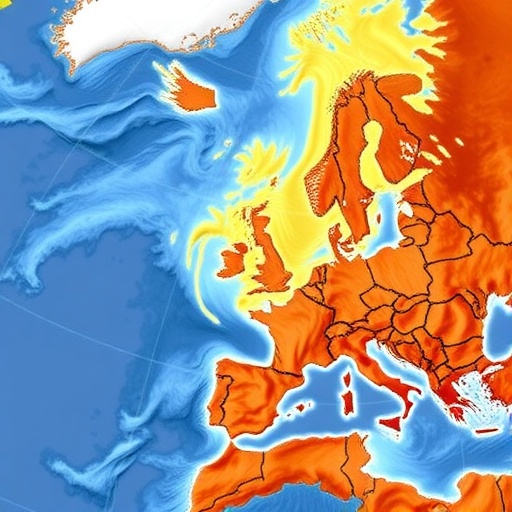
A groundbreaking study recently published in Nature Communications has unveiled a nuanced understanding of the mid-Pleistocene transition (MPT), a key climate event that dramatically reshaped Earth’s glacial cycles approximately 1.2 to 0.7 million years ago. The research, led by Quan, Sánchez Goñi, Yin, and colleagues, reveals that insolation-driven northern Atlantic westerly wind patterns played a pivotal role in orchestrating this complex transition through a triphasic process. This novel insight provides a fresh lens through which scientists can interpret the mechanisms behind Earth’s long-term climate variability and elucidates the intricate atmospheric-oceanic interplay that governs glacial evolution.
The MPT marks an enigmatic shift in Earth’s climate system when glacial cycles switched from a dominant 40,000-year periodicity to roughly 100,000-year cycles. Despite extensive research, the drivers behind this shift have remained elusive, with hypotheses often focusing on ice sheet dynamics, carbon cycle feedbacks, and orbital forcing. Quan et al.’s work breaks new ground by highlighting the key role played by the northern Atlantic westerlies—powerful winds that traverse the North Atlantic midlatitude zone—in mediating insolation effects and shaping the long-term climate behavior during the Pleistocene.
At the core of their analysis lies a sophisticated synthesis of Mediterranean sediment records, North Atlantic marine proxies, and climate modeling. By examining high-resolution paleoenvironmental data, the research team was able to reconstruct shifts in wind patterns and their temporal correlations with insolation changes, or variations in incoming solar radiation due to Earth’s orbital geometry. These records indicated that westerly wind intensities and trajectories did not alter gradually but instead exhibited distinct phases coinciding with key milestones of the MPT, suggesting a stepwise climatic reorganization rather than a smooth linear trend.
The first phase identified involves an initial strengthening of northern Atlantic westerlies linked to enhanced autumn and winter insolation, which likely promoted increased heat and moisture transport from the ocean to continental regions. This intensification of the westerlies exerted a profound influence on regional climates by modifying sea surface temperatures and influencing the extent of the North Atlantic Current, a critical conveyor of warm waters. Such atmospheric rearrangements would have altered ice sheet stability through changes in precipitation and temperature patterns, setting the stage for the subsequent phases of the MPT.
Following this, the second phase saw a redistribution of westerly wind patterns, characterized by more northerly trajectories and increased variability in their strength. This shift appears to correspond with feedback mechanisms involving sea ice expansion and retreat throughout glacial-interglacial cycles. The dynamic modification of wind patterns during this period likely reinforced the drawdown of atmospheric carbon dioxide, as ocean-atmosphere interactions influenced biological productivity and carbon sequestration in the North Atlantic. This feedback loop may have acted as an amplifying agent in pushing the climate system through the crucial thresholds defining the MPT.
Finally, the third phase revealed by the data shows the establishment of a more stable westerly wind regime, although still marked by episodic fluctuations tied to insolation peaks and troughs. This steady state could have supported the dominance of longer glacial cycles by maintaining climatic conditions conducive to large-scale ice sheet growth and persistence. The research underscores that this triphasic progression was neither abrupt nor uniform but instead marked by complex transitions mediated by a tightly coupled atmospheric and oceanic system responsive to subtle variations in external forcing.
Importantly, this study challenges previous paradigms that placed ice sheet dynamics and greenhouse gas concentrations at the center of the MPT narrative in isolation. Instead, it posits that atmospheric circulation, particularly the behavior of the westerlies governed by insolation patterns, constitutes a crucial piece of the puzzle. By integrating atmospheric circulation shifts with oceanic and cryospheric changes, the research presents a holistic view that could recalibrate how paleoclimatologists conceptualize key climate transitions.
Furthermore, the methodological approach employed by Quan and colleagues sets a new benchmark in paleoclimate research. Their blending of palaeodata and climate modeling, with an emphasis on multiproxy correlations and temporal resolution, allows for capturing subtle yet impactful climatic mechanisms that often escape detection in coarser temporal frameworks. This approach may inspire a reevaluation of other climate transitions throughout Earth’s history, where the role of atmospheric dynamics has been underappreciated.
The findings also carry implications for understanding future climate trajectories under anthropogenic forcing. Given that the northern Atlantic westerlies serve as a conduit of pole-to-equator heat transport and influence storm tracks and precipitation patterns, insights into their behavior during large-scale climate transitions enrich the predictive framework for potential future shifts in atmospheric circulation in response to greenhouse warming. Observations of modern shifts in these wind systems underscore the relevance of past patterns to contemporary climate dynamics.
Moreover, this research highlights the interconnectedness of Earth’s components—atmosphere, ocean, cryosphere, and biosphere—and demonstrates how minor tweaks in solar insolation can cascade into dramatic reconfigurations of the global climate system. The triphasic nature of the transition points to a complex feedback interdependence, where atmospheric circulation changes create conditions that amplify or dampen ice age cycles, giving them new periods and intensities.
In essence, the detailed documentation of insolation-driven westerly wind changes gives a fresh interpretative mechanism to explain the MPT. It expands the vocabulary of climatic drivers beyond ice sheets and greenhouse gases, situating atmospheric circulation as a central agent in long-term climate modulation. Early Earth climate researchers and modelers alike may find these results invaluable in refining conceptual frameworks and improving simulation accuracy.
As the work gains attention in the scientific community, multidisciplinary dialogues are expected to invigorate conferences and workshops devoted to Quaternary climate dynamics. This fresh perspective opens avenues to probe how regional atmospheric changes synchronize with global climate shifts, inviting new collaborative studies across geochemistry, sedimentology, and climate physics domains.
By illuminating the nuanced phases of wind pattern evolution tied to solar insolation, the research ultimately invites a reevaluation of how planetary-scale atmospheric circulation interacts with internal climate system variables. The implications stretch beyond paleoclimate, shaping modern climate science and our understanding of Earth system sensitivity.
To conclude, the study by Quan et al. marks a major advance in the quest to decode one of the most complex climate enigmas of the Pleistocene. It integrates paleoclimate data and theoretical models to reveal how northern Atlantic westerly wind patterns, modulated by insolation, orchestrated a three-phased mid-Pleistocene transition. This work exemplifies the power of cross-disciplinary research to unlock Earth’s climatic past in unprecedented detail, paving the way for better understanding future climate dynamics in a warming world.
Cite Scienmag News
Violet Maxwell. (July 1, 2026). Northern Atlantic Winds Shaped Mid-Pleistocene Transition. Scienmag. https://scienmag.com/northern-atlantic-winds-shaped-mid-pleistocene-transition/
Violet Maxwell. "Northern Atlantic Winds Shaped Mid-Pleistocene Transition." Scienmag, 1 July 2026, https://scienmag.com/northern-atlantic-winds-shaped-mid-pleistocene-transition/. Accessed 4 September 2026.
Violet Maxwell. "Northern Atlantic Winds Shaped Mid-Pleistocene Transition." Scienmag. July 1, 2026. https://scienmag.com/northern-atlantic-winds-shaped-mid-pleistocene-transition/


