


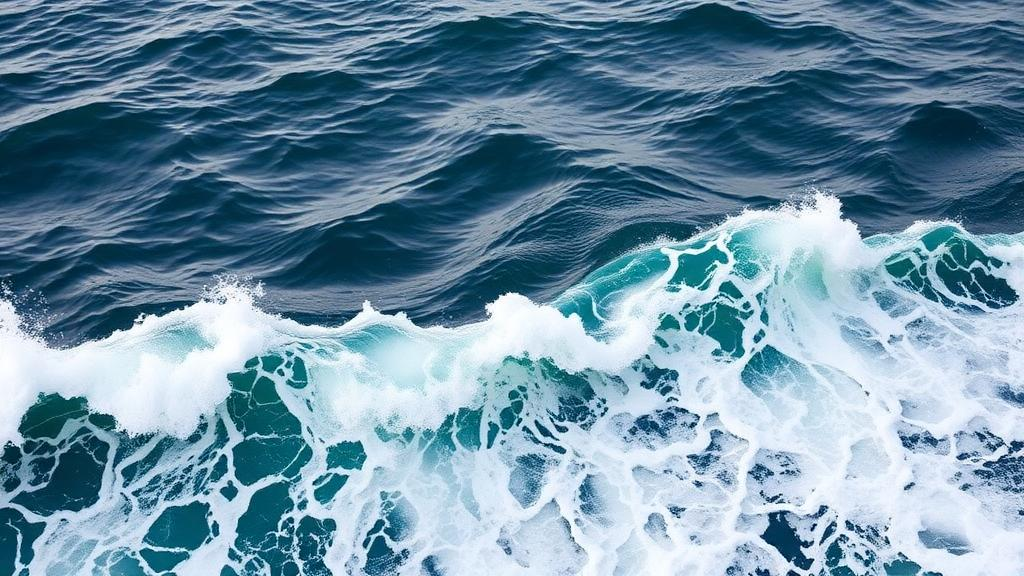
Waves are the ocean’s slow-motion fingerprints of climate change, and a new study has now read them across two of Europe’s most economically vital seas. In a comprehensive reanalysis published in Ocean Science, researchers Nikolaus Groll and Iris Grabemann of Helmholtz-Zentrum Hereon have assembled one of the largest regional wave climate ensembles ever constructed for the North Sea and the Baltic Sea, revealing a striking geographic split: significant wave heights are projected to rise along the eastern North Sea and across much of the Baltic, while falling along the western North Sea — with the magnitude of change hinging directly on how much greenhouse gas humanity emits in the coming decades.
The study revisits and dramatically expands earlier work published in 2015 and 2017, which had relied on a smaller set of climate projections drawn from the Coupled Model Intercomparison Project Phase 3, or CMIP3. By folding in newer simulations driven by CMIP5 global climate models, Groll and Grabemann assembled an ensemble of up to 14 regional wave projections for the North Sea and 8 for the Baltic Sea. Each projection combines a different global climate model, a different regional climate model used to downscale atmospheric conditions to local scales, different initial conditions, and different greenhouse gas emission scenarios. This deliberate diversity is what allows the researchers to separate genuine climate signals from the noise of natural variability.
At the heart of the analysis is the significant wave height — a standard oceanographic measure representing roughly the average height of the highest one-third of waves at a given location. It is the metric that coastal engineers, shipping companies, and offshore wind farm operators care about most, because it governs the forces that waves exert on breakwaters, ships, and turbine foundations. The researchers ran the third-generation spectral wave model WAM, forced by downscaled wind fields from the regional climate models, at a fine horizontal resolution of approximately 5 by 5 kilometres — fine enough to resolve the complex coastlines, shallow banks, and island chains that shape wave behaviour in these semi-enclosed seas.
The results paint a picture of a North Sea divided. By the final three decades of the 21st century, the ensemble projects a clear west-to-east gradient in wave height change. Along the British coast, median significant wave heights decrease by up to 5 percent, while in the eastern reaches — including the German Bight and the Skagerrak — annual maxima increase by more than 5 percent under high-emission scenarios. The 99th percentile of wave height, a proxy for extreme storm-driven seas, shows increases of 2.5 to 5 percent across the southern and eastern North Sea. These patterns are not uniform across all model runs, but they emerge as statistically robust when at least 11 of the 14 ensemble members agree on the direction and magnitude of change.
The Baltic Sea tells a different story altogether. Rather than a gradient, the ensemble projects a more widespread increase in wave heights across most of this brackish inland sea. Maximum significant wave heights rise by more than 5 percent in the central Baltic Proper, the Gulf of Riga, the Gulf of Finland, and areas west of Bornholm. Under high-emission scenarios, some central areas see increases exceeding 7.5 percent. The researchers attribute part of this Baltic-specific signal to a factor absent from the North Sea analysis: shrinking seasonal sea ice. As the climate warms, ice cover in the Bothnian Sea, the Bay of Bothnia, and the Gulf of Finland retreats, exposing previously protected waters to wind-driven wave generation for longer periods each year — a mechanism that amplifies the wave height increases in the northern Baltic.
What makes the study particularly valuable for climate policy is its explicit comparison of high- and low-emission futures. The researchers split their ensemble into two sub-groups based on projected atmospheric carbon dioxide concentrations in the year 2100, with a threshold of 700 parts per million separating the two. High-emission scenarios — including the SRES A1B and A2 pathways and the RCP8.5 pathway — consistently produce stronger and more spatially extensive wave height changes than their low-emission counterparts such as RCP2.6, B1, and B2. The spatial pattern of change remains the same in both cases, but the amplitude scales with the emissions trajectory, offering a direct illustration of how mitigation choices translate into physical ocean conditions.
Temporal analysis at four sentinel locations adds a crucial dimension of when these changes will become detectable. In the German Bight, the ensemble median of the 99th percentile wave height shows a statistically significant increase of more than 5 percent by the end of the century under high emissions, while low-emission scenarios produce changes too small to distinguish from natural variability. At Tyne, on the British coast, a steady and statistically significant decrease emerges from around 2030 onward under high emissions, reaching roughly 5 percent by 2100. In the Baltic, the Central Baltic Proper shows the most consistent signal, with high-emission scenarios producing statistically significant increases from mid-century onward — up to 10 percent in maximum wave height — while the Arkona Basin in the western Baltic shows more muted and delayed changes.
The physical mechanism behind these patterns lies in shifting atmospheric circulation. Previous analyses of the underlying climate models have identified an increased frequency of westerly wind patterns and a tendency toward more positive phases of the North Atlantic Oscillation, which steer stronger winds from the British Isles toward the Baltic. Zappa and colleagues showed in 2013 that the North Atlantic storm track is projected to extend toward Europe in winter under CMIP5 scenarios, and Ruosteenoja and colleagues found in 2019 that strong westerly winds become more frequent while easterly winds decline. The wave height changes documented by Groll and Grabemann are the ocean surface’s integrated response to these wind shifts — waves grow where westerly fetch lengthens and shrink where it shortens.
The authors are careful to frame their findings within the substantial internal variability that characterises regional climate projections. Individual ensemble members can deviate by as much as 20 percent in either direction from the ensemble mean, reflecting the chaotic nature of atmospheric dynamics on decadal timescales. This is precisely why the ensemble approach matters: no single simulation can be trusted to represent the future, but the consensus signal across many independent runs — each representing an equally plausible realisation of the climate system — provides a far more reliable picture. The researchers deliberately treated all ensemble members as equally likely, following the
Subject of Research: Projected changes in significant wave height in the North Sea and Baltic Sea under CMIP3 and CMIP5 climate scenarios
Article Title: An ensemble of regional CMIP3/CMIP5 wind wave scenarios for the North Sea and the Baltic Sea: a revisit
Article References: Groll, N., & Grabemann, I. (2026). An ensemble of regional CMIP3/CMIP5 wind wave scenarios for the North Sea and the Baltic Sea: a revisit. Ocean Science, 22(5), 3185-3206. https://doi.org/10.5194/os-22-3185-2026
Image Credits: AI Generated
Keywords: North Sea, Baltic Sea, significant wave height, wave climate, CMIP3, CMIP5, climate change, sea ice, regional climate models, WAM wave model, emission scenarios, coastal protection
Cite Scienmag News
Violet Maxwell. (October 16, 2026). North Sea Waves to Shrink While Baltic Seas Rise, Climate Ensemble Shows. Scienmag. https://scienmag.com/north-sea-waves-to-shrink-while-baltic-seas-rise-climate-ensemble-shows/
Violet Maxwell. "North Sea Waves to Shrink While Baltic Seas Rise, Climate Ensemble Shows." Scienmag, 16 October 2026, https://scienmag.com/north-sea-waves-to-shrink-while-baltic-seas-rise-climate-ensemble-shows/. Accessed 16 October 2026.
Violet Maxwell. "North Sea Waves to Shrink While Baltic Seas Rise, Climate Ensemble Shows." Scienmag. October 16, 2026. https://scienmag.com/north-sea-waves-to-shrink-while-baltic-seas-rise-climate-ensemble-shows/


