


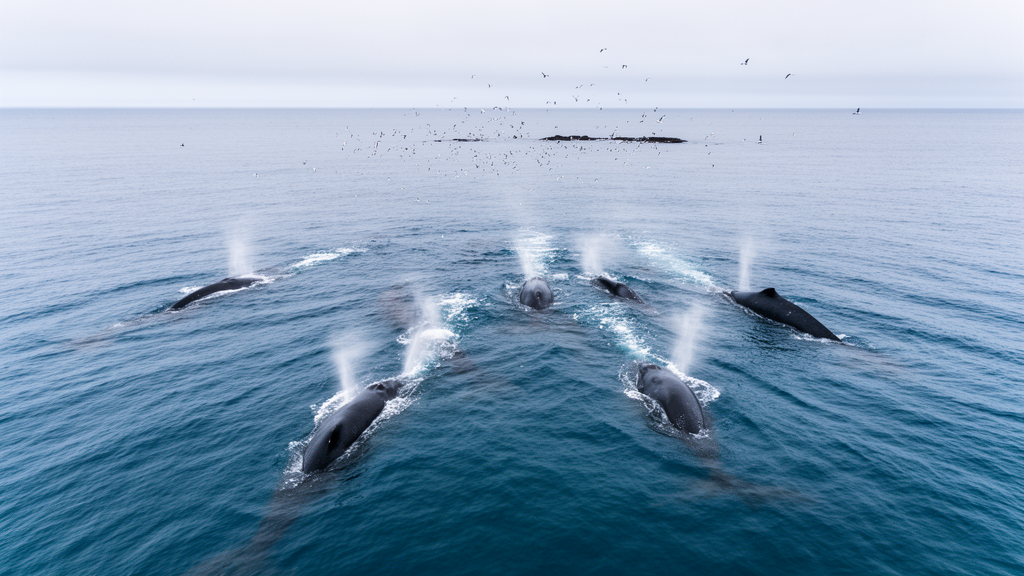
Some travellers take the scenic route. Others head straight for the destination. New research suggests southern right whales do much the same when crossing the Southern Ocean, and remarkably, both travel styles get them to dinner at roughly the same time. A team of scientists from the University of Auckland and international partners tracked 21 southern right whales, known in Māori as tohorā, from their winter breeding grounds in New Zealand’s subantarctic Auckland Islands/Maungahuka to their feeding grounds south of Australia. The findings, published in the journal Proceedings of the Royal Society B, reveal a striking degree of behavioural flexibility in one of the ocean’s largest migrants.
About half of the tracked whales took a direct route westward across the Southern Ocean. The other half headed much farther south before turning north again, creating a giant L-shaped journey across thousands of kilometres of open water. Despite these dramatically different travel plans, both groups reached their feeding grounds at approximately the same time. The whales taking the longer route left about a month earlier and travelled more slowly, while the late starters took the shorter path and moved a little faster. The mean journey time was 64 days for the long trip and 42 days for the short one, a convergence that suggests these animals are not simply drifting with the currents but actively managing their schedules.
Lead author Leena Riekkola says the findings suggest the whales may be balancing different priorities, much as people do on a road trip. Some individuals appear to be conserving energy, taking advantage of favourable conditions on a longer but potentially less demanding path, while others seem to be making up for lost time by pushing harder along a more direct route. This kind of individual variation in migration strategy is rarely documented in baleen whales, and it challenges the assumption that populations of large marine mammals follow rigid, uniform migratory programmes passed down without deviation.
The whales also showed flexibility from one year to the next. The researchers observed that a female might delay her migration in one year to allow her calf to grow bigger and stronger, taking the shorter route as a consequence, but then travel alone the following year and take the longer route instead. This suggests the animals are not locked into a single inherited pattern but are making decisions that respond to their immediate circumstances, including reproductive status and perhaps body condition. Such plasticity could prove decisive as ocean conditions shift in the coming decades.
Beyond the timing question, the study offers intriguing hints about how these giants navigate. The whales’ movements lined up with major ocean currents, underwater features and even subtle variations in Earth’s magnetic field. Rather than relying on a single cue, the animals seem to integrate several sources of information to find their way across a vast and largely featureless ocean. Multimodal navigation of this kind has been proposed for sea turtles and seabirds, but evidence in baleen whales has been difficult to gather, making these satellite tracks a valuable contribution to the field.
The use of multiple environmental signposts makes functional sense for an animal crossing the Southern Ocean, where weather systems are ferocious, surface landmarks are absent and currents can shift with the seasons. By combining information from currents, bathymetry and geomagnetic gradients, a whale could maintain a reliable heading even when any one cue becomes unreliable. The researchers suggest this redundancy in navigation systems may explain how southern right whales reliably locate productive feeding grounds year after year despite covering enormous distances.
Southern right whales were driven to near extinction by industrial whaling before receiving international protection, and the population that breeds in New Zealand’s subantarctic waters has been slowly recovering. Understanding how individual animals time and route their migrations matters for conservation, because it identifies which parts of the ocean the whales depend on and when. If some animals consistently travel through particular current systems or past particular seafloor features, those corridors become priorities for protection, especially as warming waters redraw the map of plankton and krill distribution in the Southern Ocean.
The researchers say this behavioural flexibility could be good news for the recovering population as the climate changes. Associate Professor Emma Carroll of the University of Auckland notes that a population able to adapt its behaviour has a better chance of coping with changing seas. If individual whales can switch between migration strategies depending on conditions, the population as a whole may be more resilient than one dependent on a single fixed pattern. That resilience, however, is not unlimited, and continued tracking studies will be needed to see whether these strategies hold up as the Southern Ocean warms.
The study was based on observational satellite tracking data and was published in Proceedings of the Royal Society B under the title Multiple strategies and cues define baleen whale migration. The scientists acknowledged the Kaitiaki Roopū o Murihiku and funders and supporters including Royal Society Te Apārangi, Live Ocean Foundation, the University of Auckland, the International Whaling Commission Southern Ocean Research Partnership, and the Antarctic and Southern Ocean Coalition. For now, the image of half a whale population ambling along a longer scenic route while the other half races along the short cut, all arriving at the same feeding table on time, offers a vivid reminder that even the ocean’s largest travellers have their own ways of getting where they need to be.
Subject of Research: Migration strategies and navigational cues of southern right whales in the Southern Ocean
Article Title: Whales take different routes but still reach dinner on time
Article References: Whales take different routes but still reach dinner on time. (n.d.). Original publication
Image Credits: AI Generated
DOI: Not provided
Keywords: southern right whale, whale migration, Southern Ocean, Auckland Islands, satellite tracking, baleen whales, navigation, magnetic field, ocean currents, climate change, New Zealand, Proceedings of the Royal Society B
Cite Scienmag News
Violet Maxwell. (October 16, 2026). Southern right whales choose different migration routes but arrive at feeding grounds on time. Scienmag. https://scienmag.com/southern-right-whales-choose-different-migration-routes-but-arrive-at-feeding-grounds-on-time/
Violet Maxwell. "Southern right whales choose different migration routes but arrive at feeding grounds on time." Scienmag, 16 October 2026, https://scienmag.com/southern-right-whales-choose-different-migration-routes-but-arrive-at-feeding-grounds-on-time/. Accessed 16 October 2026.
Violet Maxwell. "Southern right whales choose different migration routes but arrive at feeding grounds on time." Scienmag. October 16, 2026. https://scienmag.com/southern-right-whales-choose-different-migration-routes-but-arrive-at-feeding-grounds-on-time/


