


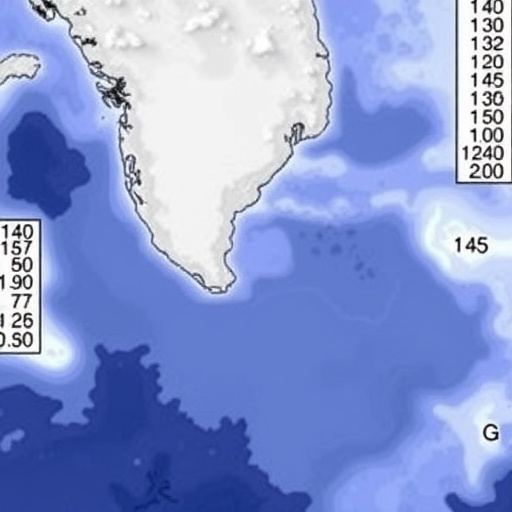
A new study published in Nature Communications reports that the North Atlantic Oscillation, or NAO, exerted a persistent influence on hydroclimate in southwestern Greenland throughout the Late Holocene. The finding places one of the North Atlantic’s most powerful atmospheric circulation patterns at the center of Greenland’s long-term climate story, suggesting that regional moisture and precipitation patterns were repeatedly shaped by large-scale changes in the atmosphere over the ocean. The study, led by J.C. Faust with Y. Zhang, A. Born and colleagues, reaches back beyond the modern instrumental record to examine how a climate system that is closely monitored today affected Greenland over thousands of years.
The NAO is a recurring pattern of atmospheric pressure differences between the subtropical North Atlantic and the region near Iceland. When the NAO is in its positive phase, the pressure contrast is stronger, typically intensifying the westerly winds that sweep across the North Atlantic. This can redirect storm tracks, alter the transport of moisture toward Europe and Greenland, and influence winter temperature and precipitation. During the negative phase, the pressure gradient weakens, the winds and storm paths shift, and the distribution of cold air and moisture changes across the basin. Although the NAO is often discussed in relation to seasonal weather, the new research highlights its potential to leave a much longer-lasting imprint on the climate of southwestern Greenland.
Hydroclimate describes the interaction between water and the climate system, including precipitation, evaporation, soil moisture, runoff, snow accumulation and the availability of water in landscapes and lakes. In Greenland, these processes are strongly controlled by the balance between snowfall, rainfall, meltwater and atmospheric moisture arriving from the North Atlantic. Southwestern Greenland is especially important because it lies at a climatic crossroads: it is exposed to North Atlantic storm systems, influenced by the Greenland Ice Sheet, and connected to coastal and inland environments that respond differently to changes in moisture. A persistent atmospheric influence in this region can therefore affect not only local ecosystems, but also the interpretation of Greenland’s wider environmental history.
The Late Holocene is the most recent portion of the Holocene Epoch, the interval that began after the last major ice age and extends to the present. Researchers often focus on this period because it contains both relatively stable natural climate conditions and increasingly strong evidence of human influence. It also provides an opportunity to compare the preindustrial climate with the modern era. By investigating how the NAO influenced southwestern Greenland during the Late Holocene, the study addresses a fundamental question in paleoclimatology: how stable are the relationships between atmospheric circulation and regional hydroclimate across centuries and millennia?
This question matters because a climate connection observed in modern measurements is not automatically permanent. The atmosphere responds to changes in ocean temperature, sea-ice cover, land-surface conditions, volcanic disturbances, solar variability and greenhouse-gas concentrations. These factors can amplify, weaken or reorganize circulation patterns. If the NAO repeatedly affected Greenland’s hydroclimate over the Late Holocene, that persistence would indicate that the link between North Atlantic atmospheric dynamics and regional water balance is deeply rooted in the climate system. It would also provide a longer baseline for determining which modern changes fall within the range of natural variability and which may represent a departure from the past.
The study’s central message is especially relevant because Greenland is undergoing rapid environmental change. Warming is altering the timing and intensity of snow accumulation and melt, while changes in rainfall, runoff and extreme weather can affect glaciers, lakes, rivers and coastal ecosystems. The Greenland Ice Sheet also influences global sea level, making any process that modifies surface mass balance scientifically important. Hydroclimate does not control the ice sheet alone, but precipitation arriving from the atmosphere and the conditions that determine whether it falls as snow or rain are crucial components of the overall balance between ice gain and ice loss.
Long-term climate records are essential for tracing these relationships because direct weather observations in Greenland cover only a limited period. Paleoclimate investigations can extend the record through natural archives that preserve evidence of past environmental conditions. Depending on the research design, such archives may include sediments, ice, biological remains, chemical signatures or other indicators that respond to precipitation and atmospheric circulation. These records are not simple weather diaries: they must be dated, calibrated and interpreted using physical and statistical models. Their value comes from combining multiple lines of evidence to reconstruct patterns that cannot be observed directly across centuries of changing climate.
The new paper therefore connects a modern atmospheric index with a much deeper history of Greenland’s climate, giving the NAO a role that extends beyond short-term forecasts and seasonal anomalies. Its conclusion that the oscillation had a persistent influence suggests that North Atlantic circulation should be treated as a key control on southwestern Greenland’s hydroclimate rather than as a temporary background fluctuation. The result may help scientists improve regional climate models, refine projections of future precipitation and runoff, and better understand how the ocean, atmosphere and ice sheet interact. As Greenland becomes one of the most closely watched regions on Earth, evidence that its water cycle has long been tied to the rhythm of the North Atlantic offers a powerful reminder: the forces shaping tomorrow’s climate may have been operating, in recognizable form, for thousands of years.
Cite Scienmag News
Violet Maxwell. (August 22, 2026). North Atlantic Oscillation Persistently Shaped Southwestern Greenland’s Late-Holocene Hydroclimate. Scienmag. https://scienmag.com/north-atlantic-oscillation-persistently-shaped-southwestern-greenlands-late-holocene-hydroclimate/
Violet Maxwell. "North Atlantic Oscillation Persistently Shaped Southwestern Greenland’s Late-Holocene Hydroclimate." Scienmag, 22 August 2026, https://scienmag.com/north-atlantic-oscillation-persistently-shaped-southwestern-greenlands-late-holocene-hydroclimate/. Accessed 4 September 2026.
Violet Maxwell. "North Atlantic Oscillation Persistently Shaped Southwestern Greenland’s Late-Holocene Hydroclimate." Scienmag. August 22, 2026. https://scienmag.com/north-atlantic-oscillation-persistently-shaped-southwestern-greenlands-late-holocene-hydroclimate/


