


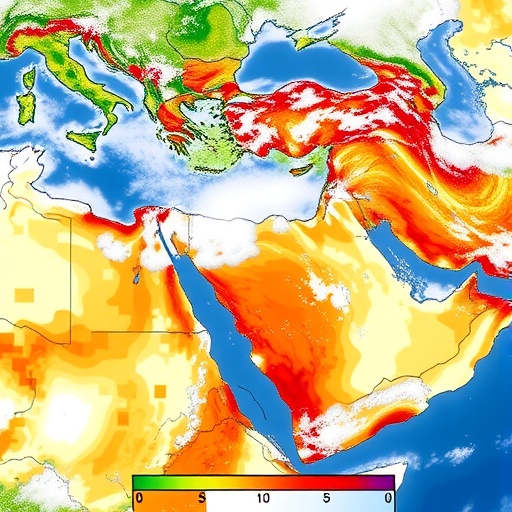
In a groundbreaking correction published recently in Environmental Earth Sciences, researcher H. Tatli revisits the complex and dynamic nature of precipitation patterns across the Mediterranean basin and the Middle East, drawing from an extensive analysis of ERA5 reanalysis data spanning from 1940 to 2024. This meticulous revision not only deepens our understanding of the nonlinear behavior of rainfall in one of the world’s most climatically sensitive regions but also sheds new light on the underlying atmospheric mechanisms that drive these fluctuations. The study underscores how the intersection of climatic variability and regional geographic attributes culminates in precipitation trends that defy simplistic forecasting models, challenging the traditional paradigms that have long guided hydrological and environmental sciences.
At the heart of this research lies the substantial utilization of ERA5 reanalysis—a state-of-the-art dataset produced by the European Centre for Medium-Range Weather Forecasts (ECMWF). ERA5 offers a global gridded climate record with unprecedented temporal and spatial resolution, enabling scientists to dissect historical weather and climate trends with remarkable accuracy. Tatli’s corrected analysis leverages this high-fidelity dataset to chart an intricate mosaic of precipitation trends over nearly a century, highlighting the influence of both natural climate oscillations and anthropogenic factors. The new findings disrupt previously held assumptions by revealing nonlinear precipitation responses to external forcings, emphasizing that traditional linear models insufficiently capture the region’s hydrological complexity.
The Mediterranean and Middle East region presents a unique and challenging environment for climatologists: a highly heterogeneous terrain coupled with variable atmospheric circulation patterns produces episodic yet impactful precipitation events. Tatli’s work brings to the forefront the interplay between large-scale atmospheric oscillations—such as the North Atlantic Oscillation and Mediterranean Oscillation—and localized orographic effects that collectively shape precipitation distribution. Notably, this revised study demonstrates how certain precipitation modes display pronounced sensitivity to subtle shifts in sea surface temperatures and atmospheric pressure gradients, leading to nonlinear precipitation anomalies that can swing from severe droughts to catastrophic floods within relatively short timescales.
The correction also addresses prior inaccuracies related to the treatment of long-term trends and variability. By refining statistical methodologies and incorporating updated climate model intercomparisons, the study ensures a more robust quantification of precipitation dynamics. This methodological enhancement is crucial because precipitation in this region is often governed by thresholds and feedbacks that amplify minor climatic perturbations, complicating the detection of genuine signals amid natural noise. Tatli meticulously separates these nonlinear responses from background variability, thereby providing a clearer lens through which future precipitation scenarios may be projected with greater confidence.
One of the most compelling aspects of Tatli’s revised research is its implications for regional water resource management and disaster preparedness. The Mediterranean and Middle East have been flagged for increasing water stress due to rising temperatures and erratic rainfall, which directly affects millions of inhabitants and critical ecosystems. The corrected precipitation patterns, showing abrupt nonlinear changes rather than smooth trends, imply that policymakers and planners must rethink existing hydrological models. Emergency response systems, agricultural planning, and urban infrastructure design all need to integrate these insights to enhance resilience against extreme weather events and shifting climatic baselines.
Climate change projections play a crucial role in contextualizing these findings. While global models forecast warming-induced alterations in precipitation regimes, Tatli’s correction elucidates that local and regional-scale processes can modulate or even counteract these broader trends. The ERA5 data examination reveals periods when regional precipitation does not align neatly with global temperature increases, thereby advocating for nuanced regional models that incorporate nonlinear feedback mechanisms. This awareness is especially pertinent given that the Mediterranean and Middle East are often considered climatic “hotspots,” where small meteorological changes can lead to outsized environmental and social impacts.
The research also delves into the influence of teleconnections and atmospheric circulation anomalies on precipitation variability. Tatli systematically correlates precipitation records with indices representing phenomena such as the El Niño-Southern Oscillation and the Arctic Oscillation, explaining how these global drivers can induce localized nonlinear responses within the Mediterranean and Middle Eastern precipitation regime. Contrary to linear attribution frameworks, the corrected analysis displays that teleconnective impacts may exhibit multiplicative effects or interact with regional dynamic feedbacks, further complicating prediction efforts and risk assessments.
Moreover, the study highlights advancements in reanalysis datasets like ERA5, emphasizing their instrumental role in climate diagnostics. This correction reflects the ongoing evolution of climate science in leveraging big data and improved data assimilation techniques to enhance our historical weather reconstructions. The reanalysis approach fills gaps often encountered in observational networks, especially in regions where direct meteorological measurements have been scarce or inconsistent over extended periods. Tatli’s work exemplifies how continuous refinement of these datasets and analytical methods can recalibrate scientific understanding and improve predictive accuracy in climate-sensitive regions.
Equally critical is the study’s evaluation of extreme precipitation events and their changing frequency or intensity. By finely dissecting historical rainfall data, the correction reveals patterns of clustering and nonstationarity, wherein extreme precipitation episodes do not follow stable probabilistic distributions but instead demonstrate bursts of heightened activity interspersed with quiescent intervals. This behavior challenges classical extreme value theory applications and calls for integrating nonlinear dynamics and complex system theory into climate risk modeling frameworks. Such refined modeling has paramount importance for flood risk mitigation and urban stormwater management in rapidly urbanizing Mediterranean and Middle Eastern locales.
Tatli’s analysis also engages with the broader scientific debate surrounding the relative roles of natural variability versus anthropogenic change in shaping precipitation trends. The study’s nonlinear perspective suggests a more intricate interplay where human-induced climate forcing modulates the amplitude and timing of natural precipitation cycles rather than simply imparting additive effects. This insight bolsters the need for integrated climate impact assessments considering both forced and internal variability components, thereby preventing misinterpretation of observational trends and misallocation of adaptation resources.
Furthermore, the corrected study has significant ramifications for agricultural productivity and food security in the Mediterranean and Middle East. Precipitation is a primary determinant of crop yields and grazing conditions, and the revealed nonlinear variability means that agricultural stakeholders face heightened uncertainty. Crop modeling and farming system simulations must incorporate this complexity to devise adaptive strategies that can buffer against volatile water availability and reduce vulnerability to sudden droughts or heavy rainfall. Tatli’s work thus contributes to the interdisciplinary nexus connecting climate science, agronomy, and socio-economic resilience planning.
The hydrological cycle’s feedbacks are also central to interpreting Tatli’s nonlinear findings. Atmospheric moisture transport, evapotranspiration rates, and soil moisture dynamics interact in convoluted ways, potentially inducing threshold effects and hysteresis within the system. The ERA5-driven correction exposes how alterations in one component reverberate through precipitation regimes, often in nonlinear fashions that are challenging to anticipate without sophisticated coupled climate-hydrology models. Understanding these interactions is key to improving forecasts and developing sustainable water management policies in the face of climate stressors.
On a methodological front, the correction advances techniques for identifying nonlinear patterns, incorporating approaches such as nonlinear time series analysis, regime shifts detection, and machine learning algorithms attuned to complex climatic signals. These innovative tools enable the distillation of meaningful precipitation dynamics from noisy data. Tatli’s methodological rigor exemplifies the importance of continually refining analytical frameworks to keep pace with evolving climate datasets and emerging scientific questions.
Looking ahead, the implications of this study invite a re-examination of climate adaptation strategies for the Mediterranean and Middle East. Policymakers and scientists alike must recognize that precipitation patterns cannot be adequately characterized by simple linear trends but demand flexible, dynamic frameworks that incorporate nonlinear system behavior. This paradigm shift affects sectors ranging from urban development and energy infrastructure to disaster risk reduction and biodiversity conservation, all of which depend heavily on accurate precipitation projections.
In sum, H. Tatli’s corrected analysis of nonlinear precipitation patterns using ERA5 reanalysis data not only refines our climatological understanding of the Mediterranean and Middle East but also sets a new standard for interpreting complex environmental data. As these regions grapple with the far-reaching consequences of climate change, such insights pave the way for smarter, science-based planning and risk management that can adapt to the inherent unpredictability of climate-driven precipitation variability.
Cite Scienmag News
Violet Maxwell. (July 31, 2025). Nonlinear Rainfall Trends in Mediterranean, Middle East. Scienmag. https://scienmag.com/nonlinear-rainfall-trends-in-mediterranean-middle-east/
Violet Maxwell. "Nonlinear Rainfall Trends in Mediterranean, Middle East." Scienmag, 31 July 2025, https://scienmag.com/nonlinear-rainfall-trends-in-mediterranean-middle-east/. Accessed 4 September 2026.
Violet Maxwell. "Nonlinear Rainfall Trends in Mediterranean, Middle East." Scienmag. July 31, 2025. https://scienmag.com/nonlinear-rainfall-trends-in-mediterranean-middle-east/


