

Wednesday, October 21, 2026
Science
No Result
View All Result
  • Login
  • HOME
  • SCIENCE NEWS
  • CONTACT US
  • HOME
  • SCIENCE NEWS
  • CONTACT US
No Result
View All Result
Scienmag
No Result
View All Result
Home Science News Medicine

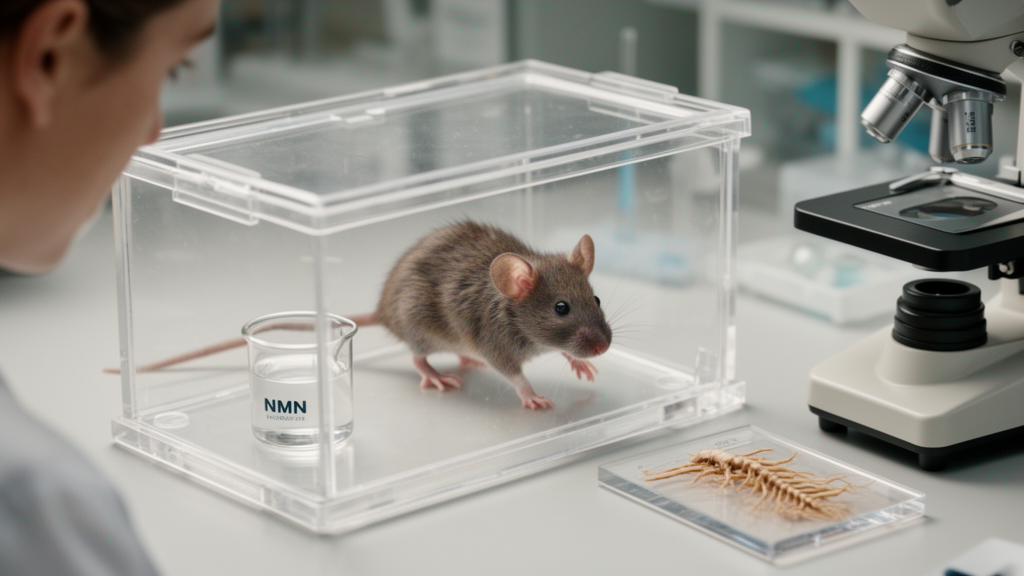
NMN reduces spinal cord damage and improves recovery in mouse study

October 21, 2026
in Medicine
Cassandra Pierce
By Cassandra Pierce Scienmag Editorial Profile - Systems Neuroscience
Reading Time: 3 mins read
0
NMN reduces spinal cord damage and improves recovery in mouse study

NMN reduces spinal cord damage and improves recovery in mouse study

65
SHARES
587
VIEWS
Share on FacebookShare on Twitter
ADVERTISEMENT

Nicotinamide mononucleotide, or NMN, raised levels of nicotinamide adenine dinucleotide, or NAD+, and reduced signs of spinal cord damage after a moderate contusion injury in mice, according to a preclinical study published in BMC Neuroscience. Researchers injected NMN immediately after injury and once daily for seven consecutive days. Treated mice had smaller areas of vacuolation and higher neuron counts in injured spinal cord tissue than animals receiving the comparison treatment.

They also performed better in tests of motor function, gait coordination, grip strength and endurance. The findings describe experimental effects in mice and do not demonstrate that NMN can treat spinal cord injury in people. Spinal cord injury can produce localized damage that extends to neighboring cells and tissues over hours, days or weeks, adding to the severity of the initial injury.

Intracellular NAD+ levels decline rapidly during this progression. NAD+ is a coenzyme involved in energy metabolism and other physiological processes, including tissue repair, so depletion of the molecule can adversely affect cells and amplify tissue damage. NMN is a direct precursor of NAD+.

The researchers tested whether increasing NAD+ after spinal cord injury could preserve tissue, restrain the post-injury inflammatory response and support motor recovery. The treatment regimen was 500 mg of NMN per kilogram of body weight, administered by intraperitoneal injection immediately after a moderate contusion-type spinal cord injury and then daily for seven days. Investigators examined spinal cord sections with paraffin hematoxylin-eosin staining to measure vacuole area and with immunofluorescence to assess neuron counts and fluorescence intensity.

The treated animals showed reduced vacuole area and increased neuron counts, indicating less visible tissue disruption under the experimental conditions. The study combined these structural measurements with behavioral assessments rather than examining biochemical changes alone. Motor outcomes were evaluated with the Basso Motor Scale, gait coordination analysis, grip strength assessment and a baton-transfer endurance test.

Mice treated with NMN performed better across these measures after the injury. The convergence between the tissue and behavioral results indicates that the histological protection observed in treated mice was accompanied by improved locomotor performance. Molecular measurements provided a possible explanation for the observed neuroprotection.

Transcriptome sequencing, quantitative reverse-transcription polymerase chain reaction, protein microarray analysis and enzyme-linked immunosorbent assays collectively suggested that NMN attenuated inflammatory responses after injury. Western blot analysis indicated that this effect may have been mediated through the NF-κB pathway. The proposed mechanism is that increasing NAD+ with NMN helps protect injured spinal cord tissue, limits neuroinflammation and thereby supports locomotor recovery.

The researchers described the pathway relationship as a possible mechanism in the mouse model, rather than a demonstrated clinical effect. Overall, the study provides preclinical evidence for NMN as an intervention that may reduce tissue injury and improve motor outcomes following spinal cord injury, while the scope of the reported experiment remains limited to mice tested with a specific dose, route and seven-day schedule.

Subject of Research: Preclinical testing of nicotinamide mononucleotide for spinal cord injury in mice

Article Title: Nicotinamide mononucleotide elevates NAD+ to protect spinal cord tissue from injury and reduces inflammatory response to promote motor recovery

Article References: Zhang, C., Li, Y., Yu, Y., Bai, F., Jing, Y., Talifu, Z., Wang, X., Zhang, X., Li, J., & Cui, G. (2026). Nicotinamide mononucleotide elevates NAD+ to protect spinal cord tissue from injury and reduces inflammatory response to promote motor recovery. BMC Neuroscience. https://doi.org/10.1186/s12868-026-01063-w

Image Credits: AI Generated

DOI: 10.1186/s12868-026-01063-w

Keywords: nicotinamide mononucleotide, NAD+, spinal cord injury, motor recovery, neuroprotection, neuroinflammation, NF-κB pathway, mouse model, contusion injury, tissue damage, Nicotinamide, mononucleotide

Cite Scienmag News

Cassandra Pierce. (October 21, 2026). NMN reduces spinal cord damage and improves recovery in mouse study. Scienmag. https://scienmag.com/nmn-reduces-spinal-cord-damage-and-improves-recovery-in-mouse-study/

Cassandra Pierce. "NMN reduces spinal cord damage and improves recovery in mouse study." Scienmag, 21 October 2026, https://scienmag.com/nmn-reduces-spinal-cord-damage-and-improves-recovery-in-mouse-study/. Accessed 21 October 2026.

Cassandra Pierce. "NMN reduces spinal cord damage and improves recovery in mouse study." Scienmag. October 21, 2026. https://scienmag.com/nmn-reduces-spinal-cord-damage-and-improves-recovery-in-mouse-study/


Tags: contusion injuryenergy metabolism in nerve cellsexperimental spinal cord injury therapymononucleotidemotor function recoverymotor recoverymouse modelNAD+NAD+ boostnerve tissue repairneuroinflammationNeuroprotectionneuroprotection in miceneuroregenerationNF-κB pathwaynicotinamidenicotinamide mononucleotideNMNpost-injury inflammationpreclinical neuroscience studyspinal cord damage reductionSpinal Cord Injuryspinal cord injury treatmenttissue damage
Share26Tweet16
Previous Post

ITPR3 phosphosites show site-specific co-regulation in human phosphoproteomics

Next Post

Research report: Local circuitry mechanisms underlying motor cortex stimulation for chronic pain treatment

Related Posts

Research report: Local circuitry mechanisms underlying motor cortex stimulation for chronic pain treatment
Medicine

Research report: Local circuitry mechanisms underlying motor cortex stimulation for chronic pain treatment

October 21, 2026
DynaVelo predicts B-cell mutation effects and rescue targets in mice
Medicine

DynaVelo predicts B-cell mutation effects and rescue targets in mice

October 21, 2026
Routine fertility conversations linked to better childhood cancer care perceptions
Medicine

Routine fertility conversations linked to better childhood cancer care perceptions

October 21, 2026
Smart wearable ownership tracks fewer depressive symptoms in older Chinese adults
Medicine

Smart wearable ownership tracks fewer depressive symptoms in older Chinese adults

October 21, 2026
Mouse study links corticohypothalamic circuit to waking from pup calls
Medicine

Mouse study links corticohypothalamic circuit to waking from pup calls

October 21, 2026
Preclinical study finds PTPN12 restrains colorectal cancer immunity
Medicine

Preclinical study finds PTPN12 restrains colorectal cancer immunity

October 21, 2026
Next Post
Research report: Local circuitry mechanisms underlying motor cortex stimulation for chronic pain treatment

Research report: Local circuitry mechanisms underlying motor cortex stimulation for chronic pain treatment

  • Mothers who receive childcare support from maternal grandparents show more optimized

    Mothers who receive childcare support from maternal grandparents show more parental warmth, finds NTU Singapore study

    27656 shares
    Share 11059 Tweet 6912
  • University of Seville Breaks 120-Year-Old Mystery, Revises a Key Einstein Concept

    1061 shares
    Share 424 Tweet 265
  • Bee body mass, pathogens and local climate influence heat tolerance

    682 shares
    Share 273 Tweet 171
  • Researchers record first-ever images and data of a shark experiencing a boat strike

    546 shares
    Share 218 Tweet 137
  • Groundbreaking Clinical Trial Reveals Lubiprostone Enhances Kidney Function

    531 shares
    Share 212 Tweet 133
Science

Embark on a thrilling journey of discovery with Scienmag.com—your ultimate source for cutting-edge breakthroughs. Immerse yourself in a world where curiosity knows no limits and tomorrow’s possibilities become today’s reality!

RECENT NEWS

  • Bacteriophages could help oncolytic viruses penetrate cold tumors
  • Mouse germinal-center confinement supports broader antibody responses
  • Norrin complex structure guides potent engineered signaling surrogates
  • Research report: Local circuitry mechanisms underlying motor cortex stimulation for chronic pain treatment

Categories

  • Agriculture
  • Anthropology
  • Archaeology
  • Athmospheric
  • Biology
  • Biotechnology
  • Blog
  • Bussines
  • Cancer
  • Chemistry
  • Climate
  • Earth Science
  • Editorial Policy
  • Marine
  • Mathematics
  • Medicine
  • Pediatry
  • Policy
  • Psychology & Psychiatry
  • Science Education
  • Science News
  • Social Science
  • Space
  • Technology and Engineering

Subscribe to Blog via Email

Enter your email address to subscribe to this blog and receive notifications of new posts by email.

Join 5,150 other subscribers

© 2025 Scienmag - Science Magazine

Welcome Back!

Login to your account below

Forgotten Password?

Retrieve your password

Please enter your username or email address to reset your password.

Log In
No Result
View All Result
  • HOME
  • SCIENCE NEWS
  • CONTACT US

© 2025 Scienmag - Science Magazine

Discover more from Science

Subscribe now to keep reading and get access to the full archive.

Continue reading