

Wednesday, October 21, 2026
Science
No Result
View All Result
  • Login
  • HOME
  • SCIENCE NEWS
  • CONTACT US
  • HOME
  • SCIENCE NEWS
  • CONTACT US
No Result
View All Result
Scienmag
No Result
View All Result
Home Science News Medicine

Mouse study links corticohypothalamic circuit to waking from pup calls

October 21, 2026
in Medicine
Cassandra Pierce
By Cassandra Pierce Scienmag Editorial Profile - Systems Neuroscience
Reading Time: 3 mins read
0
Mouse study links corticohypothalamic circuit to waking from pup calls

Mouse study links corticohypothalamic circuit to waking from pup calls

65
SHARES
587
VIEWS
Share on FacebookShare on Twitter
ADVERTISEMENT

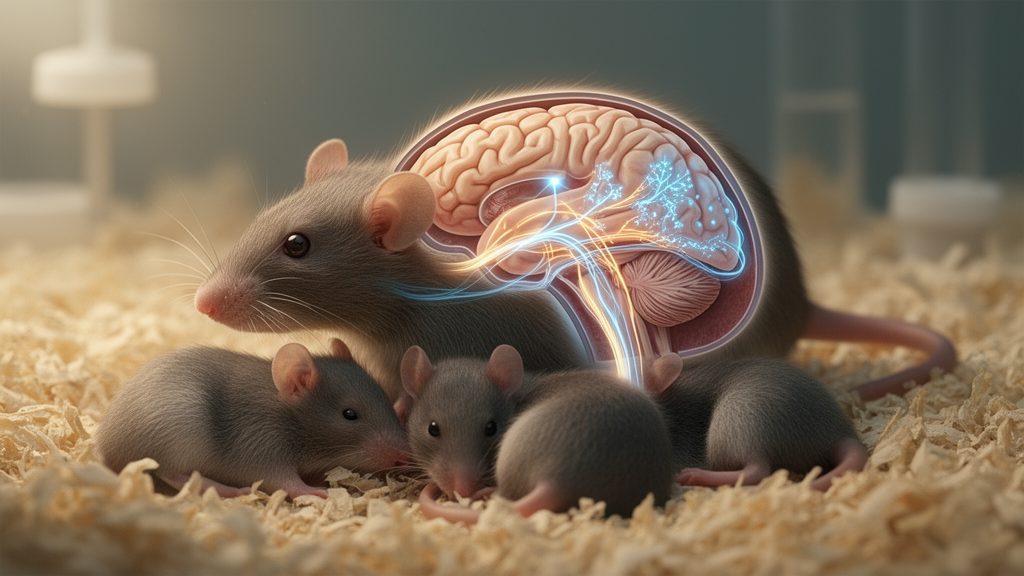
Sleeping female mice awaken in response to ultrasonic vocalizations, or USVs, produced by their pups, and a study in Nature Neuroscience identifies a corticohypothalamic circuit involved in this response. The findings point to layer 6 neurons in the temporal association and ectorhinal cortices, abbreviated TeA/Ect, that project to the preoptic area, or POA. The researchers report that disrupting this pathway reduced the awakening triggered by pup calls, showing that it mediates the behavioral response in the mouse experiments rather than merely correlating with it.

The investigators found that these USVs preferentially disrupted sleep in dams and that selected USVs reliably triggered arousal from non-rapid-eye-movement sleep. They then focused on the POA, where a population of neurons responded to pup USVs. Experimental evidence indicated that these USV-responsive POA neurons mediate pup-USV-induced awakening, linking a preoptic response to the transition from sleep to wakefulness.

The work addresses arousal itself; the supplied findings do not establish that waking through this circuit leads to any particular subsequent caregiving action. The TeA/Ect-to-POA pathway mediated pup-USV-induced maternal awakening, whereas awakening induced by non-social sounds was independent of that pathway. This selectivity is a central part of the reported result: in the tested conditions, the circuit was required for the response to pup vocalizations but not for the response to the comparison sounds.

The experiments therefore support a specialized role for the pathway in processing pup-related auditory cues, rather than showing that it mediates arousal from sound in general. Motherhood was associated with a change in how strongly the circuit responded. After dams transitioned to motherhood, TeA/Ect layer 6 neurons projecting to the POA showed enhanced responsiveness to pup calls.

The researchers linked this increase to greater expression of the dopamine D1 receptor gene, Drd1 , in the TeA/Ect-to-POA neurons. Further experiments showed that D1-expressing TeA/Ect layer 6 neurons mediated pup-USV-induced maternal awakening. The authors also traced an upstream route by which information about pup calls reaches the cortex.

They identified a pathway from the auditory thalamus to layer 6 TeA/Ect neurons and found that thalamic TeA/Ect-projecting neurons preserve responsiveness to pup USVs during non-rapid-eye-movement sleep. This provides a possible circuit-level route for a pup vocalization to be processed while a dam is asleep and then influence arousal through the corticohypothalamic pathway. The work was conducted in mice, and its conclusions are limited to the animals, sounds and experimental conditions tested.

Although the researchers describe the circuit as a possible fundamental adaptation for caregiving across mammals, the supplied evidence does not show that the same pathway, receptor dependence or behavioral effect operates identically in humans or other mammalian species.

Subject of Research: Neural mechanisms of maternal awakening to pup ultrasonic vocalizations in mice

Article Title: A corticohypothalamic circuit that mediates maternal awakening to pup cries

Article References: Tang, P., Wu, K., Pan, Y., Yang, S., Cai, Z., Liang, Y., Mai, F., Chen, P., Peng, M., Wang, Y., Chen, X., Song, C., Ji, X., & Liang, F. (2026). A corticohypothalamic circuit that mediates maternal awakening to pup cries. Nature Neuroscience. https://doi.org/10.1038/s41593-026-02458-y

Image Credits: AI Generated

DOI: 10.1038/s41593-026-02458-y

Keywords: maternal sleep, pup vocalizations, mouse neuroscience, corticohypothalamic circuit, preoptic area, temporal association cortex, ectorhinal cortex, dopamine D1 receptor, auditory thalamus, sleep arousal, corticohypothalamic, circuit

Cite Scienmag News

Cassandra Pierce. (October 21, 2026). Mouse study links corticohypothalamic circuit to waking from pup calls. Scienmag. https://scienmag.com/mouse-study-links-corticohypothalamic-circuit-to-waking-from-pup-calls/

Cassandra Pierce. "Mouse study links corticohypothalamic circuit to waking from pup calls." Scienmag, 21 October 2026, https://scienmag.com/mouse-study-links-corticohypothalamic-circuit-to-waking-from-pup-calls/. Accessed 21 October 2026.

Cassandra Pierce. "Mouse study links corticohypothalamic circuit to waking from pup calls." Scienmag. October 21, 2026. https://scienmag.com/mouse-study-links-corticohypothalamic-circuit-to-waking-from-pup-calls/


Tags: auditory thalamuscircuitcorticohypothalamiccorticohypothalamic circuitcorticohypothalamic projections and sleep regulationdopamine D1 receptorectorhinal cortexlayer 6 neurons in TeA/Ect cortexmaternal sleepmouse neurosciencemouse pup call responseneural mechanisms of maternal arousal to pup callsneural pathways mediating pup call-induced awakeningneuronal response to social sounds during sleeppreoptic areapreoptic area (POA) in sleep arousalpup vocalizationsrole of POA neuronssleep arousalsleep disruption by pup USVs in female micetemporal association cortexultrasonic vocalizations (USVs) and maternal sleep
Share26Tweet16
Previous Post

Stem-cell vesicles and cells alter rat response to vaginal mesh

Next Post

Smart wearable ownership tracks fewer depressive symptoms in older Chinese adults

Related Posts

Smart wearable ownership tracks fewer depressive symptoms in older Chinese adults
Medicine

Smart wearable ownership tracks fewer depressive symptoms in older Chinese adults

October 21, 2026
Preclinical study finds PTPN12 restrains colorectal cancer immunity
Medicine

Preclinical study finds PTPN12 restrains colorectal cancer immunity

October 21, 2026
Screening-defined neurocognitive impairment frequent in vulnerable Amazonian HIV cohort
Medicine

Screening-defined neurocognitive impairment frequent in vulnerable Amazonian HIV cohort

October 21, 2026
Research report: Barriers and facilitators to career progression and leadership among internationally educated nurses and midwives in the UK: a mixed methods systematic review
Medicine

Research report: Barriers and facilitators to career progression and leadership among internationally educated nurses and midwives in the UK: a mixed methods systematic review

October 21, 2026
Beyond generalist AI: purpose-built foundation models for transplantation
Medicine

Beyond generalist AI: purpose-built foundation models for transplantation

October 21, 2026
Structured Nursing Education Linked to Better Colorectal Surgery Outcomes
Medicine

Structured Nursing Education Linked to Better Colorectal Surgery Outcomes

October 21, 2026
Next Post
Smart wearable ownership tracks fewer depressive symptoms in older Chinese adults

Smart wearable ownership tracks fewer depressive symptoms in older Chinese adults

  • Mothers who receive childcare support from maternal grandparents show more optimized

    Mothers who receive childcare support from maternal grandparents show more parental warmth, finds NTU Singapore study

    27656 shares
    Share 11059 Tweet 6912
  • University of Seville Breaks 120-Year-Old Mystery, Revises a Key Einstein Concept

    1061 shares
    Share 424 Tweet 265
  • Bee body mass, pathogens and local climate influence heat tolerance

    682 shares
    Share 273 Tweet 171
  • Researchers record first-ever images and data of a shark experiencing a boat strike

    546 shares
    Share 218 Tweet 137
  • Groundbreaking Clinical Trial Reveals Lubiprostone Enhances Kidney Function

    531 shares
    Share 212 Tweet 133
Science

Embark on a thrilling journey of discovery with Scienmag.com—your ultimate source for cutting-edge breakthroughs. Immerse yourself in a world where curiosity knows no limits and tomorrow’s possibilities become today’s reality!

RECENT NEWS

  • Graph-learning model reports high drug-response accuracy in cancer cell lines
  • Semantic popularity control outperforms count-based control in recommender studies
  • Smart wearable ownership tracks fewer depressive symptoms in older Chinese adults
  • Mouse study links corticohypothalamic circuit to waking from pup calls

Categories

  • Agriculture
  • Anthropology
  • Archaeology
  • Athmospheric
  • Biology
  • Biotechnology
  • Blog
  • Bussines
  • Cancer
  • Chemistry
  • Climate
  • Earth Science
  • Editorial Policy
  • Marine
  • Mathematics
  • Medicine
  • Pediatry
  • Policy
  • Psychology & Psychiatry
  • Science Education
  • Science News
  • Social Science
  • Space
  • Technology and Engineering

Subscribe to Blog via Email

Enter your email address to subscribe to this blog and receive notifications of new posts by email.

Join 5,150 other subscribers

© 2025 Scienmag - Science Magazine

Welcome Back!

Login to your account below

Forgotten Password?

Retrieve your password

Please enter your username or email address to reset your password.

Log In
No Result
View All Result
  • HOME
  • SCIENCE NEWS
  • CONTACT US

© 2025 Scienmag - Science Magazine

Discover more from Science

Subscribe now to keep reading and get access to the full archive.

Continue reading