


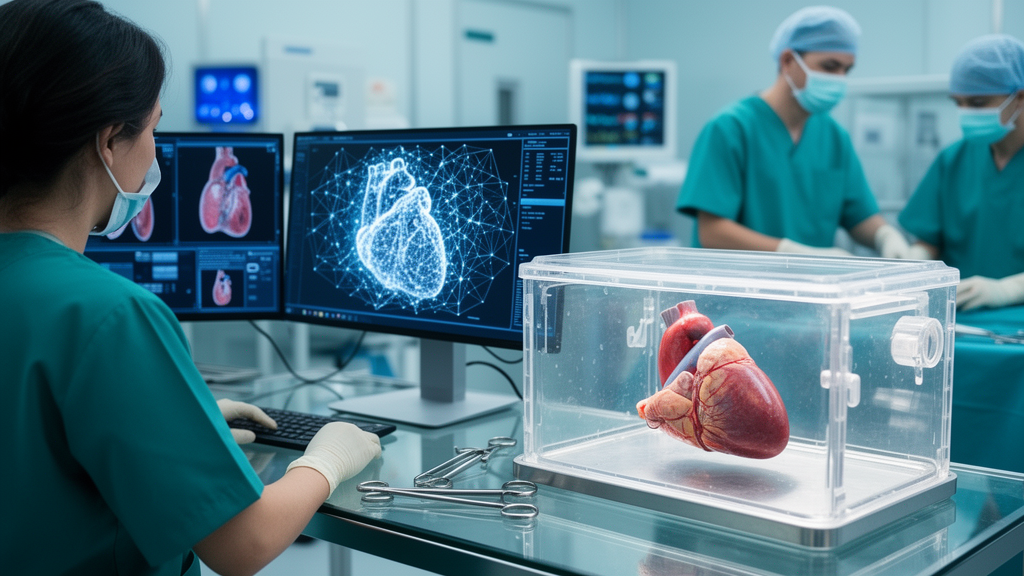
A 2026 Perspective argues that solid organ transplantation requires foundation models built around a linked donor–recipient–graft ecosystem rather than general-purpose medical AI centered on one patient and a static clinical snapshot. The authors define “transplant-native” models as those whose underlying representations are developed using transplant-native data and learning objectives, either through new pretraining or substantial continued pretraining of an existing model. Their proposal sets out five requirements: joint donor–recipient–graft representation, longitudinal continuum memory, multimodal integration, decision awareness, and continual adaptation and grounding under human oversight.
It is a conceptual roadmap rather than a report of a new model, clinical trial or demonstrated improvement in patient outcomes. The argument rests on the unusual structure of transplantation, in which a specific donor organ is transplanted into a specific recipient and the outcome depends on their interaction. Donor injury, organ quality and ischemic exposure can alter the result even when recipient characteristics and immunological compatibility appear favorable.
Alloimmune risk is managed through human leukocyte antigen matching, donor-specific antibody screening, crossmatching and immunosuppression, but these components do not exist independently of surgery, subsequent treatment and the evolving condition of both graft and recipient. The authors therefore propose that paired biological success, rather than prognosis for an isolated patient, should be the central object learned from transplant-native pretraining onward. Constructing that view presents a major data problem because donor and recipient information is usually stored separately.
Recipient records commonly reside in local electronic health systems, whereas donor characteristics, organ-quality variables and procurement details may be distributed across donor hospitals, organ procurement organizations, allocation systems, pathology platforms and procurement records. A model trained on a single hospital’s records may consequently lack the joint donor–recipient perspective needed to evaluate an organ offer. The authors describe this as an architectural mismatch, not merely a shortage of data: greater scale cannot guarantee that relationships absent from a model’s training objective will be reconstructed reliably.
Time introduces another requirement because transplant care spans pre-transplant, peri-operative and post-transplant phases, and the relevance of evidence changes between them. The same laboratory result or biopsy pattern may carry different implications depending on when it appears, what preceded it and how the graft trajectory is changing. Models optimized for a single admission, imaging study or pathology slide may treat each encounter as diagnostically self-contained, whereas transplant clinicians interpret findings against an evolving physiological state.
A transplant-native foundation model would therefore need longitudinal state representations that persist across phase transitions and update the interpretation of new evidence. The proposed unit of temporal reasoning is the transplant continuum itself, not disconnected predictions for each stage assembled after the fact. Transplant data are also multimodal, asynchronous and variably complete.
Crossmatch results and organ-quality imaging are most pertinent before transplantation, while donor-derived cell-free DNA, laboratory trajectories and biopsy histology become more important during post-transplant surveillance. The informative modalities also vary by organ: Banff histology is central to kidney transplantation, cardiac allograft vasculopathy imaging is important in heart transplantation, and vascular or bile-duct evaluation is important in liver transplantation. A suitable system cannot simply assume that all sources are co-present, equally informative or collected at the same time.
It must accommodate a changing hierarchy of evidence and relate each modality to the organ, clinical stage and surrounding longitudinal context, rather than performing only fixed fusion or independent prediction on each data stream. Published applications to date have largely adapted general foundation models to isolated transplant tasks, including chest computed tomography, pathology, tabular prediction, clinical language and operative settings. Proposed or investigated uses include donor–recipient matching, eligibility assessment, operative planning, graft-loss prediction and rejection subtyping.
The authors say these studies demonstrate component feasibility but do not establish an integrated system that jointly learns donor–recipient representations, propagates information across the care continuum and embeds allocation constraints. Strong language performance on recipient charts, for example, does not by itself demonstrate transplant readiness, because organ offers, committee deliberations, donor histories, immunological records and allocation rules extend beyond a single recipient record. Simpler tabular approaches can match or exceed adapted foundation models on some metrics, making interpretability and deployment requirements important to adoption.
A language model may summarize clinical notes effectively while lacking the architecture needed to reconcile organ offers, HLA laboratories and allocation systems. An imaging model may perform segmentation or classification while remaining unable to distinguish rejection, infection, ischemia and chronic change without timing and other evidence. A pathology model adapted from oncology may not capture allograft injury interpreted through Banff criteria, donor-specific antibodies and serial biopsy change.
The proposed response is transplant-native pretraining or substantial continued pretraining, followed by instruction tuning, retrieval-augmented reasoning and multimodal continual learning. Retrieval-augmented systems could ground outputs in transplant guidelines, protocols, current evidence, de-identified clinical notes and individual patient records, drawing on surgery, pathology, immunology, infectious disease, pharmacology and ethics. The authors also discuss dynamic models built around counterfactual reasoning, which could support exploratory analysis of how different immunosuppression regimens, organ offers, treatment timings or allocation choices might correspond to different graft trajectories.
Such simulations would not provide causal proof. Transplant records are observational and subject to confounding, incomplete measurement and limited documentation of alternatives that were not chosen. Models can organize these records and support bounded scenario analysis, but retrospective associations cannot establish that a proposed alternative would cause a better outcome, making rigorous validation essential before clinical use.
The data roadmap begins with harmonized donor–recipient–graft datasets, common data elements, standardized outcomes and provenance metadata that preserves timing, completeness, collection methods and informative missingness. Existing registries and multicentre consortia can support this work, while standards such as SNOMED CT, LOINC and HL7 FHIR could enable temporally aligned and interoperable exchange. The longer-term objective is privacy-preserving federated learning and multicentre evaluation without centralizing raw records.
These steps are important because retrospective performance can be distorted when models encounter cleaner, more complete or differently ordered data than they will face in practice. The authors do not claim that a registry alone is sufficient: allocation and outcome-monitoring systems do not necessarily contain the full multimodal detail required for transplant-native training. Validation must extend beyond retrospective discrimination metrics such as area under the receiver operating characteristic curve.
The proposed assessment includes calibration, uncertainty quantification, subgroup fairness across race and ethnicity, geography, organ type, pediatric and adult populations, and insurance or access patterns, alongside workflow integration and comparison with clinical standards. In the near term, evaluation should emphasize multicentre retrospective benchmarks using temporally ordered cases that reproduce incomplete and asynchronous evidence at genuine decision points. Later stages would include silent trials, clinician-in-the-loop assessment, pragmatic multicentre studies and measurement of clinical impact.
Long-term monitoring would need to identify model drift, hallucinations, unsafe recommendations, changes in clinical outcomes and cost-effectiveness, as well as whether decision support improves practice without increasing safety risks, disparities or workload. Deployment requires governance because transplant model outputs may affect access to scarce, life-sustaining organs, matching, immunosuppressive therapy and graft management. The authors argue that final adjudication must remain with clinical teams, while models are bounded to surfacing evidence, flagging uncertainty and supporting rather than replacing judgment.
Near-term use should therefore be supervised and assistive, including preparing committees, summarizing organ offers or helping triage surveillance, with uncertainty visualization, clinician overrides and audit trails. Because foundation models can generate adaptive and context-specific recommendations, deployment requires continuing regulatory oversight, liability arrangements, post-deployment surveillance, stakeholder collaboration and output monitoring. The central message is that transplant-native foundation models remain a proposed direction whose superiority over well-designed task-specific or adapted general models is not yet established; their eventual value must be judged in clinical settings, not benchmarks alone, with patient safety, fair access and bounded human oversight as structural requirements.
Subject of Research: A Perspective proposing design requirements and a deployment roadmap for transplant-native foundation models in solid organ transplantation
Article Title: Beyond generalist AI: purpose-built foundation models for transplantation
Article References: Jbara, L., Kanal, V., Ghosh, S., Manickavel, P., Muhundan, M., Mallavarapu, S., Bhat, V., Sharma, D., & Bhat, M. (2026). Beyond generalist AI: purpose-built foundation models for transplantation. Frontiers in Medicine, 13, Article 1988867. https://doi.org/10.3389/fmed.2026.1988867
Image Credits: AI Generated
DOI: 10.3389/fmed.2026.1988867
Keywords: transplant-native AI, foundation models, solid organ transplantation, donor-recipient matching, multimodal medical AI, longitudinal clinical data, organ allocation, graft surveillance, clinical governance, precision medicine, Beyond, generalist
Cite Scienmag News
Ophelia Keating. (October 21, 2026). Beyond generalist AI: purpose-built foundation models for transplantation. Scienmag. https://scienmag.com/beyond-generalist-ai-purpose-built-foundation-models-for-transplantation/
Ophelia Keating. "Beyond generalist AI: purpose-built foundation models for transplantation." Scienmag, 21 October 2026, https://scienmag.com/beyond-generalist-ai-purpose-built-foundation-models-for-transplantation/. Accessed 21 October 2026.
Ophelia Keating. "Beyond generalist AI: purpose-built foundation models for transplantation." Scienmag. October 21, 2026. https://scienmag.com/beyond-generalist-ai-purpose-built-foundation-models-for-transplantation/


