


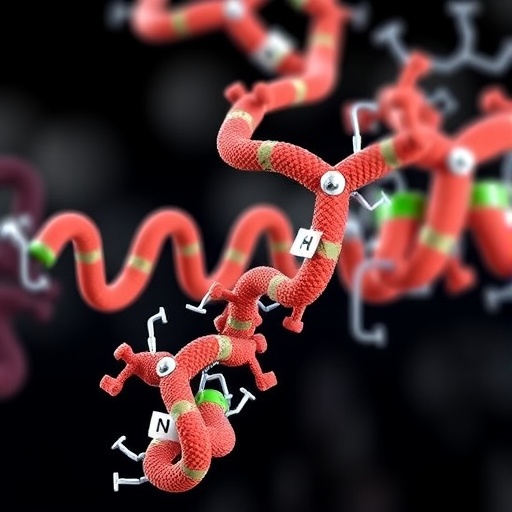
In a groundbreaking study published in Nature Chemical Biology, a team of researchers has unveiled intricate details regarding the intracellular trafficking of a pivotal intermediate in the biosynthesis of the nitrogenase FeMo-cofactor. This discovery holds profound implications for our understanding of biological nitrogen fixation, a process essential for life on Earth, and may catalyze advancements in sustainable agriculture and bioengineering.
Nitrogenase is the enzyme complex responsible for converting inert atmospheric nitrogen (N₂) into biologically accessible ammonia (NH₃), underpinning the nitrogen cycle. At the heart of this enzymatic marvel lies the iron-molybdenum cofactor (FeMo-co), a unique and complex metallocluster whose assembly pathway has remained elusive for decades. The team led by Schneider et al. employed innovative biochemical and structural approaches to elucidate the transport and assembly route of a critical FeMo-co intermediate within the microbial cell.
The study reveals that the FeMo-cofactor assembly does not occur at a single static location but rather involves a well-orchestrated intracellular trafficking mechanism. This trafficking ensures the safe transit of a labile intermediate from its site of synthesis to the nitrogenase apoenzyme, where the fully assembled cofactor is integrated. Understanding the molecular logistics governing this trafficking pathway offers a fresh perspective on how cells manage the biosynthesis of highly reactive and delicate metal clusters.
One of the remarkable technical achievements of this research is the identification of specialized protein complexes that bind and shield the FeMo-co intermediate during its intracellular journey. These chaperone-like proteins prevent the premature degradation or aggregation of the cofactor, safeguarding its integrity until final insertion. Detailed structural analysis through cryo-electron microscopy revealed conformational changes in these transport proteins, highlighting their dynamic role in cofactor delivery.
The researchers applied state-of-the-art mass spectrometry and spectroscopic techniques to track the chemical modifications and maturation steps of the FeMo-cofactor. By precisely timing the assembly events and identifying transient intermediates, they pieced together a chronological map of the biosynthetic pathway. This roadmap clarifies longstanding questions about the sequence and coordination of metallocluster assembly within bacterial cells.
Beyond the fundamental biochemical insights, this work underscores the extreme cellular innovation required to handle highly complex and sensitive cofactors. The trafficking mechanism involves crossing membrane barriers, avoiding cytoplasmic degradation pathways, and synchronizing with nitrogenase protein expression. Such compartmentalization and dynamic protein–protein interactions exemplify nature’s ingenuity in enzymatic cofactor management.
The discovery also opens exciting avenues for synthetic biology. Engineering microbial systems capable of efficient nitrogen fixation could be revolutionized by harnessing or mimicking the natural trafficking pathways uncovered here. This could lead to the development of nitrogen-fixing crops or biofertilizers, reducing dependency on chemical fertilizers and lowering environmental pollution associated with industrial nitrogen fixation.
Furthermore, the identification of modular assembly intermediates offers targets for biochemical manipulation and structural studies of nitrogenase and its cofactors. Therapeutic and industrial enzymes sharing similar biosynthetic complexities might be modulated by analogous trafficking systems, broadening the relevance of these findings beyond nitrogenase alone.
The work involved an interdisciplinary approach, combining molecular biology, advanced imaging, biophysical characterization, and computational modeling. This integrated strategy was critical for unraveling the transient and often low-abundance species involved in FeMo-cofactor assembly and trafficking. The precision and depth of the data pave the way for redefining nitrogenase assembly paradigms.
Reflecting on the evolutionary context, the study posits that the trafficking mechanism likely evolved to balance the high catalytic power of nitrogenase with cellular safety and efficiency. The delicate nature of the metal clusters necessitates specialized protective and transport systems, an evolutionary trade-off highlighted by the newly elucidated pathway.
This research also offers a cautionary tale regarding the biochemical complexity underpinning seemingly simple biological processes. The meticulous compartmentalization observed emphasizes that even fundamental enzymatic steps encompass multi-layered cellular coordination.
In summary, Schneider and colleagues have delivered a seminal contribution to the field of metalloenzyme biogenesis. Their findings illuminate the previously hidden choreography of nitrogenase cofactor assembly and trafficking and bolster our capacity to leverage biological nitrogen fixation for sustainable technological applications.
As nitrogen fixation remains a critical challenge for global agriculture and energy sustainability, this breakthrough refines our molecular toolkit and invites further exploration into optimizing and recreating these natural marvels.
Cite Scienmag News
Ophelia Keating. (March 24, 2026). Nitrogenase FeMo-Cofactor Assembly Intermediate Trafficking. Scienmag. https://scienmag.com/nitrogenase-femo-cofactor-assembly-intermediate-trafficking/
Ophelia Keating. "Nitrogenase FeMo-Cofactor Assembly Intermediate Trafficking." Scienmag, 24 March 2026, https://scienmag.com/nitrogenase-femo-cofactor-assembly-intermediate-trafficking/. Accessed 3 September 2026.
Ophelia Keating. "Nitrogenase FeMo-Cofactor Assembly Intermediate Trafficking." Scienmag. March 24, 2026. https://scienmag.com/nitrogenase-femo-cofactor-assembly-intermediate-trafficking/


