


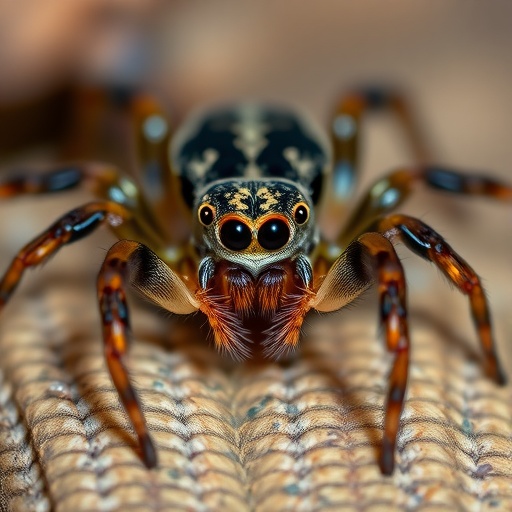
For over a century, the Happy-Face spider (Theridion grallator) has enchanted scientists and nature enthusiasts alike, primarily due to its vividly bright markings that resemble a cheerful, smiling face. Until recently, this arachnid was believed to be endemic to the Hawaiian Islands—an isolated evolutionary marvel with no known counterparts elsewhere in the world. However, a groundbreaking discovery emerging from the montane ecosystems of the Western Himalayas has challenged this long-held assumption and broadened our understanding of arachnid biodiversity. Researchers from India’s Forest Research Institute and the Regional Museum of Natural History have formally identified a new species exhibiting strikingly similar coloration patterns, officially named Theridion himalayana, or the Himalayan Happy-Face Spider.
The discovery came about serendipitously during an ecological survey originally intended to study ant populations in the Uttarakhand region. Devi Priyadarshini, a researcher at the Regional Museum of Natural History, and her colleague Ashirwad Tripathy, began receiving numerous spider specimens collected from high-altitude areas. Among these, one particularly distinctive specimen found resting beneath a Daphniphyllum leaf stunned Priyadarshini, whose familiarity with the Hawaiian Happy-Face spider instantly revealed the potential significance of this finding. Over subsequent months, extensive fieldwork and detailed specimen analysis were undertaken, ultimately culminating in the recognition of a novel spider species exhibiting polymorphism similar to their Hawaiian counterparts, yet genetically distinct.
This newly described species thrives at elevations surpassing 2,000 meters, predominantly within the alpine and subalpine zones of Uttarakhand’s mountainous terrain. The choice of the specific epithet “himalayana” pays homage to the majestic Himalayan range, a vast biodiversity hotspot offering unique ecological niches that sustain a plethora of endemic fauna and flora. The researchers noted this polymorphism in T. himalayana is remarkably diverse, with at least 32 distinct color morphs documented across three discrete geographic locations – Makku, Tala, and Mandal. Such variation underscores evolutionary dynamics that likely reflect adaptive strategies to local environmental pressures.
At the molecular level, DNA sequencing and phylogenetic analyses revealed that Theridion himalayana diverged markedly from its Hawaiian relative, with an approximate 8.5% genetic difference. This robust genetic differentiation confirms T. himalayana as a distinct taxonomic lineage, which likely evolved in geographic isolation under the selective forces exerted by the Himalayan environment. This independent evolutionary emergence of polymorphism within the genus Theridion exemplifies convergent evolutionary phenomena, where similar trait patterns arise separately in disparate lineages due to similar ecological niches or selective advantages.
The ecological significance of the spider’s polymorphic markings remains a compelling enigma. These facial-like patterns not only serve as a signature visual trait but may underpin survival benefits such as predator deterrence or intraspecific communication. However, the precise functional roles and selective pressures fostering such polymorphism are yet to be conclusively elucidated. The presence of sympatric species exhibiting analogous coloration patterns further complicates the ecological narrative, suggesting a broader evolutionary or ecological mechanism driving the distribution of these phenotypes.
Intriguingly, T. himalayana shows a strong ecological association with ginger plants belonging to the genus Hedychium. This connection mirrors the Hawaiian Happy-Face spider’s known habitat preferences, despite ginger species being nonindigenous to Hawaiian ecosystems. This parallel raises fascinating biogeographical and evolutionary questions, hinting at possible ecological convergence or ancestral habitat preferences predating geographic isolation. The researchers propose that further investigation into Hedychium host-plant interactions may illuminate evolutionary pathways and potentially uncover phylogenetic relationships within the Theridion genus.
The discovery of Theridion himalayana expands the taxonomic and biogeographic horizons for the celebrated Happy-Face spider lineage, illustrating that the evolutionary narrative of polymorphic spiders is far more intricate and widespread than previously appreciated. Moreover, it highlights the Himalayan biodiversity corridor as an underexplored reservoir of arthropod diversity, particularly among microhabitats that remain scientifically undercharacterized. This study sets the stage for more comprehensive biodiversity assessments, genetic studies, and ecological monitoring, which together can provide insights into adaptation mechanisms, evolutionary histories, and conservation priorities for high-altitude arthropods.
Beyond taxonomy and evolutionary biology, this finding underscores the indispensable value of interdisciplinary collaborations and field surveys in revealing hidden biodiversity jewels. The chance discovery during an ant survey emphasizes the potential significance of incidental findings in broadening scientific understanding. As researchers continue to catalog morphological variants and conduct genetic analyses, the prospect of uncovering additional cryptic species or polymorphic forms within this region appears promising, offering exciting frontiers for future arachnological research.
In closing, Theridion himalayana embodies both a tribute and a scientific beacon. It honors the Himalayan mountain range, symbolizing the ecological grandeur and evolutionary vitality harbored within these formidable peaks. Simultaneously, it invites a reevaluation of biogeographical hypotheses about the dispersal and divergence of polymorphic spiders. By shedding light on this remarkable species, researchers illuminate pathways toward a deeper understanding of evolutionary biology, ecology, and biodiversity conservation in mountain ecosystems worldwide.
News Publication Date:
24-Apr-2026
Web References:
http://dx.doi.org/10.3897/evolsyst.10.174338
https://evolsyst.pensoft.net/article/174338/
Cite Scienmag News
Drew Townsend. (May 19, 2026). Newly Discovered “Happy-Face” Spider Species Found in the Indian Himalayas. Scienmag. https://scienmag.com/newly-discovered-happy-face-spider-species-found-in-the-indian-himalayas/
Drew Townsend. "Newly Discovered “Happy-Face” Spider Species Found in the Indian Himalayas." Scienmag, 19 May 2026, https://scienmag.com/newly-discovered-happy-face-spider-species-found-in-the-indian-himalayas/. Accessed 4 September 2026.
Drew Townsend. "Newly Discovered “Happy-Face” Spider Species Found in the Indian Himalayas." Scienmag. May 19, 2026. https://scienmag.com/newly-discovered-happy-face-spider-species-found-in-the-indian-himalayas/


