


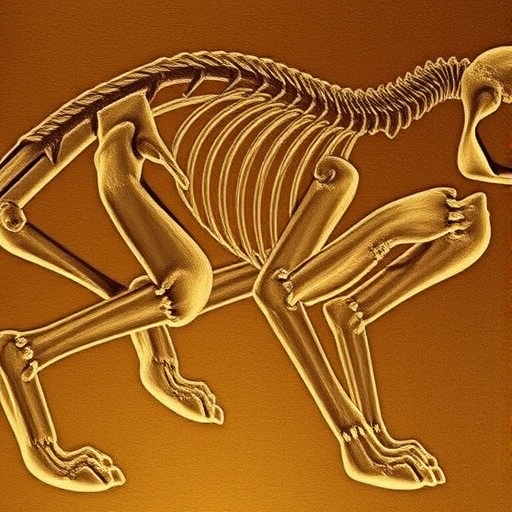
An extraordinary discovery from the depths of museum archives has shed new light on the evolutionary history of saber-toothed cats, creatures that once roamed North America more than five million years ago. What had long been dismissed as mere “feline” fossils have now been reclassified as the remarkably complete skull of Adelphailurus kansensis, an early and enigmatic member of the saber-toothed family. This finding not only expands our understanding of these formidable predators but challenges longstanding assumptions about the evolutionary trajectory of their famously long upper canines.
The fossils, reexamined by Narimane Chatar, a postdoctoral researcher at UC Berkeley, were found in a drawer at the American Museum of Natural History in New York, overlooked for decades under vague labels such as “Pseudaelurus”—a term historically used for unidentified cat-like fossils. The nearly intact cranium, accompanied by a mandible and dentition, allowed Chatar to situate this species more confidently within the machairodontine lineage, the group that includes classic saber-toothed cats like Smilodon fatalis, California’s state fossil.
Adelphailurus kansensis, previously only known from fragmented jaws and isolated teeth, exhibits a fascinating mix of primitive and derived traits. Unlike the iconic Smilodon, whose upper canines could reach an impressive seven inches, Adelphailurus sports considerably smaller, yet still laterally compressed, blade-like fangs. These sabers were finely adapted for slicing flesh and severing vital arteries, featuring subtle serrations along their edges — a rare but significant trait that likely enhanced their efficiency in processing large prey.
The discovery fuels a growing narrative that saber-toothed cats were not a monolithic group with identical hunting strategies. Early-diverging taxa like Adelphailurus possessed a distinct morphology that diverged significantly from the heavily specialized anatomy of later sabertooths. Chatar emphasizes that the diversity within saber-tooths has been underappreciated, urging a reevaluation of their ecological roles and behaviors across millions of years.
Functional morphology and biomechanical testing in Chatar’s lab further illuminate these evolutionary nuances. Through innovative methods including 3D-printing and mechanical simulations, sabertooth canines from multiple species were tested against flesh-like gels and bone-mimicking materials. Results consistently showed that while the saber teeth excelled at piercing and slicing soft tissue, they were prone to fracturing when encountering hard bone. Smilodon, the last surviving saber-toothed genus, ironically combined the most efficient piercing capabilities with the least robust teeth, indicating a precarious evolutionary balance.
This frailty likely contributed to the demise of saber-toothed cats. As post-Ice Age megafauna vanished, these hypercarnivores, specialized for slicing meat, struggled to compete with more generalized carnivores equipped with sturdier, rounder teeth capable of crushing bone. The trade-off between specialization and adaptability exemplifies a classic case of a macroevolutionary ratchet—once a lineage commits to a highly specialized adaptation like elongate saber canines, reversal becomes improbable, leading to eventual extinction when environmental conditions shift dramatically.
Intriguingly, saber-like teeth evolved multiple times across different carnivorous lineages. Beyond felids such as Smilodon and the scimitar-toothed Homotherini, evolution converged upon large canine elongation in extinct marsupial predators like Thylacosmilids and in nimravids, ancient cat-like carnivores unrelated to modern felines. This convergence underscores a powerful natural selection pressure favoring enhanced stabbing and slicing mechanisms—yet a solution that ultimately incurred significant costs.
Chatar’s chance recognition of Adelphailurus kansensis in the museum’s collection serves as a compelling reminder of the untapped potential residing in forgotten archives. Her approach combined traditional paleontological examination with cutting-edge digital scanning and comparative anatomy, enabling a reconstruction of the cat’s cranial architecture that had been obscured for nearly a century. This highlights an urgent call to revisit and reanalyze existing fossil assemblages worldwide, where misidentified or unstudied specimens may revolutionize our understanding of paleobiodiversity.
Detailed morphological analysis reveals that Adelphailurus possessed a notably elongated and narrow snout, distinct from contemporaneous saber-toothed taxa. The delicate but sharply serrated premolars and canines suggest a precise carnivorous specialization, focused on efficient flesh slicing rather than bone crushing. These attributes support a compelling evolutionary scenario in which saber-toothed cats initially evolved smaller, knife-like fangs before embarking on a lineage-specific pathway toward extreme fang elongation.
The evolutionary trajectory documented by Adelphailurus confronts the notion that saber-toothed cats could revert to less specialized dentition once their environments changed. No fossil evidence indicates a lineage capable of reversing this trait, implying an evolutionary dead-end governed by the “macroevolutionary ratchet.” This concept describes how elaborate morphological adaptations can become evolutionary cul-de-sacs, positioning organisms at high extinction risk under shifting ecological pressures.
In the end, the legacy of saber-toothed cats embodies both the marvel and peril of specialization. Their hyper-efficient teeth were exquisitely honed for predation but paradoxically vulnerable to fracture and ecological disruption. As apex predators once dominating the landscapes of prehistoric North America, their faded roar tells a story of evolutionary innovation balanced precariously on the edge of extinction.
The findings, published in the Journal of Vertebrate Paleontology, offer profound new insights into the cranial anatomy and evolutionary relationships of one of the earliest saber-toothed felids. Supported by grants from agencies including the U.S. National Science Foundation and Belgium’s scientific funding bodies, this research exemplifies the power of interdisciplinary approaches in paleontology, combining meticulous fossil analysis with biomechanical experimentation to unravel the deep past.
Narimane Chatar’s serendipitous rediscovery invites the scientific community to look anew at the fossil record, where hidden treasures await to refine the narrative of life’s intricate history. In doing so, it challenges contemporary perspectives on adaptation, extinction, and the complex pathways that shape the diversity of predatory mammals over millions of years.
News Publication Date: June 19, 2026
Web References: http://dx.doi.org/10.1080/02724634.2026.2667939
Cite Scienmag News
Gavin Prescott. (June 22, 2026). Newly Discovered Fossil Illuminates Evolutionary Journey of Saber-Toothed Cats. Scienmag. https://scienmag.com/newly-discovered-fossil-illuminates-evolutionary-journey-of-saber-toothed-cats/
Gavin Prescott. "Newly Discovered Fossil Illuminates Evolutionary Journey of Saber-Toothed Cats." Scienmag, 22 June 2026, https://scienmag.com/newly-discovered-fossil-illuminates-evolutionary-journey-of-saber-toothed-cats/. Accessed 3 September 2026.
Gavin Prescott. "Newly Discovered Fossil Illuminates Evolutionary Journey of Saber-Toothed Cats." Scienmag. June 22, 2026. https://scienmag.com/newly-discovered-fossil-illuminates-evolutionary-journey-of-saber-toothed-cats/


