


Researchers have unveiled a pioneering breeze wake-up anemometer (B-WA), employing a rolling-bearing triboelectric nanogenerator (RB-TENG) that provides a new strategy for low-energy consumption environmental monitoring. The ability of the B-WA to operate autonomously and efficiently in varying wind conditions marks a substantial advancement in the field of sustainable environmental monitoring.

Credit: Microsystems & Nanoengineering
Researchers have unveiled a pioneering breeze wake-up anemometer (B-WA), employing a rolling-bearing triboelectric nanogenerator (RB-TENG) that provides a new strategy for low-energy consumption environmental monitoring. The ability of the B-WA to operate autonomously and efficiently in varying wind conditions marks a substantial advancement in the field of sustainable environmental monitoring.
Anemometers are crucial tools for collecting meteorological data, essential for accurate weather forecasting and environmental monitoring. Traditional anemometers often face challenges related to high maintenance and operational costs, primarily due to their high quiescent power consumption and reliance on battery power. These challenges are particularly acute in remote locations where replacing batteries or repairing equipment is difficult and expensive. The introduction of low-power self-waking-up anemometers can transform environmental monitoring by enabling longer deployment periods, reducing the frequency of maintenance, and enhancing the reliability of data collection in these critical but hard-to-reach areas.
A new study (DOI: 10.1038/s41378-024-00676-7) published in Microsystems & Nanoengineering on April 8, 2024, by the team from the Beijing Institute of Nanoenergy and Nanosystems, has developed a Breeze Wake-up Anemometer (B-WA) designed to dramatically enhance remote weather monitoring capabilities.
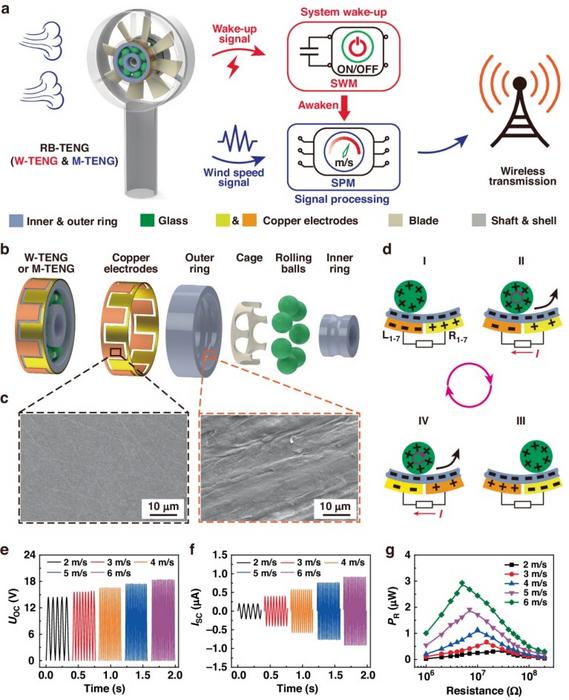
The newly developed B-WA integrates the following key components: two rolling-bearing triboelectric nanogenerators (RB-TENGs), a self-waking-up module (SWM) and a signal processing module (SPM). B-WA can remain in a near-zero power quiescent state until activated by wind speeds exceeding 2 m/s. The RB-TENG is engineered to generate power from the motion of rolling bearings, which is harnessed to wake the device from its low-power state. Upon activation, the SWM can wake up the entire system within just 0.96 seconds, enabling real-time wind speed measurement. Concurrently, the SPM processes the frequency of the signals generated by the RB-TENG to accurately monitor wind speed with a sensitivity of 9.45 Hz/(m/s), ensuring precise and reliable data collection.
Prof. Chi Zhang, the project’s lead scientist, stated, “This device not only pushes the boundaries of nanotechnology but also offers a sustainable solution to global weather monitoring challenges. Its low-energy requirement and high sensitivity are crucial for the future of environmental sensing.”
This technology is pivotal for areas like agricultural planning and natural disaster prevention, where accurate and timely weather information can significantly impact decision-making and operational safety. The B-WA’s robust and low-maintenance design makes it ideal for integrating into Internet of Things (IoT) networks, enhancing distributed environmental monitoring across various sectors.
###
References
Original Source URL
Funding information
This work was supported by the National Natural Science Foundation of China (Nos. U23A20640, 52250112, 52203308) and Beijing Natural Science Foundation (3242013).
About Microsystems & Nanoengineering
Microsystems & Nanoengineering is an online-only, open access international journal devoted to publishing original research results and reviews on all aspects of Micro and Nano Electro Mechanical Systems from fundamental to applied research. The journal is published by Springer Nature in partnership with the Aerospace Information Research Institute, Chinese Academy of Sciences, supported by the State Key Laboratory of Transducer Technology.
Journal
Microsystems & Nanoengineering
Subject of Research
Not applicable
Article Title
A near-zero quiescent power breeze wake-up anemometer based on a rolling-bearing triboelectric nanogenerator
Article Publication Date
8-Apr-2024
COI Statement
The authors declare that they have no competing interests.
Cite Scienmag News
Courtney Benton. (May 29, 2024). New wind speed sensor uses minimal power for advanced weather tracking. Scienmag. https://scienmag.com/new-wind-speed-sensor-uses-minimal-power-for-advanced-weather-tracking/
Courtney Benton. "New wind speed sensor uses minimal power for advanced weather tracking." Scienmag, 29 May 2024, https://scienmag.com/new-wind-speed-sensor-uses-minimal-power-for-advanced-weather-tracking/. Accessed 4 September 2026.
Courtney Benton. "New wind speed sensor uses minimal power for advanced weather tracking." Scienmag. May 29, 2024. https://scienmag.com/new-wind-speed-sensor-uses-minimal-power-for-advanced-weather-tracking/

