


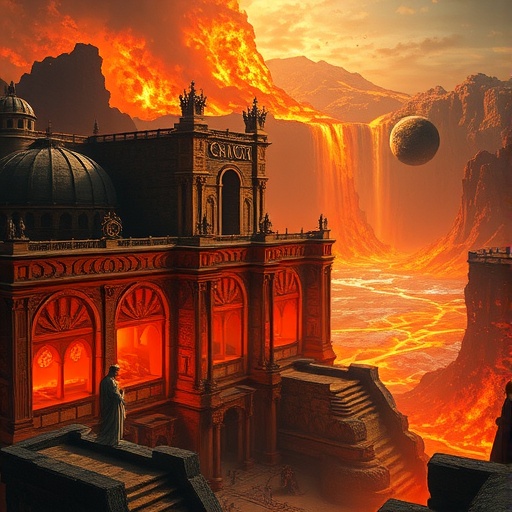
In a groundbreaking interdisciplinary study that bridges literature and planetary science, new research suggests that Dante Alighieri’s Inferno, long celebrated as a profound spiritual narrative, might also be interpreted as an early conceptual model of planetary impact physics. This revelation arises from the work of Timothy Burbery at Marshall University, who proposes that the harrowing descent of Satan in Dante’s Divine Comedy can be read not merely as metaphor but as a vivid, precise metaphorical depiction of a catastrophic high-velocity impact event shaping the very structure of the Earth.
Burbery’s hypothesis upends centuries of purely theological and symbolic interpretations by proposing that Dante’s poem encodes the dynamics of an oblong, asteroid-sized body—figuratively represented by Satan—colliding with the proto-Earth. This impact, according to the study, occurs in the Southern Hemisphere, forcefully tunneling through the Earth’s crust and mantle down toward its core. The consequences of this colossal event resonate spatially, creating the massive depression known as Hell in the Northern Hemisphere, conceptualized as a multi-ring, bottom-up crater, while simultaneously forming the mountain of Purgatory as a central peak. This interpretation parallels well-established models of crater formation observed in high-energy impacts across the solar system.
The analogies drawn between Dante’s Inferno and known impact processes are compelling. The impactor’s imagined size and velocity echo properties akin to the interstellar object ‘Oumuamua, while the scale of energy release and planetary reshaping could rival the catastrophic Chicxulub impact, which famously precipitated the mass extinction event that ended the reign of the dinosaurs. Burbery emphasizes that Dante’s Satan, like the relatively intact Hoba meteorite, is envisioned as a large, cohesive mass surviving atmospheric entry—unvaporized and capable of physically restructuring terrestrial geology. This stands in contrast to mere allegory; it suggests a sophisticated, albeit poetic, intuition of meteoritic phenomena centuries before the foundations of modern impact science.
The nine concentric circles of Hell, which have traditionally been interpreted as symbolic representations of progressive sins and punishments, take on a radical new meaning under this scientific lens. They can be paralleled to the terraced morphology displayed in multi-ring impact basins found on planetary surfaces such as the Moon, Mars, and Venus, all characterized by a series of concentric faulted rings formed during large-scale crustal deformation. Dante’s descriptions prefigure the terraced, discrete layering of these basins, implying a remarkable understanding of planetary geology encoded poetically in his narrative.
Moreover, the Inferno’s topographical and geometric complexity anticipates non-Euclidean spatial relations, which modern readers recognize in Dante’s Paradiso. This non-linear spatial conception aligns intriguingly with the physics of high-speed impacts, shockwave propagation, and crustal displacement, where classical Euclidean geometry proves insufficient to describe real-world deformation under extreme conditions. Through narrative metaphor, Dante seems to have intuited early concepts of kinetic energy transfer, deceleration, and momentum redistribution within planetary materials.
From a geophysical perspective, the model also explains the formation of Mount Purgatory: a central uplift mound emerging from the rebound and elastic response of the Earth’s mantle and crust following penetration and compression by the impactor. This matches established models of central peaks in complex craters, underscoring the deep connection between the literary architecture of the Divine Comedy and physical impact processes. The mountain’s described location and prominence are consistent with geological outcomes of such colossal extraterrestrial impacts.
This multidisciplinary reading offers more than historical reinterpretation: it provides a novel framework for planetary defense awareness. By recognizing that ancient narratives might encode geological realities and cosmic risks, this work challenges the scientific community to rethink the origins of meteoritic knowledge and the role of myth and literature in scientific discovery. Burbery’s research positions Dante not only as a literary figure but as a proto-planetary scientist, whose imaginative vision anticipated, in a symbolic form, the geomythology of catastrophic impacts long before the discipline had emerged.
The reinterpretation also confronts long-standing Aristotelian dogmas, which held the heavens as immutable and perfect, a worldview unchallenged until the dawn of the scientific revolution. Dante’s allegory, in this light, becomes a subtle but revolutionary assertion: that celestial bodies are dynamic, sometimes destructive astronomical agents capable of reshaping Earth’s geological destiny. This intellectual leap foreshadows the modern understanding of space hazards and the importance of impact studies in Earth sciences.
Furthermore, the research underscores the methodological value of gedankenexperiments—or thought experiments—in scientific inquiry. By treating a medieval poem as a quasi-empirical model, Burbery elevates literary interpretation as a tool for conceptualizing complex geophysical processes. This approach encourages a more integrative dialogue between humanities and sciences, advocating humility in scientific paradigms reminiscent of Thomas Kuhn’s ideas on the evolution of knowledge frameworks.
Scientific implications aside, this new perspective may also resonate culturally by renewing interest in the Divine Comedy’s material foundations and impact on our understanding of humanity’s cosmic vulnerability. It proposes that this thirty-century-old narrative encodes a physical drama of cosmic proportions, a planetary catastrophe rendered in allegory but grounded in the physical realities of meteoritics and planetary geology.
The upcoming presentation of this research at the European Geosciences Union (EGU) General Assembly 2026 will undoubtedly spark robust interdisciplinary discussions. Scheduled for May 8, 2026, during Session ITS3.4/GM3, this paper promises to reach a broad audience spanning geophysicists, planetary scientists, literary scholars, and historians of science. It heralds a new era where ancient texts are not only cultural artifacts but also sources of profound scientific insight and models of planetary processes.
In summation, Timothy Burbery’s analysis reconfigures Dante’s Inferno as an unprecedented scientific allegory of planetary scale impact phenomena, articulating with uncanny accuracy the geophysical and geomorphological outcomes of a colossal extraterrestrial collision. This synthesis of literature and geoscience illuminates the enduring relevance of classical works and challenges modern science to embrace a more holistic view of knowledge, where narrative, metaphor, and empirical observation coalesce to deepen our understanding of Earth’s place in the cosmos.
News Publication Date:
2026 (aligned with the EGU General Assembly 2026)
Web References:
- https://meetingorganizer.copernicus.org/EGU26/EGU26-14300.html
- https://meetingorganizer.copernicus.org/EGU26/session/57668
Cite Scienmag News
Russell Cooper. (May 8, 2026). New Study Suggests Dante’s Inferno Was Inspired by a Planetary Impact Event Predating Modern Science by 500 Years. Scienmag. https://scienmag.com/new-study-suggests-dantes-inferno-was-inspired-by-a-planetary-impact-event-predating-modern-science-by-500-years/
Russell Cooper. "New Study Suggests Dante’s Inferno Was Inspired by a Planetary Impact Event Predating Modern Science by 500 Years." Scienmag, 8 May 2026, https://scienmag.com/new-study-suggests-dantes-inferno-was-inspired-by-a-planetary-impact-event-predating-modern-science-by-500-years/. Accessed 3 September 2026.
Russell Cooper. "New Study Suggests Dante’s Inferno Was Inspired by a Planetary Impact Event Predating Modern Science by 500 Years." Scienmag. May 8, 2026. https://scienmag.com/new-study-suggests-dantes-inferno-was-inspired-by-a-planetary-impact-event-predating-modern-science-by-500-years/


