


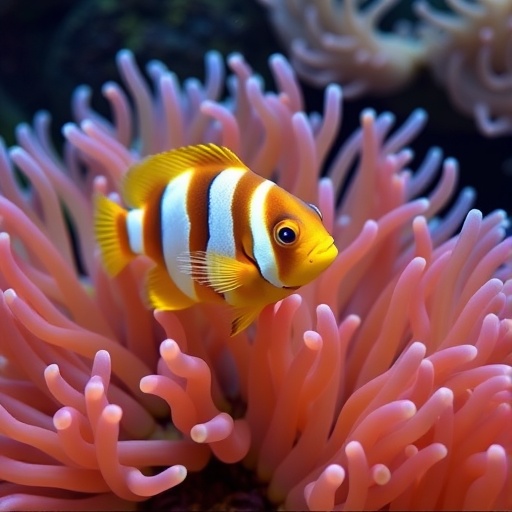
A groundbreaking study published in the Journal of Fish Biology unveils the intricate and multifaceted relationships between juvenile fish and sea anemones in the epipelagic zone, challenging the simplistic depictions popularized by mainstream media such as the film Finding Nemo. Employing the cutting-edge technique of blackwater photography, researchers have captured rare in situ interactions that suggest a previously undocumented form of mutualism, expanding our understanding of coral reef ecosystems and open sea trophic dynamics.
Blackwater photography, which involves night-time dives into open water to illuminate the largely unseen microscopic and juvenile marine life, has revolutionized marine biology observations. This non-invasive method enables scientists to document elusive species interactions under natural conditions, often hidden during daylight hours. The lead author, Gabriel Afonso, a Ph.D. student at William & Mary’s Batten School of Coastal & Marine Sciences and the Virginia Institute of Marine Science (VIMS), attributes the success of this study to advances in low-light imaging technologies and the dedicated efforts of adept divers.
The investigation revealed that various species of juvenile fish, including carangidae (young jacks), filefish, driftfish, and pomfrets, have adopted a novel behavioral strategy: carrying live larval tube anemones or button polyps in their mouths. Such behavior appears to be a form of defensive mimicry or chemical deterrence, where by harboring these stinging invertebrates, the juvenile fish gain protection against predation. This interaction may qualify as a biological alliance wherein both parties derive benefits, a concept rarely documented between pelagic actinopterygians and benthic anthozoans.
Marine ecologist and blackwater photography contributor Rich Collins, affiliated with the Florida Museum of Natural History, notes that these sightings are consistent with other rare behaviors observed through this methodology. For example, filefish have been documented carrying venomous box jellyfish in their mouths without harm, suggesting an evolved resistance or tolerance to the stings. This indicates that juvenile fish may capitalize on the noxious properties of certain invertebrates, effectively wielding them as living weapons during their vulnerable early life stages.
The biological mechanisms enabling these juvenile fish to handle stinging anthozoans without injury remain an intriguing area for further study. It is hypothesized that they may possess chemical immunity or behavioral adaptations that mitigate the nematocysts’ effects. Moreover, the evolutionary advantages conferred by these associations likely enhance survival rates during critical dispersal phases, providing a selective impetus for the emergence of such interspecies behavioral adaptations.
From the anemones’ perspective, being transported by agile juvenile fish may facilitate dispersal to novel habitats, expanding their geographical range beyond the limitations imposed by their typically sedentary nature. This form of biological transport represents a significant departure from passive larval dispersal mechanisms conventionally attributed to sessile cnidarians. Consequently, the study proposes that this partnership could constitute a previously unrecognized mode of mutualistic symbiosis within pelagic ecological contexts.
While adult reef fish have long been documented utilizing coral structures for resting, shelter, or feeding purposes, this research pushes the envelope by highlighting how open-water juvenile fish actively engage with anthozoans beyond the benthic zone. This evolving understanding underscores the dynamic complexity of marine ecosystems and the necessity of advanced observation techniques to capture these transient yet ecologically significant interactions.
The study’s detailed photographic records exemplify the power of combining technological innovation with dedicated fieldwork. By illuminating these subtle behavioral nuances, blackwater photography is shedding new light on marine biodiversity and animal behavior, prompting a reevaluation of fish-anemone relationships and their ecological implications. These revelations invite a broader scientific discourse on the adaptive strategies of juvenile marine organisms within predator-prey frameworks.
Ecologists anticipate that these findings will stimulate further experimental and observational research aimed at delineating the physiological traits that allow juvenile fish to safely manipulate stinging anemones. Understanding these mechanisms could reveal insights into chemical ecology, sensory biology, and evolutionary pathways that have remained obscured until now. This knowledge holds potential applications for biomimicry, conservation efforts, and the management of marine ecosystems under environmental stressors.
The research also accentuates the importance of interdisciplinary collaboration, integrating marine biology, ethology, and photography expertise to unravel complex natural phenomena. As the marine science community embraces blackwater methodologies, the anticipation of discovering more such uncharted interactions grows. These advances contribute profoundly to our holistic comprehension of oceanic life and reinforce the necessity for continued technological investment in marine exploration.
Lastly, this article invites the public and scientific community alike to appreciate the hidden wonders of the ocean’s twilight zones. By revealing the delicate interdependencies between fish and anthozoans, the research triggers curiosity and respect for marine biodiversity. It urges conservation efforts targeting fragile early life stages of marine fauna and emphasizes the interconnectedness that sustains oceanic health and resilience in the face of escalating anthropogenic threats.
Cite Scienmag News
Violet Maxwell. (October 7, 2025). New Study Reveals Symbiotic Relationship Between Fish and Anemones in Blackwater Environments. Scienmag. https://scienmag.com/new-study-reveals-symbiotic-relationship-between-fish-and-anemones-in-blackwater-environments/
Violet Maxwell. "New Study Reveals Symbiotic Relationship Between Fish and Anemones in Blackwater Environments." Scienmag, 7 October 2025, https://scienmag.com/new-study-reveals-symbiotic-relationship-between-fish-and-anemones-in-blackwater-environments/. Accessed 4 September 2026.
Violet Maxwell. "New Study Reveals Symbiotic Relationship Between Fish and Anemones in Blackwater Environments." Scienmag. October 7, 2025. https://scienmag.com/new-study-reveals-symbiotic-relationship-between-fish-and-anemones-in-blackwater-environments/


