


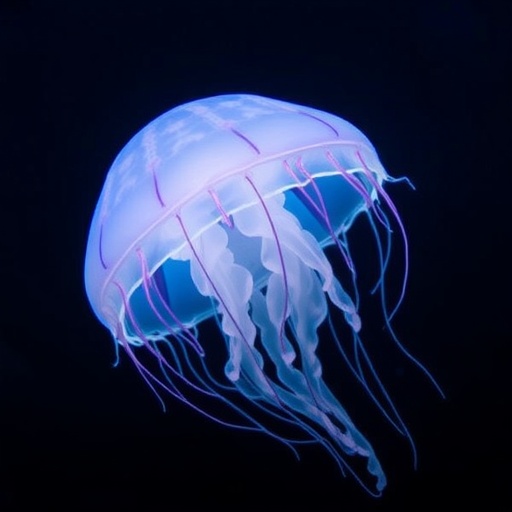
In the dim and elusive realms of coastal waters, where visibility is often limited and danger takes on a near-invisible form, the discovery of new marine species can revolutionize our understanding of oceanic biodiversity and the risks that accompany human interaction with marine ecosystems. Among such concealed perils are box jellyfish, notorious for their transparency and deadly venom. Recent scientific endeavors spearheaded by researchers at Tohoku University and the National University of Singapore have unveiled a new chapter in the story of these lethal “sea-wasps” with the identification of an entirely new species—Chironex blakangmati. This groundbreaking discovery not only enriches the taxonomic landscape of box jellyfish but also enhances public awareness regarding these cryptic marine creatures’ distribution and potential threats.
Box jellyfish of the genus Chironex are among the most venomous marine animals known to science. Their stings cause excruciating pain and, in some cases, fatal consequences for humans. The challenge in mitigating these dangers lies in the jellyfish’s near-invisibility in water, a quality that demands precise scientific study to predict their presence and to develop effective safety guidelines. The recent work by this international research team focused on the coastal waters around Singapore, where jellyfish encounters are both a public health concern and a mystery awaiting ecological and genetic resolution.
Fieldwork conducted along Sentosa Island’s coastal waters—an area with a historically ominous name, “Pulau Blakang Mati,” meaning “Island of Death Behind”—led to the collection of several specimens initially presumed to belong to the widely known Chironex yamaguchii. However, meticulous genetic analysis paired with detailed morphological examination revealed distinct characteristics that did not align with previously identified species. The new species, aptly named Chironex blakangmati, is genetically unique and exhibits specific anatomical differences that challenge longstanding assumptions in cubozoan taxonomy.
One of the defining morphological features that distinguish C. blakangmati from its congeners is the absence of pointed canals extending from the perradial lappets—hinged musculature flaps located at the base of the jellyfish’s bell-shaped body. These flaps are essential for the jellyfish’s swimming mechanics, powering the pulsing motion that propels the animal through the water column. In all other known Chironex species, pointed canals protrude from the tips of these perradial lappets, reinforcing the muscular flaps. The absence of such structures in the new species provides a functional and diagnostic trait for rapid, field-based species differentiation without immediate reliance on genetic testing.
Cheryl Ames, a lead researcher affiliated with Tohoku University and the WPI-AIMEC institute, recounts the initial confusion over the identification of this new species. “C. blakangmati appears deceptively similar to Chironex yamaguchii, a species I had first described in Okinawa during my master’s research,” Ames explains. “Our genetic data and morphological re-examination overturned years of assumption, confirming that what we once thought were population variations were, in fact, a separate species.” This re-evaluation also involved revisiting archived specimens of C. yamaguchii, allowing for comprehensive comparative analysis that strengthened the conclusions.
Beyond the discovery of C. blakangmati, the researchers documented the presence of another significant species: Chironex indrasaksajiae, previously known predominantly from Thai coastal waters. Its unanticipated appearance in Singapore’s waters marks the first recorded observation of this species in the region, thereby extending its known geographical range. The implications of this discovery are substantial, highlighting gaps in our current understanding of species distribution in marine ecosystems that are rapidly shifting due to climatic and anthropogenic influences.
Unlike the majority of jellyfish Drifters, which passively move with oceanic currents, Chironex species possess sophisticated adaptations that include muscular propulsion and complex ocular apparatus enabling active navigation. Their use of vision to detect and pursue prey underscores a behavioral ecology far more complex than the passive drifting frequently attributed to cnidarians. This behavior impacts how these species interact with their environment, potentially influencing their distribution patterns and encounters with human recreational areas.
Danwei Huang from the Lee Kong Chian Natural History Museum at the National University of Singapore emphasizes that these findings are more than taxonomic curiosities. “By clarifying species boundaries within the genus Chironex, we provide a practical framework for future research, safety management, and ecological monitoring,” Huang notes. Improved species delineation can inform public health advisories and conservation efforts tailored to the specific biology and behavior of each species, potentially reducing the risk of stings and fatalities.
The research outcomes, published in the Raffles Bulletin of Zoology in May 2026, complement ongoing studies within the World Premier International Research Center Initiative (WPI) and the Advanced Institute for Marine Ecosystem Change (WPI-AIMEC). These collaborative platforms strive to unveil oceanic life’s complex interactions and responses to planetary changes through multidisciplinary approaches integrating ocean physics, ecology, and data science.
Furthermore, the discovery of C. blakangmati and the documented range expansion of C. indrasaksajiae capture the dynamic nature of marine biodiversity amid environmental change. As oceanic conditions evolve due to global warming, altered current patterns, and human activities, understanding species distribution and ecological adaptation becomes paramount. This research contributes vital data and inspires continued surveillance of marine ecosystems that serve as critical barometers of planetary health.
Public safety implications from these findings are profound. Beaches frequented by locals and tourists alike can now be monitored with better precision, allowing for timely alerts and risk mitigation strategies rooted in species-specific knowledge. Awareness of jellyfish presence and behavior can transform potentially hazardous encounters into informed awareness, potentially saving lives.
This study not only solidifies the taxonomic framework within the box jellyfish community but also highlights the urgent need to map biodiversity more thoroughly. It exposes the undiscovered richness hidden in the world’s coastal waters, which remain vulnerable to neglect and environmental shifts. The dual discovery of a new species and the extension of another species’ range underlines the continuing necessity for marine biological research with an emphasis on integrating genetic tools and traditional morphological analysis.
As the research community further unravels the mysteries enveloping these translucent marine predators, society stands to benefit from enhanced ecological stewardship and enlightened safety protocols. The collaboration between international researchers exemplifies how global scientific synergy can bring to light the cryptic wonders of nature while addressing pressing public health challenges.
Cite Scienmag News
Violet Maxwell. (May 19, 2026). Scientists Uncover New Venomous Box Jellyfish Species in Singapore. Scienmag. https://scienmag.com/scientists-uncover-new-venomous-box-jellyfish-species-in-singapore/
Violet Maxwell. "Scientists Uncover New Venomous Box Jellyfish Species in Singapore." Scienmag, 19 May 2026, https://scienmag.com/scientists-uncover-new-venomous-box-jellyfish-species-in-singapore/. Accessed 4 September 2026.
Violet Maxwell. "Scientists Uncover New Venomous Box Jellyfish Species in Singapore." Scienmag. May 19, 2026. https://scienmag.com/scientists-uncover-new-venomous-box-jellyfish-species-in-singapore/


