


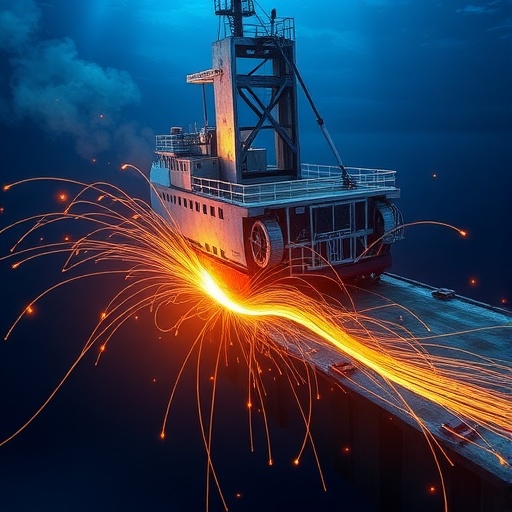
In the relentless and unforgiving environment beneath the ocean’s surface, marine infrastructure such as offshore wind turbine foundations, bridges, and ships face constant deterioration. Decades of exposure to harsh underwater conditions result in corrosion, fatigue cracks, and structural defects that threaten their performance and longevity. While underwater welding has traditionally served as a key maintenance and repair technique for these vital structures, it presents significant challenges. Conventional underwater welding methods often produce welds plagued by poor formation quality, inadequate mechanical strength, and susceptibility to corrosion, which compromise both safety and durability.
Addressing these longstanding issues, an innovative study from South China University of Technology introduces a breakthrough technique in underwater repair technology: local dry underwater laser welding augmented by pulsed laser technology with meticulously optimized pulse frequencies. Published recently in the journal China Welding, this research elucidates how manipulating pulse frequency during laser welding can dramatically improve the microstructural characteristics and performance metrics of Q355B low-alloy high-strength steel weld joints. This steel grade is prevalent in marine engineering, and its underwater welding integrity has historically been difficult to ensure.
The research team, led by Haipeng Liao, employed a rigorous experimental framework to compare pulsed laser welding (PLW) against traditional continuous laser welding (CLW) strategies. Their findings reveal that pulsed laser welding introduces distinct surface ripple patterns and significantly reduces the occurrence of weld spatter, a common defect that deteriorates joint quality. Intriguingly, as the pulse frequency increases, both weld penetration depth and bead width diminish, yet remain superior to the dimensions achieved under continuous laser welding protocols.
Through systematic experimentation, the scientists identified 80 Hz as the optimal pulse frequency. At this frequency, the weld microstructure features a maximal ferrite content of 39%. This microstructural refinement enhances mechanical properties, demonstrated by an elongation capacity reaching 23.1%, nearly 94% of the base metal’s ductility. Corrosion resistance is similarly bolstered, achieving 67% of the base material’s robustness, a significant improvement over the 47.3% exhibited by continuous laser welds. These improvements forge a well-balanced combination of strength, plasticity, and corrosion resistance.
Central to the success of this approach is the novel lamellar inorganic-like protection mechanism enabled by pulsed laser-induced periodic thermal cycles. By precisely controlling the thermal dynamics in the molten pool, the cooling rate is effectively moderated, which fosters the formation of ferrite and suppresses the brittle martensitic phases frequently responsible for cracking and corrosion vulnerability. This careful microstructural engineering transcends previous limitations, merging the precision of laser welding with compact local drying techniques that isolate the weld zone underwater without the drawbacks of complete dry chambers.
The implications of this innovation extend beyond laboratory achievement. As Liao articulates, this local dry underwater laser welding method directly addresses two critical bottlenecks in underwater repairs: inadequate weld formation and subpar corrosion protection. This is a crucial step forward for the maintenance and fabrication of essential marine structures where underwater access is required but traditional dry welding chambers are impractical or too costly. The technology’s ability to enhance the lifecycle and structural integrity of offshore wind turbines, maritime vessels, and cross-sea bridges holds the potential to improve safety and reduce operational downtime significantly.
Importantly, these advances dovetail with broader engineering and environmental objectives. Offshore wind farms, standing as pillars of renewable energy infrastructure, depend heavily on reliable underwater welding for foundation repairs that cannot tolerate long interruptions. Similarly, ships and undersea pipeline networks require robust joints resistant to aggressive saltwater exposure and mechanical stresses. Improved welding quality enabled by pulsed laser welding immersion techniques not only strengthens such structures but also reduces repair frequency, conferring savings in cost and carbon footprint.
The study also contributes essential theoretical insights and quantitative data for the engineering community. By dissecting the influence of pulse frequency on weld bead geometry, microstructural phases, mechanical elongation, and corrosion resistance metrics, it builds a comprehensive foundation upon which future underwater welding innovations can build. It also highlights the importance of laser pulse modulation as a critical parameter to tailor tailored weld properties according to the specific application and environment, pioneering a new paradigm in underwater fabrication science.
Laser welding technology itself is not new, but its integration with local dry underwater environments combined with pulse frequency optimization is a striking advancement. This fusion maximizes the benefits of precise energy delivery through high-powered laser beams while overcoming the inherent challenges posed by water’s cooling and oxidizing effects. By focusing only on the weld site and maintaining a dry microenvironment locally, the process minimizes weld disturbances and oxidation, which have traditionally undermined weld continuity and corrosion resistance in wet underwater welding methods.
Going forward, the challenge will be to scale this technology for widespread industrial application. The compactness of local drying equipment and adaptability of laser systems must be matched with durable, field-ready operational protocols that can withstand complex marine environments. However, the team’s research provides a compelling scientific framework and practical demonstrations that these hurdles are surmountable. The result is an exciting new tool that marine engineers and maintenance specialists can deploy to preserve critical infrastructure durability more effectively than ever before.
In summary, the work spearheaded by Haipeng Liao and colleagues stands as a pioneering contribution to materials science and marine engineering. By introducing pulse frequency optimization into local dry underwater laser welding of Q355B steel, it redefines the possibilities for underwater structural repair. Achieving superior weld formation, enhanced mechanical properties, and improved corrosion resistance, this technique is poised to revolutionize offshore construction and maintenance industries worldwide. As demand for resilient marine infrastructure grows amidst climate challenges and energy transitions, innovations such as this will become indispensable pillars of sustainable engineering.
Web References: http://dx.doi.org/10.1016/j.cwe.2026.100026
Cite Scienmag News
Denise Maddox. (May 19, 2026). Breakthrough in Marine Engineering: Golden Frequency Identified to Enhance Underwater Welding Durability. Scienmag. https://scienmag.com/breakthrough-in-marine-engineering-golden-frequency-identified-to-enhance-underwater-welding-durability/
Denise Maddox. "Breakthrough in Marine Engineering: Golden Frequency Identified to Enhance Underwater Welding Durability." Scienmag, 19 May 2026, https://scienmag.com/breakthrough-in-marine-engineering-golden-frequency-identified-to-enhance-underwater-welding-durability/. Accessed 3 September 2026.
Denise Maddox. "Breakthrough in Marine Engineering: Golden Frequency Identified to Enhance Underwater Welding Durability." Scienmag. May 19, 2026. https://scienmag.com/breakthrough-in-marine-engineering-golden-frequency-identified-to-enhance-underwater-welding-durability/


